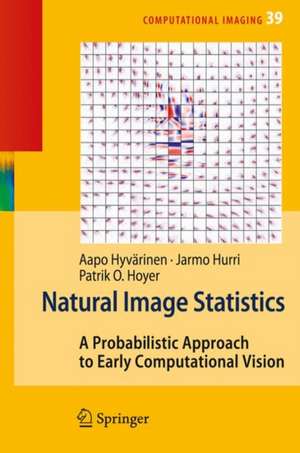
Natural Image Statistics
Autor Aapo Hyvärinen, Jarmo Hurri, Patrick O. Hoyeren Limba Engleză Hardback – 5 iun 2009
Considerăm că Natural Image Statistics reprezintă piatra de temelie a unei discipline care face legătura între biologia computațională și ingineria sistemelor de viziune artificială. Într-un domeniu care a crescut rapid începând cu anii '90, lucrarea semnată de Aapo Hyvärinen, Jarmo Hurri și Patrick O. Hoyer reușește să sintetizeze pentru prima dată modelele disparate într-un cadru teoretic coerent. Premisa este pe cât de simplă, pe atât de profundă: sistemul nostru vizual s-a adaptat evolutiv pentru a procesa eficient statisticile mediului în care trăim, iar înțelegerea acestor tipare matematice este cheia către algoritmi de viziune computerizată mai performanți.
Pe același raft cu Image Statistics in Visual Computing, această carte se distinge prin rigoarea teoretică și accentul pus pe fundamentarea biologică. În timp ce alte lucrări se pot concentra pe aplicații imediate în grafică, volumul de față construiește o punte solidă între neuroștiințe și matematică. Aapo Hyvärinen continuă și rafinează conceptele explorate în lucrarea sa precedentă, Independent Component Analysis, aplicând metodele de extragere a factorilor ascunși direct asupra stimulilor vizuali naturali.
Structura volumului este una progresivă, facilitând tranziția de la noțiuni de bază despre probabilități multivariate și filtre liniare către subiecte avansate precum funcțiile celulelor simple și complexe din cortexul vizual (V1). Notăm includerea unor capitole dedicate culorii, vederii stereoscopice și secvențelor temporale, ceea ce conferă o acoperire exhaustivă a spectrului vizual. Stilul este cel al unui manual de cercetare care nu uită să fie accesibil, oferind cititorului instrumentele matematice necesare (algebră liniară, optimizare) chiar în secțiunile finale, asigurând astfel o experiență de învățare completă.
Preț: 1079.90 lei
Preț vechi: 1316.95 lei
-18%
Carte tipărită la comandă
Livrare economică 27 iulie-10 august
Specificații
ISBN-10: 1848824904
Pagini: 472
Ilustrații: XIX, 448 p.
Dimensiuni: 160 x 241 x 31 mm
Greutate: 0.87 kg
Ediția:2009
Editura: Springer
Locul publicării:London, United Kingdom
V-ar putea interesa
-
 Independent Component AnalysisAapo Hyvärinen-9%Preț: 1146.37 lei1259.75 lei
 -
 The Phonological MindIris BerentPreț: 288.23 lei
 -
 Beyond BoundariesMiguel NicolelisPreț: 142.24 lei
 -
 -15%Preț: 621.48 lei731.15 lei
 -
 -15%Preț: 626.30 lei736.82 lei
 -
 The Playful BrainRichard RestakPreț: 139.05 lei
 -
 Sciatic Nerve: Blocks, Injuries & RegenerationDavid J Fonseca-30%Preț: 1546.51 lei2224.41 lei
 -
 -30%Preț: 1182.80 lei1699.99 lei
 -
 Glutamate: Functions, Regulation & DisordersGolda Chayat-30%Preț: 1153.59 lei1657.76 lei
 -
 Insights into the Amygdala: Structure, Functions & Implications for DisordersDeniz Yilmazer-Hanke-30%Preț: 1519.38 lei2183.51 lei
 -
 Neurological Disorders: New ResearchChloe E Thomas-30%Preț: 1000.33 lei1437.36 lei
 -
 Serotonergic Systems: Evolution, Functions & Roles in DiseaseReyna O Villanueva-30%Preț: 945.59 lei1360.01 lei
 -
 Dopamine: Methods and ProtocolsNadine Kabbani-15%Preț: 627.93 lei738.74 lei
 -
 Chemical NeurobiologyMatthew R. Banghart-18%Preț: 933.64 lei1138.59 lei
 -
 Computational Models for NeuroscienceRobert Hecht-Nielsen-5%Preț: 1081.92 lei1138.86 lei
 -
 Neurodynamics: An Exploration in Mesoscopic Brain DynamicsWalter Freeman-18%Preț: 755.90 lei921.83 lei
 -
 Preț: 90.44 lei
 -
 Nerve Cells and Nervous SystemsA. G. Brown-19%Preț: 526.70 lei650.24 lei
Public țintă
ResearchDe ce să citești această carte
Recomandăm această carte cercetătorilor și studenților care doresc să înțeleagă mecanismele matematice din spatele percepției vizuale. Este o resursă esențială pentru cei care lucrează în computer vision și neuroștiințe computaționale, oferind nu doar teorie, ci și aplicații practice prin exercițiile incluse. Veți câștiga o perspectivă unificată asupra modului în care imaginile naturale pot fi modelate pentru a replica eficiența sistemului vizual uman.
Descriere scurtă
Cuprins
Recenzii
“The authors did a wonderful job of introducing the field of natural image statistics, comprehensively. The book provides the underlying fundamental mathematics … accessible to a wide audience. … provides exercises and computer assignments at the end of the chapters. … the advanced topics are treated in a similar manner to basic theory, makes the book suitable to be used as a textbook for advanced students and by researchers in any discipline related to computer vision.” (Michael Goldberg and R. Goldberg, ACM Computing Reviews, October, 2010)
Textul de pe ultima copertă
This book is the first comprehensive introduction to the multidisciplinary field of natural image statistics and its intention is to present a general theory of early vision and image processing in a manner that can be approached by readers from a variety of scientific backgrounds. A wealth of relevant background material is presented in the first section as an introduction to the subject. Following this are five unique sections, carefully selected so as to give a clear overview of all the basic theory, as well as the most recent developments and research. This structure, together with the included exercises and computer assignments, also make it an excellent textbook.
Natural Image Statistics is a timely and valuable resource for advanced students and researchers in any discipline related to vision, such as neuroscience, computer science, psychology, electrical engineering, cognitive science or statistics.