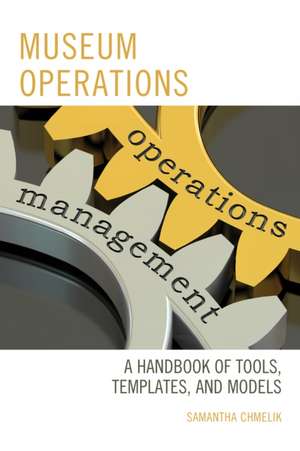
Museum Operations: A Handbook of Tools, Templates, and Models: American Association for State and Local History
Autor Samantha Chmeliken Limba Engleză Hardback – 22 feb 2017
The book consists of four parts.
Part One is an overview of the research project management process. Part Two introduces the 19 tools, templates, and models that can be used to collect, analyze, and present research results and recommendations. It also explains what each tool, template, or model is, what it does, when it should be used, and how it should be used. Part Three presents six fictional case studies that show when and how the tools, templates, and models can be used in situ. Part Four contains blank, instructional versions of the tools, templates, and models for the reader's use.
Additional resources related to project management, research and analysis, and presentation skills are also included.
Din seria American Association for State and Local History
- 33%
 Preț: 813.15 lei
 - 22%
 Preț: 209.66 lei
 - 23%
 Preț: 317.37 lei
 - 19%
 Preț: 316.09 lei
 - 11%
 Preț: 398.39 lei
 - 30%
 Preț: 355.61 lei
 - 19%
 Preț: 331.43 lei
 - 23%
 Preț: 286.27 lei
 - 24%
 Preț: 255.41 lei
 - 27%
 Preț: 501.00 lei
 - 25%
 Preț: 216.46 lei
 - 24%
 Preț: 254.02 lei
 - 19%
 Preț: 313.39 lei
 - 34%
 Preț: 951.06 lei
 - 19%
 Preț: 322.24 lei
 - 24%
 Preț: 384.05 lei
 - 31%
 Preț: 569.03 lei
 - 18%
 Preț: 334.84 lei
 - 24%
 Preț: 222.59 lei
 - 24%
 Preț: 283.12 lei
 -
 Preț: 421.53 lei
 - 21%
 Preț: 305.14 lei
 - 20%
 Preț: 373.68 lei
 - 30%
 Preț: 576.05 lei
 - 19%
 Preț: 323.58 lei
 - 25%
 Preț: 286.61 lei
 - 21%
 Preț: 365.17 lei
 - 23%
 Preț: 276.66 lei
 - 35%
 Preț: 619.19 lei
 - 31%
 Preț: 534.98 lei
 - 24%
 Preț: 255.02 lei
 - 31%
 Preț: 569.81 lei
 - 29%
 Preț: 522.70 lei
 - 19%
 Preț: 322.03 lei
 - 19%
 Preț: 322.16 lei
Preț: 524.33 lei
Preț vechi: 733.52 lei
-29%
Puncte Express: 786
Carte tipărită la comandă
Livrare economică 09-23 noiembrie
Livrare prin curier în România Termenul estimat este afișat lângă disponibilitate.
Transport gratuit pentru acest produs Plată online sau ramburs, în funcție de opțiunile comenzii.
Retur gratuit în 14 zile Comandă securizată și suport în română.
Specificații
ISBN-13: 9781442270473
ISBN-10: 1442270470
Pagini: 150
Ilustrații: 56 tables; 18 graphs
Dimensiuni: 182 x 256 x 16 mm
Greutate: 0.48 kg
Editura: Bloomsbury Publishing
Colecția Rowman & Littlefield
Seria American Association for State and Local History
Locul publicării:New York, United States
ISBN-10: 1442270470
Pagini: 150
Ilustrații: 56 tables; 18 graphs
Dimensiuni: 182 x 256 x 16 mm
Greutate: 0.48 kg
Editura: Bloomsbury Publishing
Colecția Rowman & Littlefield
Seria American Association for State and Local History
Locul publicării:New York, United States
V-ar putea interesa
-
 Your Pinkie Is More Powerful Than Your ThumbMark Di VincenzoPreț: 86.82 lei
 -
 Museums and the Shaping of KnowledgeEileen Hooper GreenhillPreț: 430.94 lei
 -
 -15%Preț: 428.25 lei503.82 lei
 -
 Collections ManagementAnne Fahy-15%Preț: 477.57 lei561.85 lei
 -
 Interpreting Objects and CollectionsSusan Pearce-8%Preț: 437.71 lei475.77 lei
 -
 The Educational Role of the MuseumEilean Hooper-GreenhillPreț: 441.00 lei
 -
 Heritage, Museums and Galleries: An Introductory ReaderGerard CorsanePreț: 450.26 lei
 -
 Preț: 341.99 lei
 -
 Preventive Conservation in MuseumsChris Caple-8%Preț: 505.74 lei549.72 lei
 -
 Preț: 119.45 lei
 -
 South Pacific Museums: Experiments in CultureChris Healy-17%Preț: 194.43 lei233.59 lei
 -
 Museum StudiesBettina Messias CarbonellPreț: 383.31 lei
 -
 A Companion to Museum StudiesSharon MacDonaldPreț: 381.16 lei
Recenzii
The author has created a good solid reference source that I will definitely add to my staff resource library. It is very difficult to find all this material condensed in this way and there is a real need for museum staff to be able to access this very helpful and practical information.
Museum Operations: A Handbook of Tools, Templates, and Models is a great resource for museum boards and management faced with a variety of operational challenges. The book provides a common sense approach to data gathering, benchmarking, project organization, and problem-solving with a number of easy to use templates. Hypothetical case studies provide a range of helpful approaches to resolving common problems in today's museum.
Managing change in museums is especially difficult when there are so many moving parts and stakeholders involved. Chmelik has assembled a straight-forward collection of tools, templates, and models that will help you move your museum forward through change - embracing it with open arms and wide eyes. Using the examples she offers and studying the case studies will inspire and motivate you to change how you measure work and communicate about decisions, ideas, concerns, and more. Personally, I often use charters, flowcharts, and other analysis tools mentioned in the book to work with committees and board members to develop strategic directions and to stay on task. I can see large and small museum workers alike using this book until it's dog-eared. I also imagine students using these tools once they enter the work place to help make a case for their ideas and to organize their tasks and plans. The examples and structure of the book make it useful for any museum worker, from entry level all the way to senior management.
Managing change in museums is especially difficult when there are so many moving parts and stakeholders involved. Chmelik has assembled a straight-forward collection of tools, templates, and models that will help you move your museum forward through change - embracing it with open arms and wide eyes. Using the examples she offers and studying the case studies will inspire and motivate you to change how you measure work and communicate about decisions, ideas, concerns, and more. Personally, I often use charters, flowcharts, and other analysis tools mentioned in the book to work with committees and board members to develop strategic directions and to stay on task. I can see large and small museum workers alike using this book until it's dog-eared. I also imagine students using these tools once they enter the work place to help make a case for their ideas and to organize their tasks and plans. The examples and structure of the book make it useful for any museum worker, from entry level all the way to senior management.
Museum Operations: A Handbook of Tools, Templates, and Models is a great resource for museum boards and management faced with a variety of operational challenges. The book provides a common sense approach to data gathering, benchmarking, project organization, and problem-solving with a number of easy to use templates. Hypothetical case studies provide a range of helpful approaches to resolving common problems in today's museum.
Managing change in museums is especially difficult when there are so many moving parts and stakeholders involved. Chmelik has assembled a straight-forward collection of tools, templates, and models that will help you move your museum forward through change - embracing it with open arms and wide eyes. Using the examples she offers and studying the case studies will inspire and motivate you to change how you measure work and communicate about decisions, ideas, concerns, and more. Personally, I often use charters, flowcharts, and other analysis tools mentioned in the book to work with committees and board members to develop strategic directions and to stay on task. I can see large and small museum workers alike using this book until it's dog-eared. I also imagine students using these tools once they enter the work place to help make a case for their ideas and to organize their tasks and plans. The examples and structure of the book make it useful for any museum worker, from entry level all the way to senior management.
Managing change in museums is especially difficult when there are so many moving parts and stakeholders involved. Chmelik has assembled a straight-forward collection of tools, templates, and models that will help you move your museum forward through change - embracing it with open arms and wide eyes. Using the examples she offers and studying the case studies will inspire and motivate you to change how you measure work and communicate about decisions, ideas, concerns, and more. Personally, I often use charters, flowcharts, and other analysis tools mentioned in the book to work with committees and board members to develop strategic directions and to stay on task. I can see large and small museum workers alike using this book until it's dog-eared. I also imagine students using these tools once they enter the work place to help make a case for their ideas and to organize their tasks and plans. The examples and structure of the book make it useful for any museum worker, from entry level all the way to senior management.