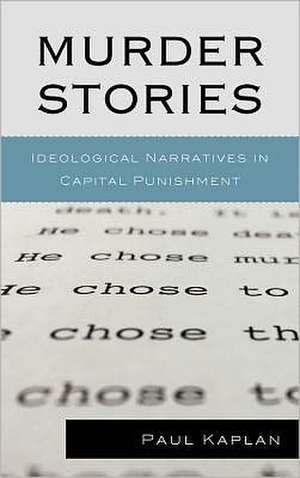
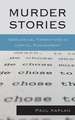
Murder Stories: Ideological Narratives in Capital Punishment: Issues in Crime and Justice
Autor Paul Kaplanen Limba Engleză Hardback – 18 ian 2012
Murder Stories draws on the entire record of California death sentence resulting trials from three large and diverse California counties for the years 1996 - 2004, as well as interviews with 26 capital caseworkers (attorneys, judges, and investigators) from the same counties. Employing the theoretical framework proposed by Ewick and Silbey (1995) to study hegemonic and subversive narratives, and also the ethnographic approach advocated by Amsterdam and Hertz (1992) to study the producers and processes of constructing legal narratives, this book traces the ideological content carried within the stories told by everyday practitioners of capital punishment by investigating the content, process, and ideological implications of these narratives.
The central theoretical finding is that the narratives constructed by both prosecutors and defenders tend to instantiate rather than subvert the ideological tenets of the American Creed.

Preț: 675.28 lei
Preț vechi: 833.68 lei
-19%
Puncte Express: 1013
Carte tipărită la comandă
Livrare economică 02-16 iunie
Specificații
ISBN-13: 9780739171707
ISBN-10: 0739171704
Pagini: 218
Dimensiuni: 163 x 239 x 20 mm
Greutate: 0.49 kg
Ediția:New.
Editura: Bloomsbury Publishing
Colecția Lexington Books
Seria Issues in Crime and Justice
Locul publicării:New York, United States
ISBN-10: 0739171704
Pagini: 218
Dimensiuni: 163 x 239 x 20 mm
Greutate: 0.49 kg
Ediția:New.
Editura: Bloomsbury Publishing
Colecția Lexington Books
Seria Issues in Crime and Justice
Locul publicării:New York, United States
Cuprins
Prologue
Chapter 1: Capital Punishment Conflicts, Narrativity, Hegemony, and Resistance
Chapter 2: The American Creed and American Capital Punishment
Chapter 3: Death Especially Deregulated
Chapter 4: The American Creed in Prosecutor and Defender Narratives
Chapter 5: Forgetting the Future: Cause Lawyering and the Work of California Capital Trial Defenders
Chapter 6: Facts and Furies: The Antinomies of Facts, Law, and Retribution in the Work of Capital Prosecutors
Epilogue
Chapter 1: Capital Punishment Conflicts, Narrativity, Hegemony, and Resistance
Chapter 2: The American Creed and American Capital Punishment
Chapter 3: Death Especially Deregulated
Chapter 4: The American Creed in Prosecutor and Defender Narratives
Chapter 5: Forgetting the Future: Cause Lawyering and the Work of California Capital Trial Defenders
Chapter 6: Facts and Furies: The Antinomies of Facts, Law, and Retribution in the Work of Capital Prosecutors
Epilogue
Recenzii
Murder Stories is a theoretically sophisticated book and Kaplan's analysis is distinctive. Kaplan uses death penalty stories to illustrate the complexities and contradictions of capital punishment in the United States and to reflect on the cultural conditions which sustain it. This book is a compelling read and makes a truly important contribution to the existing literature.
Murder Stories is a fascinating book that decodes the narratives told about murderers during the penalty phase of capital trials, and the permeation of these narratives with fundamental elements of American ideology. It sheds light on the endurance of the death penalty in the U.S., but more centrally on the powerful strategic and ideological work done by murder narratives, and on the complex relationship between ideology and punishment.
In Murder Stories, Paul Kaplan takes some of the most important insights about the death penalty in recent years and smartly re-interprets them in new ways that place race and individualism at the center of our understanding of this paradoxically American practice. In showing us how capital punishment reinforces some of our most cherished values, Kaplan has given us important insight into what it means when a jury sentences someone to die.
Paul Kaplan's timely study of capital punishment narratives is overflowing with empirical and theoretical insights into how the death penalty is ideologically constructed, why it has been retained in the United States for so long, and how to it might one day be ideologically deconstructed. Based on extensive archival analysis and interviews from three of the largest counties in California, Kaplan's ambitious book brilliantly critiques not only the death penalty system in America but more generally the modern liberal legal order and makes important and original contributions to our understanding of the narrative logic of American capital punishment and how it perpetuates racialized inequality through these narratives. Kaplan's well-written book provides a rich data set and even richer analysis of the everyday world of death penalty trials, an analysis which will be of great interest to a wide range of scholars in the social sciences, humanities and law. Bottom line: Paul Kaplan's Murder Stories: Ideological Narratives in Capital Punishment is the best book ever written about the ideological nature and logic of the American death penalty.
This is a study of the "murder stories" offered by participants in a large number of capital trials in California in the 1990s. Kaplan (San Diego State Univ.) explores how these accounts are framed so as to fit into widely held conceptions of justice within the American creed. The importance of these stories is literally a matter of life and death. To obtain a capital conviction or to avoid one, or to obtain a death sentence at a sentencing trial, both prosecutors and defense attorneys construct narratives that they hope will resonate with the jury. The prosecutor's task is to make the actions of the defendant "understandable" in ways that he or she is seen to be beyond redemption and thus subject to the death penalty. In turn the defense attorney must develop a script that humanizes the accused or offender so that while his behavior may be terrible, it is "understandable" in light of circumstances, and so that a modicum of mercy may be extended. This is a stunning book that shows the complexities and contradictions of capital punishment and at the same time reveals why capital punishment is so deeply ensconced in the American creed. Summing Up: Highly recommended.
Murder Stories is a fascinating book that decodes the narratives told about murderers during the penalty phase of capital trials, and the permeation of these narratives with fundamental elements of American ideology. It sheds light on the endurance of the death penalty in the U.S., but more centrally on the powerful strategic and ideological work done by murder narratives, and on the complex relationship between ideology and punishment.
In Murder Stories, Paul Kaplan takes some of the most important insights about the death penalty in recent years and smartly re-interprets them in new ways that place race and individualism at the center of our understanding of this paradoxically American practice. In showing us how capital punishment reinforces some of our most cherished values, Kaplan has given us important insight into what it means when a jury sentences someone to die.
Paul Kaplan's timely study of capital punishment narratives is overflowing with empirical and theoretical insights into how the death penalty is ideologically constructed, why it has been retained in the United States for so long, and how to it might one day be ideologically deconstructed. Based on extensive archival analysis and interviews from three of the largest counties in California, Kaplan's ambitious book brilliantly critiques not only the death penalty system in America but more generally the modern liberal legal order and makes important and original contributions to our understanding of the narrative logic of American capital punishment and how it perpetuates racialized inequality through these narratives. Kaplan's well-written book provides a rich data set and even richer analysis of the everyday world of death penalty trials, an analysis which will be of great interest to a wide range of scholars in the social sciences, humanities and law. Bottom line: Paul Kaplan's Murder Stories: Ideological Narratives in Capital Punishment is the best book ever written about the ideological nature and logic of the American death penalty.
This is a study of the "murder stories" offered by participants in a large number of capital trials in California in the 1990s. Kaplan (San Diego State Univ.) explores how these accounts are framed so as to fit into widely held conceptions of justice within the American creed. The importance of these stories is literally a matter of life and death. To obtain a capital conviction or to avoid one, or to obtain a death sentence at a sentencing trial, both prosecutors and defense attorneys construct narratives that they hope will resonate with the jury. The prosecutor's task is to make the actions of the defendant "understandable" in ways that he or she is seen to be beyond redemption and thus subject to the death penalty. In turn the defense attorney must develop a script that humanizes the accused or offender so that while his behavior may be terrible, it is "understandable" in light of circumstances, and so that a modicum of mercy may be extended. This is a stunning book that shows the complexities and contradictions of capital punishment and at the same time reveals why capital punishment is so deeply ensconced in the American creed. Summing Up: Highly recommended.