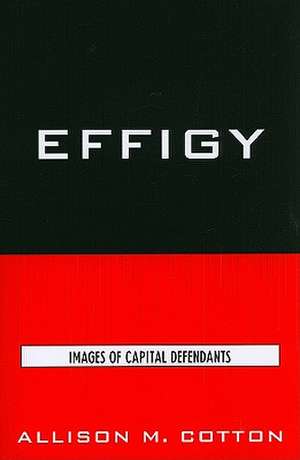
Effigy: Images of Capital Defendants: Issues in Crime and Justice
Autor Allison M. Cottonen Limba Engleză Paperback – 8 iul 2010
The prosecuting attorneys depict the defendant as a "savage beast," juxtaposing their image against that of a "troubled youth" as Page is portrayed by the defense attorneys. Slowly and methodically developed as figures with diametrically opposed features, none of which overlap or congeal, both the images are portrayed as real (buttressed by the testimony of witnesses) rather than constructed. The jury is expected to render a verdict that accepts one and rejects the other: there is no middle ground.

Preț: 336.52 lei
Preț vechi: 435.75 lei
-23%
Puncte Express: 505
Carte tipărită la comandă
Livrare economică 27 noiembrie-11 decembrie
Livrare prin curier în România Termenul estimat este afișat lângă disponibilitate.
Transport gratuit de la 400.00 lei Plată online sau ramburs, în funcție de opțiunile comenzii.
Retur gratuit în 14 zile Comandă securizată și suport în română.
Specificații
ISBN-13: 9780739125526
ISBN-10: 0739125524
Pagini: 212
Dimensiuni: 155 x 234 x 14 mm
Greutate: 0.35 kg
Editura: Bloomsbury Publishing
Colecția Lexington Books
Seria Issues in Crime and Justice
Locul publicării:New York, United States
ISBN-10: 0739125524
Pagini: 212
Dimensiuni: 155 x 234 x 14 mm
Greutate: 0.35 kg
Editura: Bloomsbury Publishing
Colecția Lexington Books
Seria Issues in Crime and Justice
Locul publicării:New York, United States
V-ar putea interesa
-
 DAMAGED THE HEARTBREAK TRUE PBCathy GlassPreț: 72.46 lei
 -
 Not Without My SisterKristina JonesPreț: 66.10 lei
 -
 The Boy Grows UpRichard Mccann-20%Preț: 72.13 lei90.71 lei
 -
 Political Violence in Ireland: Government and Resistance since 1848Charles Townshend-18%Preț: 328.69 lei402.11 lei
 -
 -28%Preț: 396.45 lei549.92 lei
 -
 Child Abuse: Law and Policy Across BoundariesLaura Hoyano-17%Preț: 730.75 lei885.21 lei
 -
 Why the West has WonVictor Davis HansonPreț: 143.73 lei
 -
 The Trader, the Owner, the SlaveJames Walvin-30%Preț: 75.37 lei106.99 lei
 -
 -26%Preț: 79.93 lei108.28 lei
 -
 When Kids KillJonathan Paul-48%Preț: 71.66 lei138.06 lei
 -
 The Serial KillersColin Wilson-47%Preț: 73.43 lei139.13 lei
 -
 The Violence of MenChloe MadanesPreț: 456.84 lei
 -
 Preț: 172.54 lei
 -
 Teacher's Guide to Protecting ChildrenJanet Kay-43%Preț: 61.01 lei107.64 lei
Cuprins
Chapter 1 Introduction Chapter 2 The Death Penalty in the U.S. and How Juries Operate Chapter 3 The Importance of Defining the Defendant Chapter 4 The Legal Fight Chapter 5 The Guilt Phase: How the Defense/Prosecution Saw their Mission Chapter 6 The Penalty Phase: The Prosecution/Defense's Mission Chapter 7 Who Is the Defendant? The Prosecution's/Defense's Answer Chapter 8 The Impact on Jurors Chapter 9 Conclusion
Recenzii
[Cotton] cites the relevant scientific research on juror decision making, and then takes a more open-ended approach to study how jurors reached a guilty verdict in this case. This ultimately provides valuable insight into how jurors are likely to make judgments about human behavior based on their own experience, rather than relying on expert testimony that challenges commonly held assumptions about rational action. Recommended.