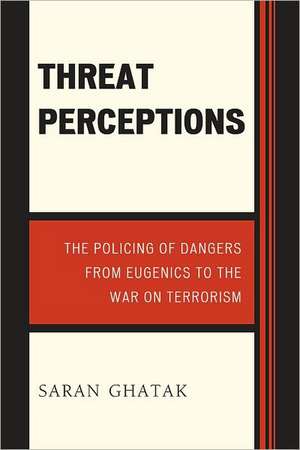
Threat Perceptions: The Policing of Dangers from Eugenics to the War on Terrorism: Issues in Crime and Justice
Autor Saran Ghataken Limba Engleză Hardback – 13 dec 2010
The very idea of "risk" is contingent on, and produced through the intersection of various social processes. Prevailing social conditions and political trends influence the production of risk perceptions, just as legislations and judicial precedents institutionalize the calculation and control of risk by criminal justice and security apparatuses of a nation. Simultaneously, the prediction of risk is established by scientific discourses and practices, as psychological profiles, statistical models, and other measures of risk factors render the future calculable-hence, predictable. Thus, a comprehensive understanding of risk management and security practices necessitates the analysis of these processes that essentially transforms a possibility into reality, which then forms the basis of public policies and governmental processes.



Preț: 561.46 lei
Preț vechi: 862.30 lei
-35%
Puncte Express: 842
Carte tipărită la comandă
Livrare economică 27 noiembrie-11 decembrie
Livrare prin curier în România Termenul estimat este afișat lângă disponibilitate.
Transport gratuit pentru acest produs Plată online sau ramburs, în funcție de opțiunile comenzii.
Retur gratuit în 14 zile Comandă securizată și suport în română.
Specificații
ISBN-13: 9780739129579
ISBN-10: 0739129570
Pagini: 140
Dimensiuni: 163 x 240 x 16 mm
Greutate: 0.38 kg
Ediția:New.
Editura: Bloomsbury Publishing
Colecția Lexington Books
Seria Issues in Crime and Justice
Locul publicării:New York, United States
ISBN-10: 0739129570
Pagini: 140
Dimensiuni: 163 x 240 x 16 mm
Greutate: 0.38 kg
Ediția:New.
Editura: Bloomsbury Publishing
Colecția Lexington Books
Seria Issues in Crime and Justice
Locul publicării:New York, United States
Cuprins
Chapter 1 Introduction
Chapter 2 Chapter 1: Science and Criminal Danger in the Nineteenth Century
Chapter 3 Chapter 2: Eugenics and Hereditarianism in the United States
Chapter 4 Chapter 3: Origin of the Psychopathology of Crime
Chapter 5 Chapter 4: The Advent of Actuarial Justice
Chapter 6 Chapter Five: Policing of Political Dissent
Chapter 7 Chapter 6: "Risk Wars": The Campaign against Terrorism
Chapter 8 Conclusion: The Vigilant New World: Science, Law and the Policing of Threats
Chapter 2 Chapter 1: Science and Criminal Danger in the Nineteenth Century
Chapter 3 Chapter 2: Eugenics and Hereditarianism in the United States
Chapter 4 Chapter 3: Origin of the Psychopathology of Crime
Chapter 5 Chapter 4: The Advent of Actuarial Justice
Chapter 6 Chapter Five: Policing of Political Dissent
Chapter 7 Chapter 6: "Risk Wars": The Campaign against Terrorism
Chapter 8 Conclusion: The Vigilant New World: Science, Law and the Policing of Threats
Recenzii
Ghatak provides a most lucid addition to the literature on the governance of risk in modern America. He masterfully traces the historical roots of new forms of scientific and legal categories and knowledge about perceived dangerousness and risk, from the `psychopathic` criminal, to new ways of constructing the problems of immigration and terrorism. He adds vital new concepts which help us understand and perhaps moderate the tensions between anticipating risk and danger before it engulfs us and holding to the democratic processes and values that most of us hold dear.
Threat Perceptions recovers for us the the complex mix of political, legal and scientific events in the 19th and 20th centuries, behind the present techniques of risk surveillance and control. Ghatak shows us that while these techniques are vulnerable in their dependence on the shifting grounds of law, politics, and science, they are remarkably robust in their ability to recirculate and reappear. This book will be of great value to anyone studying or worrying about our increasingly intrusive security state.
Threat Perceptions recovers for us the the complex mix of political, legal and scientific events in the 19th and 20th centuries, behind the present techniques of risk surveillance and control. Ghatak shows us that while these techniques are vulnerable in their dependence on the shifting grounds of law, politics, and science, they are remarkably robust in their ability to recirculate and reappear. This book will be of great value to anyone studying or worrying about our increasingly intrusive security state.