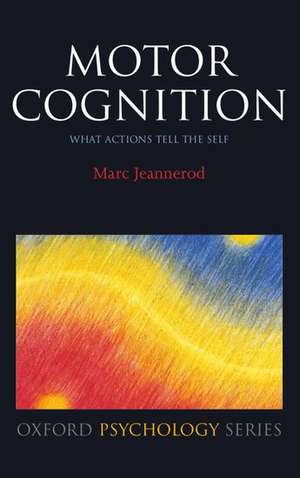
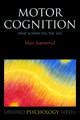
Motor Cognition: What actions tell the self: Oxford Psychology Series, cartea 42
Autor Marc Jeanneroden Limba Engleză Hardback – 29 iun 2006
Our ability to acknowledge and recognise our own identity - our 'self' - is a characteristic doubtless unique to humans. Where does this feeling come from? How does the combination of neurophysiological processes coupled with our interaction with the outside world construct this coherent identity? We know that our social interactions contribute via the eyes, ears etc. However, our self is not only influenced by our senses. It is also influenced by the actions we perform and those we see others perform. Our brain anticipates the effects of our own actions and simulates the actions of others. In this way, we become able to understand ourselves and to understand the actions and emotions of others. This book is the first to describe the new field of 'Motor Cognition' - one to which the author's contribution has been seminal. Though motor actions have long been studied by neuroscientists and physiologists, it is only recently that scientists have considered the role of actions in building the self. How consciousness of action is part of self-consciousness, how one's own actions determine the sense of being an agent, how actions performed by others impact on ourselves for understanding others, differentiating ourselves from them and learning from them: these questions are raised and discussed throughout the book, drawing on experimental, clinical, and theoretical bases.The advent of new neuroscience techniques, like neuroimaging and direct electrical brain stimulation, together with a renewal of behavioral methods in cognitive psychology, provide new insights into this area. Mental imagery of action, self-recognition, consciousness of actions, imitation can be objectively studied using these new tools. The results of these investigations shed light on clinical disorders in neurology, psychiatry and in neuro-development.This is a major new work that will lay down the foundations for the field of motor cognition.
Din seria Oxford Psychology Series
- 32%
 Preț: 897.81 lei
 - 21%
 Preț: 373.12 lei
 - 32%
 Preț: 2181.88 lei
 - 16%
 Preț: 339.90 lei
 - 30%
 Preț: 348.26 lei
 - 21%
 Preț: 379.24 lei
 - 30%
 Preț: 422.14 lei
 - 31%
 Preț: 698.32 lei
 - 28%
 Preț: 396.46 lei
 - 33%
 Preț: 1880.92 lei
 - 33%
 Preț: 757.76 lei
 - 31%
 Preț: 523.04 lei
 - 31%
 Preț: 535.51 lei
 - 31%
 Preț: 793.31 lei
 - 32%
 Preț: 600.75 lei
 - 21%
 Preț: 364.07 lei
 - 33%
 Preț: 916.11 lei
 - 29%
 Preț: 422.48 lei
 - 31%
 Preț: 576.66 lei
 - 33%
 Preț: 961.06 lei
 - 28%
 Preț: 420.37 lei
 - 21%
 Preț: 366.50 lei
 - 38%
 Preț: 1440.90 lei
 - 33%
 Preț: 1387.14 lei
 - 33%
 Preț: 722.39 lei
 - 11%
 Preț: 368.70 lei
 - 28%
 Preț: 518.24 lei
 - 33%
 Preț: 1388.22 lei
 - 33%
 Preț: 979.51 lei
 - 33%
 Preț: 625.64 lei
 -
 Preț: 134.59 lei
 - 10%
 Preț: 340.37 lei
 - 29%
 Preț: 469.70 lei
 - 33%
 Preț: 1707.62 lei
 - 31%
 Preț: 606.38 lei
 - 32%
 Preț: 717.65 lei
 - 31%
 Preț: 622.40 lei
 - 33%
 Preț: 918.33 lei
 - 31%
 Preț: 567.25 lei
 - 28%
 Preț: 508.06 lei
 - 30%
 Preț: 474.70 lei
 - 34%
 Preț: 701.48 lei
 - 27%
 Preț: 408.05 lei
 - 28%
 Preț: 446.75 lei
 - 31%
 Preț: 906.56 lei
Preț: 632.70 lei
Preț vechi: 939.15 lei
-33%
Puncte Express: 949
Carte tipărită la comandă
Livrare economică 19-24 noiembrie
Livrare prin curier în România Termenul estimat este afișat lângă disponibilitate.
Transport gratuit pentru acest produs Plată online sau ramburs, în funcție de opțiunile comenzii.
Retur gratuit în 14 zile Comandă securizată și suport în română.
Specificații
ISBN-13: 9780198569640
ISBN-10: 0198569645
Pagini: 220
Ilustrații: 1 halftone, numerous line drawings
Dimensiuni: 188 x 268 x 44 mm
Greutate: 0.47 kg
Editura: OUP OXFORD
Colecția OUP Oxford
Seria Oxford Psychology Series
Locul publicării:Oxford, United Kingdom
ISBN-10: 0198569645
Pagini: 220
Ilustrații: 1 halftone, numerous line drawings
Dimensiuni: 188 x 268 x 44 mm
Greutate: 0.47 kg
Editura: OUP OXFORD
Colecția OUP Oxford
Seria Oxford Psychology Series
Locul publicării:Oxford, United Kingdom
V-ar putea interesa
-
 -28%Preț: 477.92 lei668.26 lei
 -
 The Agile MindWilma Koutstaal-20%Preț: 503.88 lei632.90 lei
 -
 -15%Preț: 322.91 lei380.59 lei
 -
 -31%Preț: 997.16 lei1449.07 lei
 -
 Psychophysiology of ConsciousnessEugene Sokolov-35%Preț: 740.85 lei1147.96 lei
 -
 Agency and Joint AttentionJanet Metcalfe-14%Preț: 904.26 lei1051.47 lei
 -
 -17%Preț: 261.37 lei314.69 lei
 -
 On CreativityDavid BohmPreț: 171.83 lei
 -
 Preț: 381.53 lei
 -
 -5%Preț: 367.79 lei387.15 lei
 -
 PersuasionTimothy C. Brock-27%Preț: 1326.51 lei1817.14 lei
 -
 Psychophysiology: Human Behavior and Physiological ResponseJohn L. Andreassi-15%Preț: 671.66 lei790.19 lei
 -
 -5%Preț: 387.69 lei408.09 lei
 -
 -18%Preț: 704.62 lei859.28 lei
Recenzii
This book is a tour de force covering encompassing neuropsychology, neurophysiology, philosophy, neuoimaging, comparative neurobiology and clinical studies to support a thought provoking perspective on motor functioning. I would recommend this book to those interested in the study of neural production of movements ...
Notă biografică
Marc Jeannerod, born in Lyon, France. Doctor in Medicine (1965), Thesis in Lyon, on sleep mechanisms. Post-doc at the Brain Research Institute, UCLA, Los Angeles (California). Professor in Physiology at the University Claude Bernard, Lyon. Runs his own lab on sensory-motor coordination, until 1997. 1997-2005: Founder and Director of the Institut des Sciences Cognitives, Lyon. In this Institute, works on the mechanisms of the generation of actionsMember, Académie des Sciences.