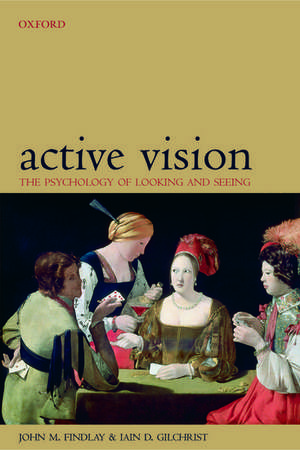
Active Vision: The Psychology of Looking and Seeing: Oxford Psychology Series, cartea 37
Autor John M Findlay, Iain D Gilchristen Limba Engleză Paperback – 7 aug 2003
Din seria Oxford Psychology Series
- 32%
 Preț: 920.13 lei
 - 20%
 Preț: 381.84 lei
 - 32%
 Preț: 2181.88 lei
 - 16%
 Preț: 339.90 lei
 - 30%
 Preț: 348.26 lei
 - 21%
 Preț: 379.24 lei
 - 30%
 Preț: 422.14 lei
 - 31%
 Preț: 698.32 lei
 - 28%
 Preț: 396.46 lei
 - 33%
 Preț: 1880.92 lei
 - 33%
 Preț: 757.76 lei
 - 31%
 Preț: 523.04 lei
 - 31%
 Preț: 535.51 lei
 - 31%
 Preț: 793.31 lei
 - 32%
 Preț: 600.75 lei
 - 21%
 Preț: 364.07 lei
 - 33%
 Preț: 916.11 lei
 - 29%
 Preț: 422.48 lei
 - 31%
 Preț: 576.66 lei
 - 33%
 Preț: 961.06 lei
 - 28%
 Preț: 420.37 lei
 - 21%
 Preț: 366.50 lei
 - 38%
 Preț: 1440.90 lei
 - 33%
 Preț: 1387.14 lei
 - 33%
 Preț: 722.39 lei
 - 11%
 Preț: 368.70 lei
 - 28%
 Preț: 518.24 lei
 - 33%
 Preț: 1388.22 lei
 - 33%
 Preț: 979.51 lei
 - 33%
 Preț: 625.64 lei
 -
 Preț: 139.21 lei
 - 10%
 Preț: 340.37 lei
 - 29%
 Preț: 469.70 lei
 - 33%
 Preț: 1707.62 lei
 - 32%
 Preț: 717.65 lei
 - 31%
 Preț: 622.40 lei
 - 33%
 Preț: 918.33 lei
 - 31%
 Preț: 567.25 lei
 - 28%
 Preț: 508.06 lei
 - 30%
 Preț: 474.70 lei
 - 34%
 Preț: 701.48 lei
 - 27%
 Preț: 417.73 lei
 - 28%
 Preț: 446.75 lei
 - 31%
 Preț: 906.56 lei
Preț: 606.38 lei
Preț vechi: 884.09 lei
-31%
Puncte Express: 910
Carte tipărită la comandă
Livrare economică 27 noiembrie-02 decembrie
Livrare prin curier în România Termenul estimat este afișat lângă disponibilitate.
Transport gratuit pentru acest produs Plată online sau ramburs, în funcție de opțiunile comenzii.
Retur gratuit în 14 zile Comandă securizată și suport în română.
Specificații
ISBN-13: 9780198524793
ISBN-10: 019852479X
Pagini: 236
Ilustrații: numerous figures and halftones
Dimensiuni: 157 x 234 x 14 mm
Greutate: 0.41 kg
Editura: OUP OXFORD
Colecția OUP Oxford
Seria Oxford Psychology Series
Locul publicării:Oxford, United Kingdom
ISBN-10: 019852479X
Pagini: 236
Ilustrații: numerous figures and halftones
Dimensiuni: 157 x 234 x 14 mm
Greutate: 0.41 kg
Editura: OUP OXFORD
Colecția OUP Oxford
Seria Oxford Psychology Series
Locul publicării:Oxford, United Kingdom
V-ar putea interesa
-
 How Implicit is Implicit Learning?Dianne C. Berry-34%Preț: 713.70 lei1077.64 lei
 -
 The Developing Visual BrainJanette AtkinsonPreț: 139.21 lei
 -
 -34%Preț: 701.26 lei1055.82 lei
 -
 Consciousness and the WorldBrian O'Shaughnessy-27%Preț: 391.60 lei536.22 lei
 -
 Fuzzy Grammar: A ReaderBas Aarts-28%Preț: 427.63 lei589.93 lei
 -
 -28%Preț: 376.58 lei521.99 lei
 -
 Events, Phrases, and QuestionsRobert Truswell-25%Preț: 353.35 lei473.58 lei
 -
 Memory: A Philosophical StudySven Bernecker-12%Preț: 350.62 lei396.55 lei
 -
 The Opacity of Mind: An Integrative Theory of Self-KnowledgePeter Carruthers-13%Preț: 116.65 lei133.69 lei
 -
 -5%Preț: 416.11 lei438.01 lei
 -
 Make it StickPeter C. BrownPreț: 240.97 lei
 -
 Brain RulesJohn MedinaPreț: 94.98 lei
 -
 Soft-WiredDr Michael Merzenich PhdPreț: 99.38 lei
Recenzii
. . . Findlay and Gilchrist deliver a book that will function as a good map to any diver looking for hidden treasures in the field of eye movements, search, and attention. This map shows where the different groups of divers are located relative to each other, their working techniques, their goals. All of this is done without overwhelming beginner divers or putting experienced divers to sleep. Now, it is up to the divers themselves to make good use of the book and keep swimming away. Who knows, it might help us find the hidden treasure. If it does indeed exist at all!
. . . a marvellous and bold book, which, as the authors state, attempts to initiate a paradigm shift. The type of research questions vision scientists ask in 20 years time will only then reveal whether the authors have succeeded.
. . . a marvellous and bold book, which, as the authors state, attempts to initiate a paradigm shift. The type of research questions vision scientists ask in 20 years time will only then reveal whether the authors have succeeded.
Cuprins
- Passive Vision and Active Vision
- 1.1: Introduction
- 1.2: Passive vision
- 1.3: Visual attention
- 1.4: Active vision
- 1.5: Active vision and vision for action
- 1.6: Outline of the book
- Background to Active Vision
- 2.1: Introduction
- 2.2: The inhomogeneity of the visual projections
- 2.3: Parallel visual pathways
- 2.4: The oculomotor system
- 2.5: Saccadic eye movements
- 2.6: Summary
- Visual Selection, Covert Attention and Eye Movements
- 3.1: Covert and overt attention
- 3.2: Covert spatial attention
- 3.3: The relationship between covert and overt attention
- 3.4: Speed of attention
- 3.5: Neurophysiology of attention
- 3.6: Non-spatial attention
- 3.7: Active vision and attention
- 3.8: Summary
- Visual Orienting
- 4.1: Introduction
- 4.2: What determines the latency of orienting saccades?
- 4.3: Physiology of saccade initiation
- 4.4: What determines the landing position of orienting saccades?
- 4.5: Physiology of the WHERE system
- 4.6: The Findlay and Walker model
- 4.7: Development and plasticity
- Visual Sampling during Text Reading
- 5.1: Introduction
- 5.2: Basic patterns of visual sampling during reading
- 5.3: Perception during fixations in reading
- 5.4: Language processing
- 5.5: Control of fixation duration
- 5.6: Control of landing position
- 5.7: Theories of eye control during reading
- 5.8: Practical aspects of eye control in reading
- 5.9: Overview
- Visual Search
- 6.1: Visual search tasks
- 6.2: Theories of visual search
- 6.3: The need for eye movements in visual search
- 6.4: Eye movements in visual search
- 6.5: Ocular capture in visual search
- 6.6: Saccades in visual search: scanpaths
- 6.7: Physiology of visual search
- 6.8: Summary
- Natural Scenes and Activities
- 7.1: Introduction
- 7.2: Analytic studies of scene and object perception
- 7.3: Dynamic scenes and situations
- 7.4: Summary
- Human Neuropsychology
- 8.1: Blindsight
- 8.2: Neglect
- 8.3: Balint's syndrome and dorsal simultanagnosia
- 8.4: Frontal lobe damage
- 8.5: Orienting without eye movements
- 8.6: Summary
- Space Constancy and Trans-saccadic Integration
- 9.1: The traditional approach: 'compensatory taking
- into account'
- 9.2: Trans-saccadic integration
- 9.3: Resolution of the conflicting results
- 9.4: Conclusion: The Active Vision Cycle
- 9.5: Future directions