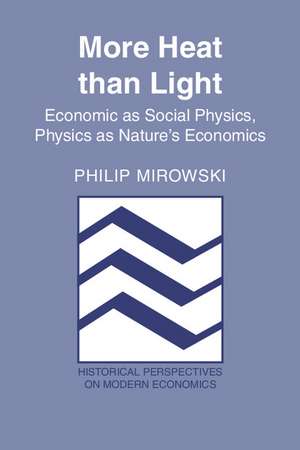
More Heat than Light: Economics as Social Physics, Physics as Nature's Economics: Historical Perspectives on Modern Economics
Autor Philip Mirowskien Limba Engleză Paperback – 28 noi 1991
Considerăm More Heat than Light o lectură esențială pentru cercetători, studenți la nivel de masterat sau MBA și teoreticieni interesați de fundamentele epistemologice ale științelor sociale. Philip Mirowski propune o examinare riguroasă a modului în care economia neoclasică a încercat să emuleze fizica secolului al XIX-lea, împrumutând nu doar metafore, ci și structuri matematice întregi pentru a defini valoarea. Descoperim aici o analiză critică a „simbiozei” dintre cele două discipline, pornind de la conceptele de invarianță și conservare a energiei. Ca și Michael Schulz în Statistical Physics and Economics, autorul distilează experiență reală în principii acționabile, însă Mirowski merge mai adânc în istoria ideilor, avertizând asupra riscurilor de a prelua modele fizice fără a înțelege limitările lor în context social. Această lucrare se poziționează ca un pilon central în opera lui Philip Mirowski, făcând legătura între explorarea metaforelor din Natural Images in Economic Thought și critica mecanismelor informaționale din The Knowledge We Have Lost in Information. Volumul nu este doar o cronică istorică, ci un avertisment tehnic detaliat despre modul în care utilizarea eronată a principiilor de conservare a dus la blocaje în formalizarea teoriei economice moderne. Stilul este dens, academic și necesită o familiaritate solidă cu calculul matematic, oferind în schimb o perspectivă unică asupra modului în care „legile naturii” au fost recrutate pentru a justifica ordinea economică.
Din seria Historical Perspectives on Modern Economics
-
 Preț: 315.34 lei
 - 11%
 Preț: 516.36 lei
 -
 Preț: 297.09 lei
 - 11%
 Preț: 401.07 lei
 -
 Preț: 286.49 lei
 -
 Preț: 355.78 lei
 -
 Preț: 297.62 lei
 -
 Preț: 331.22 lei
 -
 Preț: 411.29 lei
 -
 Preț: 405.88 lei
 -
 Preț: 332.54 lei
 - 11%
 Preț: 589.55 lei
 -
 Preț: 336.74 lei
 -
 Preț: 363.37 lei
 -
 Preț: 295.22 lei
 - 14%
 Preț: 806.94 lei
 -
 Preț: 369.83 lei
 -
 Preț: 360.23 lei
 -
 Preț: 362.51 lei
 -
 Preț: 317.19 lei
 -
 Preț: 268.43 lei
 -
 Preț: 280.77 lei
 -
 Preț: 449.53 lei
 -
 Preț: 424.76 lei
 - 14%
 Preț: 744.26 lei
 -
 Preț: 275.21 lei
 -
 Preț: 397.56 lei
 -
 Preț: 354.30 lei
Preț: 439.62 lei
Carte tipărită la comandă
Livrare economică 03-17 iulie
Specificații
ISBN-10: 0521426898
Pagini: 464
Ilustrații: 1 table, 7 line drawings
Dimensiuni: 152 x 229 x 26 mm
Greutate: 0.7 kg
Editura: Cambridge University Press
Colecția Cambridge University Press
Seria Historical Perspectives on Modern Economics
Locul publicării:New York, United States
V-ar putea interesa
-
 An Introduction to Auction TheoryFlavio M. Menezes-14%Preț: 378.68 lei441.57 lei
 -
 Applied Welfare EconomicsChris Jones-37%Preț: 687.58 lei1089.98 lei
 -
 Principled Agents?: The Political Economy of Good GovernmentTimothy Besley-14%Preț: 285.19 lei331.77 lei
 -
 Capabilities and HappinessLuigino Bruni-27%Preț: 889.11 lei1218.29 lei
 -
 -17%Preț: 67.23 lei81.04 lei
 -
 Handbook of Antitrust EconomicsPaolo BuccirossiPreț: 555.58 lei
 -
 Preț: 425.49 lei
 -
 The World in the Model: How Economists Work and ThinkMary S. MorganPreț: 393.07 lei
 -
 Government and Markets: Toward a New Theory of RegulationEdward J. BalleisenPreț: 373.54 lei
 -
 A First Course in Optimization TheoryRangarajan K. SundaramPreț: 383.73 lei
 -
 Mathematics for Economics and Finance: Methods and ModellingMartin Anthony-8%Preț: 349.41 lei379.04 lei
 -
 The Philosophy of Economics: An AnthologyDaniel M. HausmanPreț: 369.33 lei
 -
 Theory of Decision under UncertaintyItzhak GilboaPreț: 266.58 lei
 -
 An Economic Theory of Greed, Love, Groups, and NetworksPaul FrijtersPreț: 343.77 lei
 -
 On CompetitionMichael E. PorterPreț: 258.39 lei
 -
 Economists' Mathematical ManualKnut SydsaeterPreț: 317.17 lei
De ce să citești această carte
Adresată profesioniștilor care doresc să înțeleagă rădăcinile reale ale modelelor matematice folosite în economie, această carte oferă claritate asupra limitelor științifice ale domeniului. Cititorul va câștiga o capacitate critică de a evalua validitatea teoriilor economice neoclasice, înțelegând exact unde s-au produs fracturile logice în procesul de împrumut metodologic de la fizică. Este un instrument indispensabil pentru o înțelegere profundă a istoriei gândirii economice.
Despre autor
Philip Mirowski este profesor de economie și istoria și filozofia științei la Universitatea Notre Dame, fiind o autoritate recunoscută în studiul politicii cunoașterii. Opera sa, care include titluri precum Nine Lives of Neoliberalism sau Machine Dreams, explorează intersecția dintre științele naturale și economie. Expertiza sa vastă, care i-a adus premiul Ludwig Fleck pentru The Effortless Economy of Science, îi permite să navigheze cu precizie între istoria fizicii și complexitatea modelelor economice, oferind cititorilor o perspectivă rară, interdisciplinară asupra modului în care s-au format disciplinele moderne.
Descriere scurtă
Cuprins
Recenzii
"...a major contribution to twentieth century literature in economic thought. It is destined to become a classic and must be read and reread." Southern Economic Journal
"...an excellent and enthralling volume, written with great erudition and wit." Review of Political Economy
"No previous writer has made such a sustained and determined effort to explore the undeniably important conceptual links between economics and physics; and this alone is a landmark contribution of importance to all economists, not merely to specialist historians of the discipline." Kyklos
"...an example of the history of economic theory at its best." Charles M. A. Clark, Eastern Economic Journal