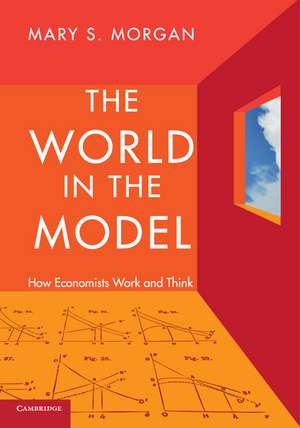
The World in the Model
Autor Mary S. Morganen Limba Engleză Paperback – 7 ian 2015
După parcurgerea acestui volum, cititorul va fi capabil să decripteze mecanismele interne ale gândirii economice moderne, înțelegând nu doar ce spun modelele, ci mai ales cum sunt ele construite pentru a reprezenta realitatea. Considerăm că The World in the Model reprezintă o resursă esențială pentru a trece dincolo de suprafața tehnică a cifrelor, oferind o perspectivă istorică și filosofică asupra modului în care economia a devenit o știință a abstractizării. Subliniem faptul că abordarea lui Mary S. Morgan nu este una pur tehnică, ci se adresează intelectualului care dorește să înțeleagă eșecurile și succesele modelelor economice care ne guvernează viața. Ca și Harro Maas în Economic Methodology, autoarea distilează experiență reală în principii acționabile, urmărind evoluția disciplinei în ultimele două secole. Totuși, Mary S. Morgan merge mai departe, integrând teme pe care le-a explorat anterior în Models as Mediators sau How Well Do Facts Travel?, precum rolul narațiunii și circulația faptelor între discipline. Structura cărții este una progresivă: pornim de la „rețetele” și ingredientele de bază ale unui model (capitolele 1-2), trecem prin procesul creativ de imaginare și utilizare a metaforelor (capitolele 3-5) și ajungem la validarea prin experimente și simulări (capitolele 7-8). Reținem că această progresie transformă cititorul dintr-un observator pasiv într-un critic avizat al modului în care „lumea din model” ajunge să influențeze „modelul din lume”. Este o lucrare de referință care explică de ce economiștii gândesc în felul în care o fac, folosind 75 de ilustrații pentru a clarifica vizual concepte complexe.
Preț: 403.44 lei
Carte tipărită la comandă
Livrare economică 04-18 decembrie
Specificații
ISBN-10: 0521176190
Pagini: 442
Ilustrații: 71 b/w illus. 4 colour illus. 6 tables
Dimensiuni: 178 x 254 x 24 mm
Greutate: 0.83 kg
Ediția:New.
Editura: Cambridge University Press
Locul publicării:New York, United States
V-ar putea interesa
-
 WHY WERE GETTING EXAIIE PBCahal MoranPreț: 142.59 lei
 -
 The Worldly PhilosophersRobert L Heilbroner-30%Preț: 65.18 lei93.65 lei
 -
 Making Sense of ChaosJ. Doyne FarmerPreț: 93.87 lei
 -
 Mathematical Biology: A Very Short IntroductionPhilip K. Maini-19%Preț: 57.39 lei71.06 lei
 -
 Essentials of Econophysics ModellingFrantisek Slanina-11%Preț: 469.59 lei527.63 lei
 -
 Economics: The Culture of a Controversial ScienceMelvin W. RederPreț: 250.57 lei
 -
 What’s Wrong with Economics?: A Primer for the PerplexedRobert SkidelskyPreț: 96.83 lei
 -
 Economics RulesDani RodrikPreț: 72.62 lei
 -
 The New Nature of BusinessAndre HoffmannPreț: 116.19 lei
 -
 -36%Preț: 77.62 lei122.11 lei
 -
 Social, Methods, and MicroeconomicsFrederic S Lee-23%Preț: 578.13 lei750.82 lei
 -
 -27%Preț: 67.41 lei92.54 lei
 -
 The Great Mental Models: General Thinking ConceptsRhiannon BeaubienPreț: 142.70 lei
 -
 The Change Book: Fifty models to explain how things happenMikael Krogerus-19%Preț: 63.90 lei78.83 lei
 -
 The Shortest History of EconomicsAndrew LeighPreț: 72.12 lei
 -
 Stealing The FutureDavid MorrisPreț: 116.45 lei
 -
 Another WayDave WhortonPreț: 189.16 lei
De ce să citești această carte
Recomandăm această carte profesioniștilor și studenților din economie, istorie sau filosofie care doresc să înțeleagă anatomia modelelor economice. Cititorul câștigă o capacitate critică de a evalua teoriile economice actuale, înțelegând limitările și forța abstractizării. Este o lectură fundamentală pentru a înțelege cum instrumentele matematice au înlocuit discursul narativ în definirea politicilor globale.
Despre autor
Mary S. Morgan este o figură proeminentă în mediul academic internațional, fiind profesor de istoria și filosofia economiei la London School of Economics și la Universitatea din Amsterdam. Statutul său de membru al British Academy și al Academiei Regale Olandeze de Arte și Științe atestă rigoarea cercetărilor sale. Opera sa vastă, care include titluri precum Narrative Science și The History of Econometric Ideas, se concentrează pe intersecția dintre statistică, experimente și narațiune. În The World in the Model, ea își valorifică expertiza de decenii pentru a oferi o sinteză clară asupra modului în care modelarea a transformat identitatea economiei ca știință socială.
Descriere scurtă
Cuprins
Recenzii
'Mary Morgan has developed a distinctive approach to economic methodology, relying on a great variety of examples – each one analysed and dissected in-depth like a careful entomologist. Her main message is that modelling should be kept distinct from formalism and mathematization: when we model, we use a specific entity both as an object of enquiry and as an instrument to study economic reality. Historians and philosophers of economics have been waiting for this book for years, and it will not fail to impress.' Francesco Guala, University of Milan
'Modern economics is about models – they are the 'working objects' of economic science – and yet we have traditionally had so little understanding of exactly what models are and how they work. This book provides us with that understanding. It is the culmination of Mary Morgan's many years of research on economic models and as such it is the definitive treatment of the subject. She gives us a complex historical investigation – not 3-by-5 card economic methodology – and such a detailed case studies-based history is exactly what is needed to understand the diversity of ways that models work, and have worked, in economic science. It will be an instant classic in the history and philosophy of modern economics.' D. Wade Hands, University of Puget Sound
'The Nobel laureate James Heckman has written that, just as the Jews are 'the people of the book', economists are 'the people of the model'. Mary Morgan in her The World in the Model provides an anthropological account of economists as model-makers and model-users – a mixture of their stories, their practices, and their languages. In Morgan's case studies, history provides an insightful window on methodology and philosophy, which, in turn, enlightens and enlivens a complex and previously untold history.' Kevin D. Hoover, Duke University
'In this superb book, models appear as little, artificial worlds, and Mary Morgan is the perfect guide to their structures and mysteries. Never content with generalizations, she joins the reader in exploring a series of rich and intriguing cases and shows how much the modern role of economics depends on the ambiguous relationships of these models to real economic institutions and behaviors.' Ted Porter, University of California, Los Angeles
'The World in the Model argues that economic models are not merely or mainly representations of phenomena; they are flexible tools that configure the domain, constitute its objects, and display salient features, thereby facilitating thinking about economics. Through a series of carefully crafted case studies, Mary S. Morgan shows how economic modeling and thinking about economic matters evolved in tandem. Anyone interested in scientific models or in economic understanding will find this book rewarding.' Catherine Z. Elgin, Harvard University
'Morgan's book constitutes a substantial contribution to the history of economics and a crucial one on the practice of modelling. Nearly, all the chapters of the long book are adapted from papers published in journals and books in the previous years. They can be read independently of each other, although there are great benefits in going through the whole book to appraise all the evidence for the claims made in the first chapter. This book has been, since 2012, and will be, for some years, of interest to multiple audiences.' Maxime Desmarais-Tremblay, The European Journal of the History of Economic Thought