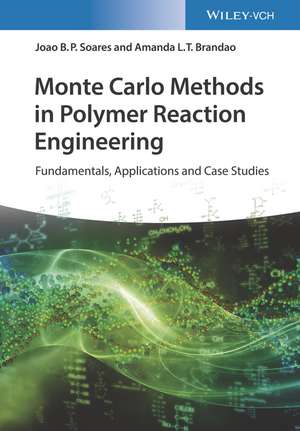
Monte Carlo Methods in Polymer Reaction Engineering
Autor Joao B. P. Soares, Amanda L. T. Brandao, Mohammed Al-Khayyaten Limba Engleză Hardback – 20 ian 2027
The author, one of the leading experts in the field, teaches readers how to program Monte Carlo algorithms to solve their own specific problems in polymer reaction engineering, starting with simple principles and moving on to more complex examples. Additional educational software is available online.
The handbook is aimed at polymer scientists and engineers in academia and industry, but is of equal interest to PhD students.
Preț: 640.75 lei
Preț vechi: 745.05 lei
-14% Precomandă
Carte nepublicată încă
Specificații
ISBN-10: 3527341080
Pagini: 240
Dimensiuni: 170 x 244 mm
Editura: Wiley-VCH GmbH
Locul publicării:Weinheim, Germany
V-ar putea interesa
-
 Exploring Monte Carlo MethodsWilliam L. Dunn-31%Preț: 439.63 lei638.61 lei
 -
 Applied Numerical Methods for Chemical EngineersNavid Mostoufi-16%Preț: 482.22 lei571.56 lei
 -
 -18%Preț: 930.46 lei1134.71 lei
 -
 Multiscale Modelling of PolymersDoros N. Theodorou-23%Preț: 580.29 lei748.86 lei
 -
 SimulationSheldon M. Ross-32%Preț: 510.77 lei749.22 lei
 -
 The Elements of Polymer Science and EngineeringAlfred Rudin-29%Preț: 761.98 lei1069.93 lei
 -
 Predictive Modeling in Polymer Science: Properties and PerformanceMohammad Hossein Keshavarz-32%Preț: 852.47 lei1253.10 lei
 -
 Chemical and Engineering Thermodynamics, 5eStanley I. Sandler-19%Preț: 581.45 lei717.84 lei
 -
 Furan Polymers and Their ReactionsAlessandro Gandini-23%Preț: 756.43 lei982.37 lei
 -
 -23%Preț: 660.63 lei857.96 lei
 -
 Understanding Polymer ProcessingTim A. Osswald-18%Preț: 674.38 lei822.41 lei
 -
 -26%Preț: 905.22 lei1230.11 lei
 -
 -30%Preț: 97.81 lei139.80 lei
 -
 Statistics for ScientistsUmberto Michelucci-20%Preț: 279.62 lei349.53 lei
 -
 A Concise Introduction to Polymer PhysicsReinhard Hentschke-11%Preț: 428.27 lei481.21 lei
 -
 Polymer CrystallizationJyotishkumar Parameswaranpillai-14%Preț: 869.53 lei1011.08 lei
 -
 Advanced Control Methods for Industrial ProcessesPablo A. López-Pérez-23%Preț: 698.89 lei907.65 lei
 -
 Artificial Intelligence in CatalysisValentine P. Ananikov-23%Preț: 781.96 lei1015.53 lei
 -
 Computer Simulation of Polymeric MaterialsJapan Association For Chemical Innovation-18%Preț: 993.67 lei1211.80 lei
Public țintă
Polymer Chemists, Chemical Engineers, Ph.D. Students in Material Sciences, Ph.D. Students in Engineering Sciences, Plastics Technologists, Chemical Industry, Materials Scientists, LibrariesNotă biografică
João B. P. Soares is a Professor in the Department of Chemical and Materials Engineering at the University of Alberta. A Fellow of the Chemical Institute of Canada and Editor-in-Chief of the Canadian Journal of Chemical Engineering, he has published more than 180 journal articles, written 12 book chapters, and delivered 27 public and 22 in-house industrial short courses worldwide. He consults for polyolefin-manufacturing companies across Canada, the USA, Europe, Asia, and the Middle East.
Amanda L. T. Brandão is a PhD student at the Universidade Federal do Rio de Janeiro, specializing in kinetics of polymerization systems with long chain branches. Her research focuses on optimal experimental design, modeling and simulation of polymerization systems, and optimization of chemical reactors. She holds a BSc and MSc in Chemical Engineering from institutions in Rio de Janeiro.
Mohammed Al-Khayyat tba
Cuprins
2 Introduction
2.1 The Uniform Distribution and the Generation of Random Numbers
2.2 Polymerizations are Stochastic Processes
2.3 A Preliminary Monte Carlo Simulation Algorithm
2.4 Chain Length and Molecular Weight Averages
2.5 Final Thoughts
2.6 Extra Readings
3 Steady State Monte Carlo Models
3.1 Case Study 3.1: Styrene Free-Radical Polymerization
3.2 Case Study 3.2: Free-Radical Copolymerization of Styrene and Methyl Methacrylate
3.3 Case Study 3.3: Coordination Polymerization with the Formation of Long Chain Branches
3.4 Final Thoughts
3.5 Extra Readings
4 Dynamic Monte Carlo Models
4.1 Case Study 4.1 ? Part 1: Step-Growth Polymerization
4.2 Gillespie?s Method: A Stochastic Approach to Dynamic Simulation
4.3 Case Study 4.1 ? Part 2: Gillespie Algorithm for Step-Growth Polymerization
4.4 Case Study 4.1 ? Part 3: Non-Stoichiometric Step-Growth Polymerization
4.5 Reaction Networks and Competing Events
4.6 How to Select the Size of the Control Volume
4.7 Case Study 4.2: Dynamic Styrene Free-Radical Polymerization with Gel Effect
4.8 Case Study 4.3: ATRP Copolymerization of Styrene and n-Butyl Acrylate
4.9 Case Study 4.4: Thermal Degradation of Polystyrene
4.10 Final Thoughts
4.11 Extra Readings
5 Optimization of Monte Carlo Methods
5.1 Big O Notation and Computational Complexity
5.2 Compilation versus Interpretation
5.3 Homopolymerization Geometric Sampling
5.4 Copolymerization Geometric Sampling
5.5 Minimizing Random Number Generation Overhead
5.6 Balancing Accuracy and Speed
5.7 Disjoint Set Union for Gelation Tracking
5.8 GPU Parallel Computing
5.9 Final Thoughts
5.10 Extra Readings
6 Epilogue: Creating Molecules to Understand Them
6.1 Lessons from Monte Carlo Simulation
6.2 Ten Rules for Writing Monte Carlo Algorithms
6.3 The Expanding Role of Monte Carlo Methods in Polymer Reaction Engineering
6.4 Final Thoughts
Appendix A: Instantaneous Chain Length Distribution (CLD) of Polymers Made by Free Radical Polymerization