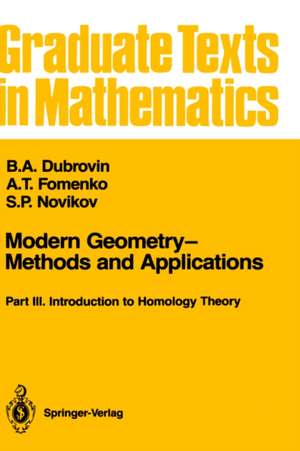
Modern Geometry-Methods and Applications: Graduate Texts in Mathematics, cartea 124
Autor B. A. Dubrovin, A. T. Fomenko, S. P. Novikov Traducere de Robert G. Burnsen Limba Engleză Hardback – 18 oct 1990
Observăm în ultimele decenii o transformare profundă a curriculei matematice, unde metodele geometrice și topologice ale teoriei varietăților au încetat să mai fie opționale, devenind piloni centrali în fizica teoretică și matematica pură. Modern Geometry-Methods and Applications reprezintă materializarea acestei tranziții, oferind un cadru riguros pentru tehnici care, până recent, erau considerate subiecte de nișă. Acest al treilea volum al seriei semnate de B. A. Dubrovin, A. T. Fomenko și S. P. Novikov se concentrează pe teoria omologiei, un instrument indispensabil pentru înțelegerea structurilor topologice complexe. Spre deosebire de primele două volume ale Modern Geometry- Methods and Applications, care puneau bazele calculului tensorial și variațional, acest tom avansează spre metodele contemporane de clasificare a varietăților. Structura sa este una progresivă, pornind de la rețete de calcul pentru coomologie și omologia complexelor algebrice, până la subiecte sofisticate precum dualitatea Poincaré în omologia simplicială și teoria omologiei pentru fibrate (produse strâmbe). Cititorii familiarizați cu Visual Geometry and Topology de Anatolij T. Fomenko vor aprecia aici rigoarea analitică ce completează intuiția vizuală, volumul de față fiind mult mai ancorat în formalismul algebric necesar cercetării. Ne-a atras atenția modul în care autorii reușesc să mențină un limbaj accesibil, în ciuda densității matematice, făcând legătura între grupurile de omologie și grupurile fundamentale ale suprafețelor. Comparativ cu abordarea lui Edwin H. Spanier din Algebraic Topology, lucrarea de față este mai strâns legată de aplicațiile fizice, integrând natural concepte precum formele diferențiale închise și invarianța la homotopie în contextul varietăților diferențiabile.
Din seria Graduate Texts in Mathematics
- 13%
 Preț: 407.97 lei
 -
 Preț: 526.10 lei
 - 15%
 Preț: 414.37 lei
 - 15%
 Preț: 403.03 lei
 - 15%
 Preț: 413.96 lei
 - 15%
 Preț: 530.03 lei
 - 15%
 Preț: 449.14 lei
 - 15%
 Preț: 532.83 lei
 - 15%
 Preț: 530.66 lei
 - 15%
 Preț: 501.17 lei
 - 15%
 Preț: 543.00 lei
 - 13%
 Preț: 406.00 lei
 -
 Preț: 446.38 lei
 - 15%
 Preț: 579.99 lei
 -
 Preț: 381.34 lei
 - 15%
 Preț: 455.36 lei
 - 15%
 Preț: 560.82 lei
 - 17%
 Preț: 453.24 lei
 - 15%
 Preț: 590.39 lei
 -
 Preț: 500.30 lei
 -
 Preț: 451.05 lei
 -
 Preț: 386.90 lei
 - 15%
 Preț: 614.52 lei
 - 15%
 Preț: 477.57 lei
 -
 Preț: 460.05 lei
 - 15%
 Preț: 498.36 lei
 -
 Preț: 504.56 lei
 - 18%
 Preț: 808.24 lei
 -
 Preț: 472.04 lei
 - 15%
 Preț: 621.81 lei
 -
 Preț: 398.40 lei
 - 15%
 Preț: 656.51 lei
 - 15%
 Preț: 602.39 lei
 - 15%
 Preț: 531.78 lei
 -
 Preț: 405.89 lei
Preț: 560.05 lei
Preț vechi: 658.88 lei
-15%
Carte tipărită la comandă
Livrare economică 07-21 decembrie
Specificații
ISBN-10: 0387972714
Pagini: 432
Ilustrații: X, 418 p.
Dimensiuni: 161 x 240 x 29 mm
Greutate: 0.76 kg
Ediția:1990
Editura: Springer
Colecția Graduate Texts in Mathematics
Seria Graduate Texts in Mathematics
Locul publicării:New York, NY, United States
V-ar putea interesa
-
 Trigonometry Demystified 2/EStan GibiliscoPreț: 213.91 lei
 -
 An Introductory Course in Commutative AlgebraA. W. Chatters-20%Preț: 362.22 lei450.89 lei
 -
 Finite Geometries, Buildings, and Related TopicsWilliam M. Kantor-21%Preț: 305.49 lei386.25 lei
 -
 Fractals: A User's Guide for the Natural SciencesHarold M. Hastings-29%Preț: 512.78 lei723.31 lei
 -
 Projective Geometry: An introductionRey Casse-28%Preț: 478.10 lei659.83 lei
 -
 Fractals: A Very Short IntroductionKenneth Falconer-20%Preț: 56.97 lei70.82 lei
 -
 Chaos and FractalsHeinz-Otto Peitgen-23%Preț: 724.70 lei941.16 lei
 -
 Fractals and Scaling in FinanceBenoit B. Mandelbrot-18%Preț: 1049.92 lei1280.39 lei
 -
 Geometry: Euclid and BeyondRobin HartshornePreț: 508.72 lei
 -
 -11%Preț: 496.78 lei558.19 lei
 -
 Topology from the Differentiable ViewpointJohn MilnorPreț: 375.92 lei
 -
 Topics in Critical Point TheoryKanishka Perera-11%Preț: 510.26 lei573.32 lei
 -
 Geometry For Dummies 3eMark RyanPreț: 115.96 lei
 -
 -15%Preț: 668.72 lei786.73 lei
 -
 The Foundations of GeometryDavid HilbertPreț: 69.28 lei
 -
 A Short Course in Computational Geometry and TopologyHerbert Edelsbrunner-15%Preț: 521.16 lei613.12 lei
 -
 Preț: 399.68 lei
 -
 Complex Geometry - an IntroductionDaniel Huybrechts-15%Preț: 504.56 lei593.61 lei
 -
 Geometry and PhysicsJürgen Jost-15%Preț: 489.53 lei575.92 lei
 -
 Computational GeometryMark de BergPreț: 441.16 lei
 -
 Gems of GeometryJohn Barnes-8%Preț: 420.17 lei456.71 lei
 -
 Preț: 505.55 lei
 -
 Non-metrisable ManifoldsDavid GauldPreț: 404.04 lei
Public țintă
Lower undergraduateDe ce să citești această carte
Este o resursă esențială pentru studenții și cercetătorii care doresc să stăpânească teoria omologiei într-un context modern. Volumul oferă nu doar demonstrații teoretice, ci și „rețete de calcul” practice pentru grupurile de coomologie, fiind ideal pentru cei care fac tranziția de la geometria clasică la topologia algebrică aplicată în fizica teoretică. Câștigați o perspectivă unificată asupra clasificării varietăților, susținută de expertiza unora dintre cei mai importanți matematicieni contemporani.