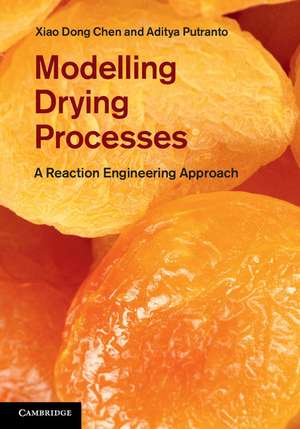
Modelling Drying Processes: A Reaction Engineering Approach
Autor Xiao Dong Chen, Aditya Putrantoen Limba Engleză Hardback – 22 mai 2013
Preț: 908.00 lei
Preț vechi: 1055.82 lei
-14%
Puncte Express: 1362
Carte tipărită la comandă
Livrare economică 09-23 iulie
Livrare prin curier în România Termenul estimat este afișat lângă disponibilitate.
Transport gratuit pentru acest produs Plată online sau ramburs, în funcție de opțiunile comenzii.
Retur gratuit în 14 zile Comandă securizată și suport în română.
Specificații
ISBN-13: 9781107012103
ISBN-10: 1107012104
Pagini: 252
Ilustrații: 134 b/w illus. 19 tables
Dimensiuni: 178 x 253 x 15 mm
Greutate: 0.64 kg
Ediția:New.
Editura: Cambridge University Press
Colecția Cambridge University Press
Locul publicării:New York, United States
ISBN-10: 1107012104
Pagini: 252
Ilustrații: 134 b/w illus. 19 tables
Dimensiuni: 178 x 253 x 15 mm
Greutate: 0.64 kg
Ediția:New.
Editura: Cambridge University Press
Colecția Cambridge University Press
Locul publicării:New York, United States
V-ar putea interesa
-
 Unit Operations of Chemical Engineering (Int'l Ed)Warren McCabe-26%Preț: 369.74 lei502.16 lei
 -
 -18%Preț: 1046.20 lei1275.86 lei
 -
 Bioprocess Engineering PrinciplesRoss Carlson-33%Preț: 577.49 lei867.31 lei
 -
 Elements of Chemical Reaction EngineeringBryan Goldsmith-23%Preț: 886.37 lei1151.13 lei
 -
 -23%Preț: 883.87 lei1147.88 lei
 -
 Adventures in FermentationJohnny DrainPreț: 143.41 lei
 -
 Unit Operations in Winery, Brewery, and Distillery DesignDavid E. Block-8%Preț: 410.17 lei445.83 lei
 -
 Thermoforming Modeling and SimulationFouad Erchiqui-9%Preț: 1111.41 lei1221.33 lei
 -
 Chemical, Biochemical, and Engineering ThermodynamicsStanley I. Sandler-19%Preț: 566.47 lei699.34 lei
 -
 Chemical Reaction EngineeringOctave Levenspiel-18%Preț: 1786.21 lei2178.31 lei
 -
 -19%Preț: 411.77 lei508.35 lei
 -
 -11%Preț: 622.75 lei699.72 lei
 -
 Incropera's Principles of Heat and Mass Transfer, Global EditionAdrienne S. Lavine-19%Preț: 456.39 lei563.44 lei
 -
 Fundamentals of Momentum, Heat, and Mass Transfer, EMEA EditionDavid G. FosterPreț: 459.56 lei
 -
 Transport Processes and Separation Process Principles, Global EditionChristie Geankoplis-8%Preț: 660.73 lei718.18 lei
 -
 -23%Preț: 645.49 lei838.29 lei
 -
 Advanced Computational Approaches for Drying in Food ProcessingKrunal M. Gangawane-18%Preț: 1073.10 lei1308.66 lei
 -
 -14%Preț: 961.53 lei1118.05 lei
 -
 Advanced Control Methods for Industrial ProcessesPablo A. López-Pérez-23%Preț: 674.96 lei876.57 lei
 -
 Mathematical Modeling and SimulationKai Velten-23%Preț: 687.26 lei892.54 lei
Cuprins
1. Introduction: 1.1. Practical background; 1.2. A 'microstructural' discussion of the phenomena of drying of moist porous materials; 1.3. The reaction engineering approach (REA) to modeling drying; 1.4. Summary; 2. Reaction Engineering Approach I: Lumped-REA: 2.1. The REA formulation; 2.2. Determination of REA model parameters; 2.3. Coupling the momentum, heat and mass balances; 2.4. Mass or heat transfer limiting; 2.5. Convective drying of particulates or thin layer products modeled using the L-REA; 2.6. Convective drying of thick samples modeled using the L-REA; 2.7. The intermittent drying of food materials modeled using the L-REA; 2.8. The intermittent drying under time-varying temperature and humidity modeled using the L-REA; 2.9. The heating of wood under linear-increased gas temperature modeled using the L-REA; 2.10. The baking of cake modeled using the L-REA; 2.11. The infrared-heating drying of a mixture of polymer solution under time-varying infrared-heating intensity modeled using the L-REA; 2.12. The intermittent drying of a mixture of polymer solution under time-varying infrared-heating intensity modeled using the L-REA; 2.13. Summary; 3. Reaction Engineering Approach II: Spatial-REA: 3.1. The spatial reaction engineering approach (S-REA) formulation; 3.2. Determination of the S-REA parameters; 3.3. The S-REA for convective drying; 3.4. The S-REA for intermittent drying; 3.5. The S-REA for wood heating under constant heating rate; 3.6. The S-REA for baking of bread; 3.7. Summary; 4. Comparisons of the REA with Fickian-Type Drying Theories, Luikov's and Whitaker's approach: 4.1. Model formulation; 4.2. Boundary conditions' controversies; 4.3. Diffusion-based model with the local evaporation rate; 4.4. Comparison of the diffusion-based model and the L-REA on the convective drying; 4.5. Comparison of the diffusion-based model and the S-REA on the convective drying; 4.6. Model formulation of Luikov's approach; 4.7. Model formulation of Whitaker's approach; 4.8. Comparison of the L-REA, Luikov's and Whitaker's approach for modeling heat treatment of wood under constant heating rate; 4.9. Comparison of the S-REA, Luikov's and Whitaker's approach for modeling heat treatment of wood under constant heating rate; 4.10. Summary.
Recenzii
'The REA is easy to use with the guidance of featured application examples given in this book … highly recommended for both academics and industry practitioners involved in any aspect of thermal drying.' Zhanyong Li, Tianjin University of Science and Technology
'An interesting book on a novel approach to mathematical modeling of an important process … a single comprehensive reference source.' Sakamon Devahastin, King Mongkut's University of Technology Thonburi
'… a profound [and] at the same time relatively easily implementable modelling approach to model and predict drying processes … a very fundamental and theoretically rigorous spatially distributed modelling approach …' Benu P. Adhikari, University of Ballarat, Australia
'An interesting book on a novel approach to mathematical modeling of an important process … a single comprehensive reference source.' Sakamon Devahastin, King Mongkut's University of Technology Thonburi
'… a profound [and] at the same time relatively easily implementable modelling approach to model and predict drying processes … a very fundamental and theoretically rigorous spatially distributed modelling approach …' Benu P. Adhikari, University of Ballarat, Australia
Descriere
A comprehensive summary of the state of the art in the reaction engineering approach to drying processes, including modelling, experimentation and applications.