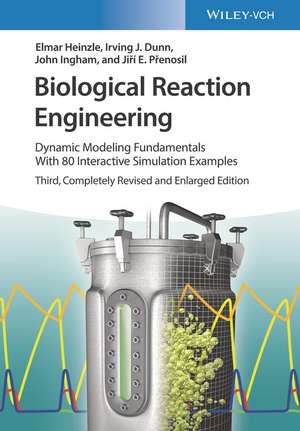
Biological Reaction Engineering 3e – Dynamic Modelling Fundamentals with 80 Interactive Simulation Examples
Autor E Heinzleen Limba Engleză Hardback – 21 apr 2021
În literatura academică dedicată biotehnologiei, observăm adesea o falie între teoria abstractă a cineticii enzimatice și aplicarea practică în ingineria proceselor la scară industrială. Biological Reaction Engineering 3e – Dynamic Modelling Fundamentals with 80 Interactive Simulation Examples completează exact această lacună, oferind un instrument de lucru care prioritizează înțelegerea fenomenologică în fața demonstrațiilor matematice dense. Remarcăm cum ediția a treia, revizuită și substanțial extinsă, reușește să integreze progresele recente din biologia sistemelor și ingineria metabolică, domenii esențiale pentru noua generație de biocombustibili și produse farmaceutice.
Structura volumului este riguros organizată în capitole ce pornesc de la formularea ecuațiilor de bilanț și cinetica microbiană, până la transportul de masă și controlul automat al bioproceselor. Această progresie logică permite cititorului să construiască modele complexe pentru bioreactoare de tip tank sau plug-flow, utilizând cele 80 de exemple interactive rulate în limbajul Berkeley Madonna. Putem afirma că volumul transformă procesul de învățare dintr-unul pasiv într-o experiență aplicată, unde rezultatele pot fi vizualizate simultan prin grafice multiple.
Lucrarea semnată de E Heinzle completează perspectiva oferită de Bioreaction Engineering de K. Schügerl, adăugând o componentă software mult mai accesibilă și un accent sporit pe dinamica sistemelor în timp real. În timp ce K. Schügerl se concentrează pe analiza fluxului metabolic la un nivel avansat, E Heinzle facilitează tranziția spre ingineria proceselor pentru studenți și ingineri chimiști, oferind soluții gata de utilizat pentru optimizarea productivității în industria bio-farmaceutică.
Preț: 959.72 lei
Preț vechi: 1115.95 lei
-14%
Carte disponibilă
Livrare economică 16-30 noiembrie
Livrare express 30 octombrie-05 noiembrie pentru 66.44 lei
Specificații
ISBN-10: 3527325247
Pagini: 560
Dimensiuni: 176 x 248 x 33 mm
Greutate: 1.23 kg
Ediția:3rd, Completely Revised and Enlarged Edition
Editura: Wiley Vch
Locul publicării:Weinheim, Germany
V-ar putea interesa
-
 Sequencing Technologies in Microbial Food Safety and QualityDevarajan Thangardurai-18%Preț: 1817.27 lei2216.18 lei
 -
 Agitator Design for Gas-Liquid Fermenters and BioreactorsGregory T Benz-9%Preț: 917.12 lei1007.81 lei
Public țintă
Students in Chemical Engineering, Students of Biotechnology, Chemical Engineers, Biotechnologists, Bioengineers, Process Engineers, Chemists in Industry, Biochemists, Chemical IndustryDe ce să citești această carte
Această ediție este indispensabilă studenților și profesioniștilor din ingineria proceselor care doresc să stăpânească modelarea dinamică fără a se pierde în complexitatea matematică. Câștigați o înțelegere practică a modului în care variabilele de proces influențează randamentul, utilizând simulări gata de rulat. Este resursa ideală pentru trecerea de la experimentul de laborator la producția industrială automatizată.
Despre autor
E Heinzle este un expert recunoscut în domeniul ingineriei reacțiilor biologice, cu o vastă experiență didactică și de cercetare acumulată în instituții de prestigiu. Specializarea sa acoperă intersecția dintre ingineria chimică și biotehnologie, având contribuții semnificative în dezvoltarea metodelor de monitorizare și control al bioproceselor. Prin această a treia ediție a lucrării sale fundamentale, autorul își valorifică expertiza în utilizarea instrumentelor informatice pentru simplificarea conceptelor complexe de cinetică și transfer de masă, facilitând formarea noilor generații de bioingineri.
Descriere scurtă
Madonna solves models comprising many ordinary differential equations using very simple programming, including arrays. It is so powerful that the model parameters may be defined as "sliders", which allow the effect of their change on the model behavior to be seen almost immediately. Data may be included for curve fitting, and sensitivity or multiple runs may be performed. The results can be viewed simultaneously on multiple–graph windows or by using overlays. The examples can be varied to fit any real situation, and the suggested exercises provide practical guidance.
The extensive teaching experience of the authors is reflected in this well–balanced presentation, which is suitable for the teacher, student, biochemist or the engineer.
Descriere
Biological reactions may be mediated by enzymes, and whole microbial, animal or plant cells are at the core of many processes and products in a wide range of industries, such as the food and beverage, health, pharmaceutical, environmental, and chemical industries. Biological engineering has gained in breadth as we have moved from traditional biological processes for chemicals and pharmaceuticals to modern biotech medicine, and to specialty chemicals for food and industrial use. At the same time, much progress has been made in systems biology and metabolic engineering leading to next generation processes for biofuels and chemicals. Biological engineering still represents the heart of the biotech industry, such that the scaling of high productivity processes as well as the increased use of automation is critical.
This practical book presents the modeling of dynamic biological engineering processes in a readily comprehensible manner, using the unique combination of simplified fundamental theory and direct hands–on computer simulation. The mathematics is kept to a minimum, and yet the 60 examples supplied on the web–server illustrate almost every aspect of biological engineering science, with each one described in detail, including the model equations. The programs are written in the modern user–friendly simulation language Berkeley Madonna, which runs on both Windows PC and Apple computers. The results may be viewed simultaneously on multiple–graph windows or by using overlays, and the examples varied to fit any real situation.
The authors? extensive teaching experience is reflected in this well–balanced presentation, which is suitable for teachers, students, biochemists or engineers.
Cuprins
PART I: Principles of Bioreactor Modelling
MODELLING PRINCIPLES
Fundamentals of Modelling
Formulation and Structuring of the Problem
Formulation of Balance Equations
BASIC BIOREACTOR CONCEPTS
Information for Bioreactor Modelling
Bioreactor Operation
BIOLOGICAL KINETICS
Enzyme Kinetics
Simple Microbial Kinetics
Structured Kinetic Models
BIOREACTOR MODELLING
General Balances for Tank–Type Biological Reactors
Modelling Tubular Plug Flow Bioreactors
MASS TRANSFER
Mass Transfer in Biological Reactors
Interphase Gas–Liquid Mass Transfer
General Oxygen Balances for Gas–Liquid Transfer
DIFFUSION AND BIOLOGICAL REACTION IN IMMOBILIZED BIOCATALYST SYSTEMS
External Mass Transfer
Internal Diffusion and Reaction within Biocatalysts
AUTOMATIC BIOPROCESS CONTROL FUNDAMENTALS
Elements of Feedback Control
Types of Controller Action
Advanced Control Strategies
Controller Tuning
Concepts for Bioprocess Control
BASICS OF CELL FACTORY MODELLING
Modularisation of Cell Modelling (Transport, Enzymatic Reactions, Enzyme Regulation, Expression Control, ...)
Compartmentation and Transport
Combination of Model Elements (Kinetics, Regulation, Induction, Repression, Transport, ...)
Cell Population Modelling
PART II: Modelling, Dynamic Simulation Examples, and the BERKELEY MADONNA Simulation Language
EXAMPLES OF MODEL SET UP
Introductory Examples
SIMULATION EXAMPLES OF BIOLOGICAL REACTION PROCESSES USING BERKELEY MADONNA
Introductory Examples
Batch Reactors
Fed Batch Reactors
Continuous Reactors
Oxygen Uptake Systems
Controlled Reactor
Diffusion Systems
Multi–Organism Models