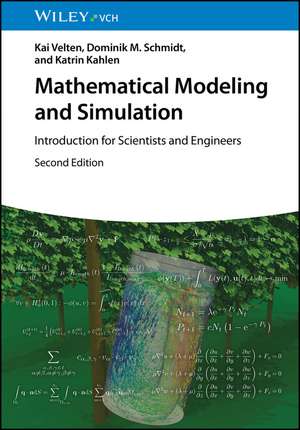
Mathematical Modeling and Simulation
Autor Kai Velten, Katrin Kahlen, Dominik M. Schmidten Limba Engleză Paperback – 7 aug 2024
În cadrul programelor de studiu din facultățile de inginerie, fizică și științe aplicate, tranziția de la teorie la rezolvarea problemelor din lumea reală necesită un cadru metodologic riguros. Mathematical Modeling and Simulation, scrisă de Kai Velten, Katrin Kahlen și Dominik M. Schmidt, se poziționează ca o resursă fundamentală pentru cursurile introductive de modelare, oferind o punte între abstracția matematică și aplicațiile practice. Ne-a atras atenția modul în care această a doua ediție, publicată de Wiley-VCH GmbH, reușește să extindă materialul original cu peste 200 de pagini, integrând tehnologii moderne esențiale pentru cercetarea contemporană. Specificul acestui volum rezidă în abordarea integrată: spre deosebire de textele care se limitează la o singură metodologie, autorii tratează simultan modele mecanice, statistice și hibride. Apreciem în mod deosebit includerea secțiunilor de „Crash Course” pentru R, Python și Maxima, care permit studenților să implementeze rapid simulări fără a necesita cursuri separate de programare. Cititorii familiarizați cu Introduction to Mathematical Modeling and Computer Simulations de Vladimir Mityushev vor aprecia în acest volum adâncimea tehnică sporită și accentul pus pe instrumente software profesionale, precum OpenFOAM sau Salome, oferite prin sistemul de operare dedicat, GmLinux. Structura este logică și progresivă, pornind de la definirea tipologiilor de modele și ajungând la estimarea parametrilor și validare. Deși necesită doar cunoștințe de bază de calcul și algebră, volumul nu evită complexitatea, detaliind structuri matematice ce variază de la statistică la ecuații diferențiale parțiale, aplicabile în domenii diverse, de la economie la inginerie electrică. Este un instrument de lucru care transformă modelarea dintr-o disciplină teoretică într-o competență tehnică aplicabilă imediat.
Preț: 628.05 lei
Preț vechi: 682.66 lei
-8%
Carte tipărită la comandă
Livrare economică 27 noiembrie-11 decembrie
Livrare express 22-28 octombrie pentru 118.64 lei
Specificații
ISBN-10: 3527414142
Pagini: 496
Ilustrații: 7 schwarz-weiße Abbildungen, 9 schwarz-weiße Tabellen
Dimensiuni: 168 x 242 x 27 mm
Greutate: 0.96 kg
Ediția:2. Auflage
Editura: Wiley-VCH GmbH
Locul publicării:Weinheim, Germany
V-ar putea interesa
-
 AQA Physics: A Level Year 2Jim Breithaupt-24%Preț: 288.16 lei380.89 lei
 -
 Physical Laws of the Mathematical UniverseNeeti SinhaPreț: 278.14 lei
 -
 Statistische Physik und ThermodynamikWalter GrimusPreț: 284.59 lei
 -
 Materialien und SystemeUwe HartmannPreț: 420.17 lei
 -
 Preț: 300.39 lei
 -
 Preț: 87.57 lei
 -
 Explicit solvent effects on protein physicsGiovanni SalviPreț: 369.51 lei
 -
 -8%Preț: 459.66 lei499.63 lei
 -
 Applications of SR-TXRF Analysis in XASFlorian Meirer-8%Preț: 521.21 lei566.53 lei
 -
 -8%Preț: 409.93 lei445.58 lei
 -
 Protein structure prediction and folding dynamicsKatrin WolffPreț: 344.28 lei
 -
 -8%Preț: 528.00 lei573.91 lei
 -
 Charged colloids as model systems for metalsIna KlassenPreț: 358.50 lei
 -
 Magnetization Dynamics in Spin ValvesFrederik WegelinPreț: 344.53 lei
 -
 CRESST-II Dark Matter ExperimentPatrick Huff-8%Preț: 469.29 lei510.09 lei
 -
 MINT-WigrisGudrun Kalmbach H. E.-15%Preț: 453.68 lei533.74 lei
 -
 Geodèsia físicaJoan Josep Martinez-BenjaminPreț: 141.54 lei
 -
 MODE PHY & TECH UNDERGRA (2ND ED)Folan Lorcan MPreț: 456.05 lei
 -
 MODE PHY & TECH UNDERGRA (2ND ED)Folan Lorcan MPreț: 237.71 lei
 -
 A VOICE FOR SCIENCE IN THE SOUTHSchaffer DanielPreț: 400.78 lei
De ce să citești această carte
Această ediție a doua este ideală pentru studenții de licență și practicienii care doresc să stăpânească întregul flux al modelării matematice. Cititorul câștigă nu doar baze teoretice solide, ci și competențe practice de programare în Python și R prin intermediul resurselor software incluse. Este o recomandare excelentă pentru cei care caută o metodologie clară de validare a modelelor folosind exclusiv instrumente open source gratuite.
Descriere
Notă biografică
Dominik Schmidt holds M.Sc. (Beverage Technology) and PhD (Agriculture) degrees obtained from Hochschule Geisenheim University and University of Gießen. Working in the Department of Modeling and Systems Analysis of Hochschule Geisenheim University since 2013, he performed a broad range of research projects in the fields of data science, mathematical modeling and computational fluid dynamics.
Katrin Kahlen is a mathematician working at Hochschule Geisenheim University since 2011. She holds PhD (Mathematics) and habilitation (Agronomy) degrees obtained from University of Hannover and became Adjunct Professor at Hochschule Geisenheim University in 2021. She is particularly interested in modeling and simulation of plant-environment interactions, and the development and use of virtual plants.
Cuprins
1 PRINCIPLES OF MATHEMATICAL MODELING
1.1 A Complex World Needs Models
1.2 Systems, Models, Simulations
1.3 Mathematics as a Natural Modeling Language
1.4 Definition of Mathematical Models
1.5 Examples and Some More Definitions
1.6 Even More Definitions
1.7 Classification of Mathematical Models
1.8 Everything Looks Like a Nail?
2 PHENOMENOLOGICAL MODELS
2.1 Elementary Statistics
2.2 Linear Regression
2.3 Multiple Linear Regression
2.4 Nonlinear Regression
2.5 Smoothing Splines
2.6 Neural Networks
2.7 Big Data Analysis
2.8 Signal Processing
2.9 Design of Experiments
2.10 Other Phenomenological Modeling Approaches
3 MECHANISTIC MODELS I: ODES
3.1 Distinguished Role of Differential Equations
3.2 Introductory Examples
3.3 General Idea of ODE?s
3.4 Setting Up ODE Models
3.5 Some Theory You Should Know
3.6 Solution of ODE?s: Overview
3.7 Closed Form Solutions
3.8 Numerical Solutions
3.9 Fitting ODE?s to Data
3.10 More Examples
4 MECHANISTIC MODELS II: PDES
4.1 Introduction
4.2 The Heat Equation
4.3 Some Theory You Should Know
4.4 Closed Form Solutions
4.5 Numerical Solution of PDE?s
4.6 The Finite Difference Method
4.7 The Finite Element Method
4.8 The Finite Volume Method
4.9 Software packages to solve PDEs
4.10 A Sample Session on the Numerical Solution of Thermal Conduction
4.11 A Look Beyond the Heat Equation
4.12 Computational Fluid Dynamics (CFD)
4.13 Numerical solutions of exaple flow problems
5 VIRTUALIZATION
5.1 Introduction
5.2 Virtual Plants
5.3 Examples of Advanced Applications
6 CRASH COURSES AND BOOK SOFTWARE
6.1 Crashcourse R
6.2 Crashcourse Maxima
6.3 CrashCrashcourse Python (and all the rest)
6.4 Book software and GmLinux
References
Index