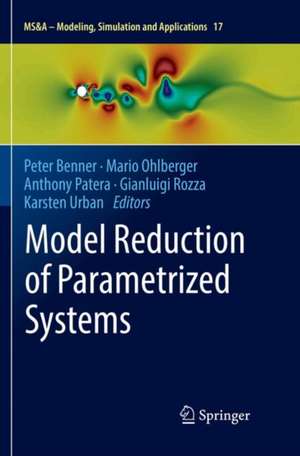
Model Reduction of Parametrized Systems: MS&A, cartea 17
Editat de Peter Benner, Mario Ohlberger, Anthony Patera, Gianluigi Rozza, Karsten Urbanen Limba Engleză Paperback – 10 aug 2018
Lucrarea Model Reduction of Parametrized Systems, publicată sub egida editurii Springer, reprezintă o sinteză de referință a ultimilor 12 ani de progrese în domeniul metodelor de reducere a ordinii modelelor. Ne-a atras atenția modul în care acest volum colectiv reușește să unifice concepte diverse — de la metodele bazei reduse și descompunerea ortogonală proprie, până la tehnici de învățare automată și „compressed sensing” — oferind o perspectivă de ansamblu asupra sistemelor parametrizate complexe.
Putem afirma că volumul depășește sfera teoretică pură, integrând capitole dedicate aplicațiilor industriale reale. Structura este riguroasă, debutând cu tratarea timpului în metodele de bază redusă (RB) și evoluând spre probleme de control optimal, elasticitate liniară și vibroacustică. Merită menționat că, deși nu este un manual în sens tradițional, conținutul este organizat astfel încât secțiunile pot servi drept note de curs pentru școlile doctorale sau masteratele de analiză numerică.
În contextul operei editorului Peter Benner, această lucrare completează titluri precum Realization and Model Reduction of Dynamical Systems, unde accentul era pus pe teoria sistemelor și controlului. Aici, perspectiva este extinsă către sisteme guvernate de ecuații cu derivate parțiale (PDE) și probleme multifizice cuplate. Ca alternativă la Reduced Order Methods for Modeling and Computational Reduction de Alfio Quarteroni pentru cursurile de modelare computațională, acest volum aduce avantajul unei acoperiri tematice mai largi, incluzând metode recente de aproximare prin wavelet și scheme semi-implicite pentru interacțiunea fluid-structură. Tonul este unul de înaltă specializare, reflectând eforturile unei comunități globale de cercetare în plină expansiune.
Din seria MS&A
- 24%
 Preț: 965.69 lei
 -
 Preț: 404.31 lei
 - 15%
 Preț: 675.97 lei
 -
 Preț: 398.38 lei
 - 15%
 Preț: 676.20 lei
 - 15%
 Preț: 608.87 lei
 -
 Preț: 408.17 lei
 - 15%
 Preț: 692.40 lei
 - 18%
 Preț: 940.01 lei
 - 15%
 Preț: 731.65 lei
 - 18%
 Preț: 905.27 lei
 - 18%
 Preț: 1050.52 lei
 -
 Preț: 494.72 lei
 -
 Preț: 407.91 lei
 - 15%
 Preț: 670.74 lei
 -
 Preț: 380.62 lei
 -
 Preț: 390.25 lei
 - 15%
 Preț: 559.65 lei
 - 15%
 Preț: 672.46 lei
Preț: 858.21 lei
Preț vechi: 1129.21 lei
-24%
Carte tipărită la comandă
Livrare economică 30 noiembrie-07 decembrie
Specificații
ISBN-10: 3319864750
Pagini: 516
Ilustrații: XII, 504 p.
Dimensiuni: 155 x 235 x 28 mm
Greutate: 0.77 kg
Ediția:Softcover reprint of the original 1st edition 2017
Editura: Springer
Colecția MS&A
Seria MS&A
Locul publicării:Cham, Switzerland
V-ar putea interesa
-
 SimulationSheldon M. Ross-32%Preț: 510.77 lei749.22 lei
 -
 Deterministic and Stochastic Optimal Control and Inverse ProblemsBaasansuren JadambaPreț: 444.23 lei
 -
 -35%Preț: 521.26 lei795.90 lei
 -
 Data-Driven Science and EngineeringSteven L. Brunton-22%Preț: 385.43 lei496.40 lei
 -
 Interpolatory Methods for Model ReductionAthanasios C. Antoulas-9%Preț: 642.38 lei705.92 lei
 -
 Recent Advances in Pure and Applied MathematicsFrancisco Ortegón GallegoPreț: 404.07 lei
 -
 Realization and Model Reduction of Dynamical SystemsChristopher Beattie-18%Preț: 794.14 lei968.46 lei
 -
 Model Order Reduction and ApplicationsMichael Hinze-17%Preț: 404.51 lei487.36 lei
 -
 Robust and Adaptive ControlEugene LavretskyPreț: 542.07 lei
 -
 Real Time Reduced Order Computational MechanicsGianluigi Rozza-18%Preț: 754.93 lei920.66 lei
 -
 Select Ideas in Partial Differential EquationsPeter J. Costa-15%Preț: 612.08 lei720.09 lei
 -
 -18%Preț: 1267.69 lei1545.95 lei
 -
 -18%Preț: 1043.99 lei1273.16 lei
 -
 Applied Numerical Methods for Partial Differential EquationsCarl L. GardnerPreț: 474.24 lei
 -
 Automotive Air ConditioningQuansheng Zhang-9%Preț: 712.95 lei783.46 lei
 -
 Advanced Control Methods for Industrial ProcessesPablo A. López-Pérez-23%Preț: 698.89 lei907.65 lei
 -
 -24%Preț: 729.90 lei960.39 lei
De ce să citești această carte
Această resursă este esențială pentru cercetătorii și inginerii care lucrează cu simulări numerice de înaltă fidelitate, unde reducerea costului computațional este critică. Cititorul câștigă acces la metodologii de ultimă oră pentru optimizarea și controlul sistemelor complexe, precum și la dovezi matematice privind controlul erorilor. Este o recomandare certă pentru bibliotecile departamentelor de matematică aplicată și inginerie mecanică.
Despre autor
Editorii acestui volum, printre care se numără Peter Benner și Gianluigi Rozza, sunt figuri centrale în matematica numerică europeană. Peter Benner este director la Institutul Max Planck pentru Dinamica Sistemelor Tehnice Complexe, fiind recunoscut pentru contribuțiile sale fundamentale în modelarea sistemelor dinamice și optimizare. Gianluigi Rozza este profesor la SISSA, specializat în metode de reducere a ordinii pentru mecanica fluidelor. Experiența lor cumulată garantează rigoarea științifică a celor 12 capitole, transformând această lucrare într-un pilon al seriei MS&A.
Descriere scurtă
The book represents the state of the art in the development of reduced order methods. It contains contributions from internationally respected experts, guaranteeing a wide range of expertise and topics. Further, it reflects an important effor
t, carried out over the last 12 years, to build a growing research community in this field.
Though not a textbook, some of the chapters can be used as reference materials or lecture notes for classes and tutorials (doctoral schools, master classes).
Cuprins
PDEs defined on domains with variable shape.- 13 Localized Reduced Basis Approximation of a Nonlinear Finite Volume Battery Model with Resolved Electrode Geometry.- 14 A-posteriori error estimation of discrete POD models for PDE-constrained optimal control.- 15 Hi-POD solution of parametrized fluid dynamics problems: preliminary results.- 16 Adaptive sampling for nonlinear dimensionality reduction based on manifold learning.- 17 Cross-Gramian-Based Model Reduction: A Comparison.- 18 Truncated Gramians for Bilinear Systems and their Advantages in Model Order Reduction.- 19 Leveraging Sparsity and Compressive Sensing for Reduced Order Modeling.- 20 A HJB-POD approach to the control of the level set equation.- 21 Model order reduction approaches for infinite horizon optimal control problems via the HJB equation.- 22 Interpolatory methods for H model reduction of multi-input/multi-output systems.- 23 Model reduction of linear time-varying systems with applications for moving loads.- 24 Interpolation Strategy for BT-based Parametric MOR of Gas Pipeline-Networks.- 25 Energy stable model order reduction for the Allen-Cahn equation.- 26 MOR-based Uncertainty Quantification in Transcranial Magnetic Stimulation.- 27 Model Order Reduction of Nonlinear Eddy Current Problems using Missing Point Estimation.- 28 On Efficient Approaches for Solving a Cake Filtration Model under Parameter Variation.- 29 Model reduction for coupled near-well and reservoir models using multiple space-time discretizations.- 30 Time-dependent Parametric Model Order Reduction for Material Removal Simulations
Notă biografică
Mario Ohlberger is a Full Professor of Applied Mathematics and Managing Director of Applied Mathematics at the University of Münster’s Institute of Analysis and Numerics. He is an Associate Editor of five mathematical journals, including SIAM Journal on Scientific Computing. He is a member of the Center for Nonlinear Science, the Center for Multiscale Theory and Computation, and the Cluster of Excellence “Cells in Motion”.
Anthony T. Patera is the Ford Professor of Engineering and a Professor of Mechanical Engineering at MIT, and Co-Director of the MIT Center for Computational Engineering. His research interests include partial differential equations, computational methods, model order reduction, a posteriori error estimation, and data assimilation. Professor Patera holds SB and SM degrees in Mechanical Engineering from MIT, and a PhD in Applied Mathematics, also from MIT. He served as Co-Editor-in-Chief of the journal Mathematical Modeling and Numerical Analysis from 2003 to 2012.