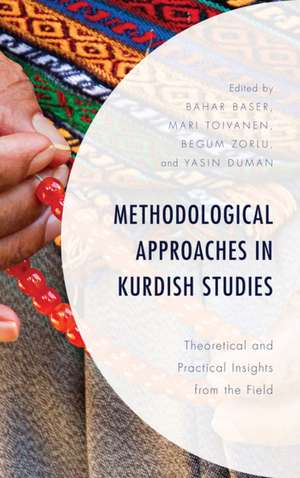
Methodological Approaches in Kurdish Studies: Theoretical and Practical Insights from the Field: Kurdish Societies, Politics, and International Relations
Editat de Bahar Baser, Mari Toivanen, Begum Zorlu, Yasin Duman Contribuţii de Yasemin Gulsum Acar, Polat Alpman, Demet Arpacik, Lana Askari, Marlies Casier, Semih Celik, Vera Eccarius-Kelly, Joost Jongerden, Jowan Mahmod, Yesim Mutlu, Francis O’Connor, Thomas Schmidinger, Marlene Schäfers, Ozden Melis Ulug, Marc Sinan Winrowen Limba Engleză Hardback – 6 noi 2018
This volume is multidisciplinary in its focus and approach. It includes contributions from scholars from various disciplinary backgrounds, ranging from sociology and political science to social psychology and anthropology. The complexity of security situations, and the atmospheres of distrust and suspicion have led the contributors to be creative and to adapt their research methods in ways that at times transcend disciplinary boundaries and conventions. Relatedly, the contributions also open the often-considered Pandora's box of discussing the failures in what is often a "messy" research field, and how to adopt one's methods to rapidly changing political circumstances. This necessitates greater reflexivity in existing power relations of the surrounding context and how those affect not only the interaction situations between the researcher and the participants, but also raise questions for the overall research process, concerning namely social justice, representation and knowledge production. The contributions unravel this by unpacking positionalities beyond ethnicities, discussing how gendered and other positionalities are constructed in fieldwork interactions and by illustrating how the surrounding structures of power and dominance are present in every-day fieldwork.
What differentiates this book from the existing literature is that it is the first academic endeavor that solely focuses on methodological reflections aimed to the field of Kurdish Studies. It offers a comprehensive and multidisciplinary account of scholars' fieldwork experiences in the Kurdish regions and as such, it is also of value to scholars conducting or about to conduct fieldwork in conflict regions elsewhere.
Din seria Kurdish Societies, Politics, and International Relations
- 28%
 Preț: 222.52 lei
 - 33%
 Preț: 549.03 lei
 - 33%
 Preț: 582.68 lei
 - 36%
 Preț: 526.41 lei
 - 27%
 Preț: 254.72 lei
 - 32%
 Preț: 551.50 lei
 - 27%
 Preț: 255.71 lei
 - 26%
 Preț: 280.53 lei
 - 25%
 Preț: 174.88 lei
 - 36%
 Preț: 525.78 lei
 - 26%
 Preț: 281.03 lei
 - 30%
 Preț: 534.96 lei
 - 35%
 Preț: 625.26 lei
 - 33%
 Preț: 516.98 lei
 - 14%
 Preț: 571.14 lei
 - 27%
 Preț: 254.12 lei
 - 27%
 Preț: 256.41 lei
 - 36%
 Preț: 523.56 lei
 - 31%
 Preț: 463.17 lei
 - 28%
 Preț: 220.75 lei
 - 36%
 Preț: 525.61 lei
 - 33%
 Preț: 516.88 lei
 - 31%
 Preț: 526.57 lei
 - nou
 Preț: 551.54 lei
Preț: 585.45 lei
Preț vechi: 680.75 lei
-14%
Puncte Express: 878
Carte tipărită la comandă
Livrare economică 20 noiembrie-04 decembrie
Livrare prin curier în România Termenul estimat este afișat lângă disponibilitate.
Transport gratuit pentru acest produs Plată online sau ramburs, în funcție de opțiunile comenzii.
Retur gratuit în 14 zile Comandă securizată și suport în română.
Specificații
ISBN-13: 9781498575218
ISBN-10: 1498575218
Pagini: 284
Ilustrații: 1 b/w illustrations;
Dimensiuni: 152 x 230 x 24 mm
Greutate: 0.64 kg
Editura: Bloomsbury Publishing
Colecția Lexington Books
Seria Kurdish Societies, Politics, and International Relations
Locul publicării:New York, United States
ISBN-10: 1498575218
Pagini: 284
Ilustrații: 1 b/w illustrations;
Dimensiuni: 152 x 230 x 24 mm
Greutate: 0.64 kg
Editura: Bloomsbury Publishing
Colecția Lexington Books
Seria Kurdish Societies, Politics, and International Relations
Locul publicării:New York, United States
V-ar putea interesa
-
 Schooling the Symbolic Animal: Social and Cultural Dimensions of EducationBradley A. U. Levinson-21%Preț: 354.18 lei450.27 lei
 -
 Globalization, the State, and ViolenceJonathan Friedman-21%Preț: 365.11 lei465.06 lei
 -
 Ethics and the Profession of Anthropology: Dialogue for Ethically Conscious PracticeCarolyn Fluehr-Lobban-19%Preț: 324.41 lei399.54 lei
 -
 -20%Preț: 320.75 lei399.77 lei
 -
 -11%Preț: 325.74 lei364.34 lei
 -
 A Natural History of the Brown Mouse LemurSylvia Atsalis-18%Preț: 1467.42 lei1789.53 lei
 -
 A World Full of WomenMartha C. Ward-18%Preț: 1475.69 lei1799.62 lei
 -
 Kinship in Action: Self and GroupAndrew Strathern-18%Preț: 1471.50 lei1794.51 lei
 -
 Men in GroupsLionel Tiger-18%Preț: 1266.85 lei1544.94 lei
 -
 Rural Vietnam: The Small World of Khanh HauJames B. Hendry-18%Preț: 1112.48 lei1356.68 lei
 -
 Structure and Change in Indian SocietyBernard S. Cohn-18%Preț: 1272.95 lei1552.38 lei
 -
 The Domestication and Exploitation of Plants and AnimalsG. W. Dimbleby-18%Preț: 1248.98 lei1523.15 lei
 -
 Cultural Change from a Business Anthropology PerspectiveMaryann McCabe-35%Preț: 681.03 lei1055.29 lei
 -
 -33%Preț: 550.78 lei816.13 lei
 -
 Kurdish Alevis and the Case of DersimErdal Gezik-15%Preț: 647.91 lei762.25 lei
 -
 Shackled Sentiments: Slaves, Spirits, and Memories in the African DiasporaEric J. Montgomery-32%Preț: 583.67 lei864.29 lei
 -
 From Classic to ContemporaryOrit Tamir-23%Preț: 703.88 lei914.13 lei
Cuprins
Ch. 1: Critical Ethnography: Emancipatory Knowledge And Alternative Dialogues
Vera Eccarius-Kelly
Ch. 2: Living Structures: Methodological Considerations On People And Place
Joost Jongerden
Ch. 3: Online-Offline Research On Diasporic Identities: Methodological Benefits, Challenges and Critical Insights
Jowan Mahmod
Ch. 4: Tracing Global History Through The Kurds In The Imperial And National Archives And Beyond
Marc Sinan Winrow
Ch. 5: Troubled Terrain: Lines of Allegiance and Political Belonging in Northern Kurdistan
Marlene Schäfers
Ch. 6: Working Upon the Communities under the Political Domination: Subaltern Kurds in Turkey
Polat Alpman
Ch. 7: Feeling Solidarity in An Estranged City: Ethnography In The Post-War Diyarbakir Under Surveillance
Demet Arpacik
Ch. 8: Outsiders Twice Over in Kurdistan
Francis O'Connor And Semih Celik
Ch. 9: The Omnipresent Absentee? Challenges In Researching The Kurdistan Workers' Party In Europe And Turkey
Marlies Casier
Ch. 10: "She's Turkish but Good": Researching On Kurdish Internal Displacement As A 'Turkish' Female Researcher
Yesim Mutlu
Ch. 11: Straddling The Insider-Outsider Divide: Challenges Of Turkish Identity As An Outsider Researcher In The Kurdish Context
Yasemin Gulsum Acar And Ozden Melis Ulug
Ch. 12: Beyond The Insider-Outsider Dichotomy: Conducting Ethnographic Fieldwork As A Kurdish Returnee In Iraqi Kurdistan
Lana Askari
Ch. 13: Embedded Research and Political Violence: Kurdish Studies In Conflict Areas
Thomas Schmidinger
Conclusion: Reflections on Research: Challenges And Opportunities
Begum Zorlu and Yasin Duman
Vera Eccarius-Kelly
Ch. 2: Living Structures: Methodological Considerations On People And Place
Joost Jongerden
Ch. 3: Online-Offline Research On Diasporic Identities: Methodological Benefits, Challenges and Critical Insights
Jowan Mahmod
Ch. 4: Tracing Global History Through The Kurds In The Imperial And National Archives And Beyond
Marc Sinan Winrow
Ch. 5: Troubled Terrain: Lines of Allegiance and Political Belonging in Northern Kurdistan
Marlene Schäfers
Ch. 6: Working Upon the Communities under the Political Domination: Subaltern Kurds in Turkey
Polat Alpman
Ch. 7: Feeling Solidarity in An Estranged City: Ethnography In The Post-War Diyarbakir Under Surveillance
Demet Arpacik
Ch. 8: Outsiders Twice Over in Kurdistan
Francis O'Connor And Semih Celik
Ch. 9: The Omnipresent Absentee? Challenges In Researching The Kurdistan Workers' Party In Europe And Turkey
Marlies Casier
Ch. 10: "She's Turkish but Good": Researching On Kurdish Internal Displacement As A 'Turkish' Female Researcher
Yesim Mutlu
Ch. 11: Straddling The Insider-Outsider Divide: Challenges Of Turkish Identity As An Outsider Researcher In The Kurdish Context
Yasemin Gulsum Acar And Ozden Melis Ulug
Ch. 12: Beyond The Insider-Outsider Dichotomy: Conducting Ethnographic Fieldwork As A Kurdish Returnee In Iraqi Kurdistan
Lana Askari
Ch. 13: Embedded Research and Political Violence: Kurdish Studies In Conflict Areas
Thomas Schmidinger
Conclusion: Reflections on Research: Challenges And Opportunities
Begum Zorlu and Yasin Duman
Recenzii
This book is a timely and much-needed contribution to the growing literature on methodological and ethical challenges involved in conducting research in conflict settings. With a wide range of outstanding contributions from leading scholars, the volume fills an important gap on how ethnographic knowledge is primarily shaped by power relations. It serves as a stark reminder of the need to go beyond a standardized, one-size-fits-all approach to studying complex conflict environments. It is a vital resource for students and scholars of Kurdish studies, Middle Eastern studies, and those interested in conducting research in conflict zones.
Methodological Approaches in Kurdish Studies: Theoretical and Practical Insights from the Field is not only a must read for those interested in Kurdish Studies, but is a reference book for doing research in politically sensitive and unstable contexts. Contributors from various social science disciplines present objective and creative methodologies spanning from ethnographic to archival data. It is the first book in Kurdish Studies on the practical, ethical, theoretical, epistemological, and methodological challengesresearchers face and the innovative solutions they come up with while working in and about the "stateless" Kurds in Turkey, Syria, Iraq and diaspora.
This massive volume not only opens new methodological, theoretical and epistemological avenues in the Kurdish studies, but also questions the very meaning of producing social sciences on the "risky" topics of the 21st Century.
For understandable reasons, the field of Kurdish Studies has long been dominated by an overt focus on the politics of the Kurdish Question and Kurdish identity. This has, however, resulted in the neglect of other important areas that merit scholarly attention. For some time, Kurdish studies has lacked self-reflective, critical research on the practice and politics of knowledge production within this field. This well-written edited volume, the first of its kind, makes a timely contribution to our understanding of the practical, methodological and epistemological challenges faced by scholars of Kurdish Studies.
Methodological Approaches in Kurdish Studies: Theoretical and Practical Insights from the Field is not only a must read for those interested in Kurdish Studies, but is a reference book for doing research in politically sensitive and unstable contexts. Contributors from various social science disciplines present objective and creative methodologies spanning from ethnographic to archival data. It is the first book in Kurdish Studies on the practical, ethical, theoretical, epistemological, and methodological challengesresearchers face and the innovative solutions they come up with while working in and about the "stateless" Kurds in Turkey, Syria, Iraq and diaspora.
This massive volume not only opens new methodological, theoretical and epistemological avenues in the Kurdish studies, but also questions the very meaning of producing social sciences on the "risky" topics of the 21st Century.
For understandable reasons, the field of Kurdish Studies has long been dominated by an overt focus on the politics of the Kurdish Question and Kurdish identity. This has, however, resulted in the neglect of other important areas that merit scholarly attention. For some time, Kurdish studies has lacked self-reflective, critical research on the practice and politics of knowledge production within this field. This well-written edited volume, the first of its kind, makes a timely contribution to our understanding of the practical, methodological and epistemological challenges faced by scholars of Kurdish Studies.