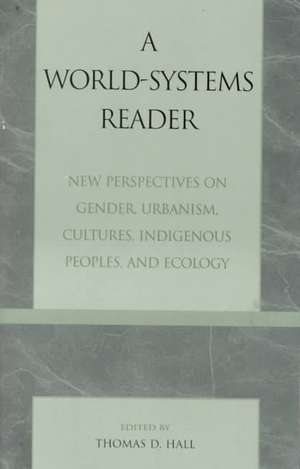
A World-Systems Reader: New Perspectives on Gender, Urbanism, Cultures, Indigenous Peoples, and Ecology
Contribuţii de Tim Bartley, Albert Bergesen, Terry Boswell, Christopher Chase-Dunn, Wilma A. Dunaway, Stephen W. K. Chiu, Colin Flint, Peter Grimes, Thomas D. Hall, Leslie S. Laczko, Joya Misra, Peter N. Peregrine, Fred M. Shelley, David A. Smith, Alvin Y. So, Yodit Solomon, Elon Stander, Debra Straussfogel, William R. Thompson, Carol Warden Limba Engleză Paperback – mar 2000
Preț: 320.75 lei
Preț vechi: 399.77 lei
-20%
Puncte Express: 481
Carte tipărită la comandă
Livrare economică 26 noiembrie-10 decembrie
Livrare prin curier în România Termenul estimat este afișat lângă disponibilitate.
Transport gratuit de la 400.00 lei Plată online sau ramburs, în funcție de opțiunile comenzii.
Retur gratuit în 14 zile Comandă securizată și suport în română.
Specificații
ISBN-13: 9780847691845
ISBN-10: 0847691845
Pagini: 352
Dimensiuni: 142 x 218 x 20 mm
Greutate: 0.43 kg
Ediția:0352
Editura: Bloomsbury Publishing
Colecția Rowman & Littlefield
Locul publicării:New York, United States
ISBN-10: 0847691845
Pagini: 352
Dimensiuni: 142 x 218 x 20 mm
Greutate: 0.43 kg
Ediția:0352
Editura: Bloomsbury Publishing
Colecția Rowman & Littlefield
Locul publicării:New York, United States
V-ar putea interesa
-
 Endangered Languages of AustronesiaMargaret Florey-33%Preț: 1187.57 lei1766.39 lei
 -
 The Manambu Language of East Sepik, Papua New GuineaAlexandra Aikhenvald-21%Preț: 539.86 lei686.82 lei
 -
 Creativity and Cultural ProductionP. McIntyrePreț: 392.81 lei
 -
 The Most Dangerous AnimalDavid Livingstone SmithPreț: 123.33 lei
 -
 Introduction to SyndemicsMerrill Singer-5%Preț: 667.39 lei702.51 lei
 -
 Haddon the Head HunterA. C. Hingston QuigginPreț: 169.09 lei
 -
 Preț: 227.53 lei
 -
 People of the Lakes: Stories of Our Van Tat Gwich’in Elders/Googwandak Nakhwach’ànjòo Van Tat Gwich’inVuntut Gwitchin First Nation-18%Preț: 266.51 lei323.92 lei
 -
 SaharasiaJames DemeoPreț: 284.03 lei
 -
 Anthropology as EthicsT. M. S. (Terry) EvensPreț: 307.59 lei
 -
 -23%Preț: 165.07 lei215.16 lei
 -
 -17%Preț: 113.73 lei136.50 lei
Cuprins
Chapter 1 Introduction: World-Systems Analysis: A Small Sample from a Large Universe
Chapter 2 Recent Research in World-Systems Analysis
Part 3 From Many Disciplines
Chapter 4 Archaeology and World-Systems Theory
Chapter 5 Geography & World-Systems Analysis
Chapter 6 K-Waves, Leadership Cycles, and Global War: A Non-Hyphenated Approach to World Systems Analysis
Chapter 7 Gender and the World-System: Engaging the Feminist Literature on Development
Part 8 World-System Overviews
Chapter 9 Canada's Linguistic and Ethnic Dynamics in an EvolvingWorld-System
Chapter 10 Urbanization in the World-System: A Retrospective and Prospective Look
Chapter 11 World-Systems Theory in the Context of Systems Theory: An Overview
Chapter 12 Postmodernism Explained
Part 13 Gender, Urbanism, Cultures, Indigenous Peoples, and Ecology
Chapter 14 Women at Risk: Capitalist Incorporation and Community Transformation on the Cherokee Frontier
Chapter 15 Resistance Through Healing among American Indian Women
Chapter 16 World-Systems, Frontiers, and Ethnogenesis: Rethinking the Theories
Chapter 17 Modern East Asia in World-Systems Analysis
Part 18 Future Visions
Chapter 19 Spiral of Socialism and Capitalism
Chapter 20 World System and Ecosystem
Chapter 2 Recent Research in World-Systems Analysis
Part 3 From Many Disciplines
Chapter 4 Archaeology and World-Systems Theory
Chapter 5 Geography & World-Systems Analysis
Chapter 6 K-Waves, Leadership Cycles, and Global War: A Non-Hyphenated Approach to World Systems Analysis
Chapter 7 Gender and the World-System: Engaging the Feminist Literature on Development
Part 8 World-System Overviews
Chapter 9 Canada's Linguistic and Ethnic Dynamics in an EvolvingWorld-System
Chapter 10 Urbanization in the World-System: A Retrospective and Prospective Look
Chapter 11 World-Systems Theory in the Context of Systems Theory: An Overview
Chapter 12 Postmodernism Explained
Part 13 Gender, Urbanism, Cultures, Indigenous Peoples, and Ecology
Chapter 14 Women at Risk: Capitalist Incorporation and Community Transformation on the Cherokee Frontier
Chapter 15 Resistance Through Healing among American Indian Women
Chapter 16 World-Systems, Frontiers, and Ethnogenesis: Rethinking the Theories
Chapter 17 Modern East Asia in World-Systems Analysis
Part 18 Future Visions
Chapter 19 Spiral of Socialism and Capitalism
Chapter 20 World System and Ecosystem
Recenzii
The strength of this book remains the variety of themes that it explains through a world systems theory approach.
A World-Systems Reader extends the theoretical territory of world systems theory by bringing it up to date in terms of exploring its relationship to postmodernism, ecology, and globalism. As a result of its breadth, it provides a good introductory text.
The book offers perspective on the different views of its contributors and makes the debates among them more visible. This makes the book useful to graduate students entering these contested fields and useful to scholars already campaigning across them.
Unlike so many readers, the articles were either specifically written for or adapted to the collection, so that each clearly attempts to serve these editorial goals. The result is a collection that had more coherence than that found in most books of this sort. Among other things, each article provides a door into a rich literature for anyone wanting to pursue a particular topic. This book is both challenging and accessible. It does what no general text can do. It invites students into the conversation about world-system analysis by practitioners in the field. It makes clear that world-system analysis is an evolving and expanding field. It illustrates the wide range of issues to which world-system analysis can be applied. It identifies unanswered questions, and sources of continued debate. It provides examples of how specific empirical questions have been addressed by using a world-systems analytical framework, including basic questions on the future of human society. In short, it helps students see world-systems analysis as an ongoing intellectual enterprise, rather than just another 'theory' to be learned.
An important contribution to literature, and anyone would benefit from reading it. All of the essays promise to help readers extend their understanding of one of the most important explanatory paradigms of contemporary times.
From the Stone Age to the stoned age and from Appalachia to Zanzibar, A World-Systems Reader takes students on a fascinating journey through time and space. The authors demonstrate the range and versatility of this vital and expanding social science perspective through both deft summaries and in-depth examples of contemporary research. A World-Systems Reader is thus an excellent choice for courses on social change.
A World-Systems Reader extends the theoretical territory of world systems theory by bringing it up to date in terms of exploring its relationship to postmodernism, ecology, and globalism. As a result of its breadth, it provides a good introductory text.
The book offers perspective on the different views of its contributors and makes the debates among them more visible. This makes the book useful to graduate students entering these contested fields and useful to scholars already campaigning across them.
Unlike so many readers, the articles were either specifically written for or adapted to the collection, so that each clearly attempts to serve these editorial goals. The result is a collection that had more coherence than that found in most books of this sort. Among other things, each article provides a door into a rich literature for anyone wanting to pursue a particular topic. This book is both challenging and accessible. It does what no general text can do. It invites students into the conversation about world-system analysis by practitioners in the field. It makes clear that world-system analysis is an evolving and expanding field. It illustrates the wide range of issues to which world-system analysis can be applied. It identifies unanswered questions, and sources of continued debate. It provides examples of how specific empirical questions have been addressed by using a world-systems analytical framework, including basic questions on the future of human society. In short, it helps students see world-systems analysis as an ongoing intellectual enterprise, rather than just another 'theory' to be learned.
An important contribution to literature, and anyone would benefit from reading it. All of the essays promise to help readers extend their understanding of one of the most important explanatory paradigms of contemporary times.
From the Stone Age to the stoned age and from Appalachia to Zanzibar, A World-Systems Reader takes students on a fascinating journey through time and space. The authors demonstrate the range and versatility of this vital and expanding social science perspective through both deft summaries and in-depth examples of contemporary research. A World-Systems Reader is thus an excellent choice for courses on social change.