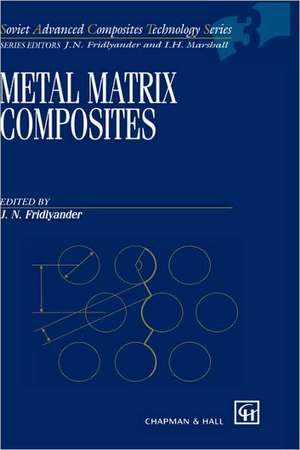
Metal Matrix Composites
Editat de J. Fridlyanderen Limba Engleză Hardback – 31 dec 1994
Preț: 3047.94 lei
Preț vechi: 3717.00 lei
-18%
Puncte Express: 4572
Carte tipărită la comandă
Livrare economică 16-30 noiembrie
Livrare prin curier în România Termenul estimat este afișat lângă disponibilitate.
Transport gratuit pentru acest produs Plată online sau ramburs, în funcție de opțiunile comenzii.
Retur gratuit în 14 zile Comandă securizată și suport în română.
Specificații
ISBN-13: 9780412582608
ISBN-10: 0412582600
Pagini: 700
Ilustrații: XI, 682 p.
Dimensiuni: 156 x 234 x 38 mm
Greutate: 1.15 kg
Ediția:1995 edition
Editura: Springer Nature B.V.
Locul publicării:Dordrecht, Netherlands
ISBN-10: 0412582600
Pagini: 700
Ilustrații: XI, 682 p.
Dimensiuni: 156 x 234 x 38 mm
Greutate: 1.15 kg
Ediția:1995 edition
Editura: Springer Nature B.V.
Locul publicării:Dordrecht, Netherlands
V-ar putea interesa
-
 NMR Imaging of MaterialsBernhard Blumich-33%Preț: 675.62 lei1011.80 lei
 -
 Advanced 2D MaterialsAshutosh Tiwari-23%Preț: 1449.59 lei1882.58 lei
 -
 -27%Preț: 1273.65 lei1735.98 lei
 -
 Nanometer-Scale Defect Detection Using Polarized LightPierre-Richard Dahoo-9%Preț: 988.47 lei1086.22 lei
 -
 EmulsionsTharwat F. Tadros-8%Preț: 527.88 lei573.78 lei
 -
 Springer Handbook of Metrology and TestingHorst Czichos-18%Preț: 1924.34 lei2346.76 lei
 -
 Spiral Grain and Wave Phenomena in Wood FormationJohn M. Harris-15%Preț: 614.24 lei722.63 lei
 -
 Liquid ExplosivesJiping Liu-18%Preț: 926.66 lei1130.08 lei
Public țintă
ResearchCuprins
1 Physio-chemical fundamentals of metal matrix composites.- 1.1 Formation of metal matrix composite structure and properties during the production process.- 1.2 Principles of metal matrix composite development and optimization.- 1.3 Conclusions.- References.- 2 Basic components used in the production of metal composites.- 2.1 Fibrous reinforcing agents.- 2.2 Dispersed strengtheners.- 2.3 Matrix alloys.- References.- 3 Metal matrix composite fabrication methods.- 3.1 Solid-phase fabrication methods (V.M. Tchubarov).- 3.2 Liquid-phase fabrication methods (A.A. Zabolotsky).- 3.3 Moulding of structural components from metal composite materials (G.A. Krivov).- Notation.- References.- 4 Composites of the aluminium—boron system.- 4.1 General.- 4.2 Boron—aluminium production procedure.- 4.3 Strength under static load.- 4.4 Strength at elevated temperature.- 4.5 Impact strength.- 4.6 Strength under cyclic load.- 4.7 Employment of boron-aluminium.- References.- 5 Composites of the magnesium-boron system.- 5.1 Obtaining magnesium—boron composite materials by solid-phase combination.- 5.2 Obtaining magnesium-boron composite materials by liquid-phase combination.- 5.3 Corrosion resistance of magnesium-boron composite materials.- Notation.- References.- 6 Composite materials of the aluminium—carbon system.- 6.1 Composite materials based on an aluminium matrix reinforced with carbon fibers (V.I. Kostikov and V.C. Kilin).- 6.2 Aluminium-carbon system composites (A.A. Zabolotsky).- Notation.- References.- 7 Composites of the aluminium—steel system.- 7.1 Selection of fibres.- 7.2 Selection of matrix.- 7.3 Manufacturing techniques.- 7.4 Kinetics of formation and growth of intermetallic compounds on phase boundaries.- 7.5 Properties.- 7.6 Manufacturing of CAS-type material.- 7.7Properties of structural elements.- 7.8 Thermal effects on interaction.- 7.9 Summary.- Notation.- References.- 8 Composite materials of aluminium—silicon carbide system.- 8.1 General.- 8.2 Analysis of composition and morphology of reinforcing fillers and admixture phases.- 8.3 Chemical properties of reinforcing fillers.- 8.4 Purification of reinforcing fillers of admixture phases.- 8.5 Obtaining composite materials by infiltration under pressure.- 8.6 Obtaining materials by methods of powder metallurgy.- 8.7 Prospective uses of Al—SiC composite materials.- References.- 9 Laminated fibrous metal—polymer composites.- 9.1 Introduction.- 9.2 Components of laminated fibrous metal—polymer composites.- 9.3 Properties and specific features of laminated-fibrous metal—polymer composites under static loading.- 9.4 Specific features of fatigue fracture of laminated fibrous metal—polymer composites.- 9.5 Damping properties of laminated fibrous metal—polymer composites.- 9.6 Production of parts and structures from laminated fibrous metal—polymer composites.- 9.7 Resistance of aluminium—organic plastic composites to environmental and corrosive effects.- 9.8 Conclusions.- Notation.- References.- 10 Mechanical testing of composite materials.- 10.1 Tension testing.- 10.2 Compression testing.- 10.3 Shear testing.- 10.4 Crack-resistance testing.- 10.5 Fatigue testing.- Notation.- 11 Theoretical and experimental research into the strength and deformation of fibrous metal composite materials.- 11.1 Materials investigated.- 11.2 Stretching in the reinforcement direction.- 11.3 Compression in the reinforcement direction.- 11.4 Compression perpendicular to the reinforcement.- 11.5 Three-point bending.- 11.6 Cyclic tension in the reinforcement direction.- 11.7 Deformation anddestruction of orthogonally reinforced metal composite materials under tensile stress.- Notation.- References.- 12 Structural micromechanics of elasto-plastic deformation of composites.- 12.1 Induced defects on interfaces.- 12.2 Stress fields of reinforcing fibres.- 12.3 Disinclination formation on edges of faceted reinforcing particles or fibres.- 12.4 Residual stresses elastically heterogeneous plastically deformed materials.- 12.5 Resistance to deformation.- 12.6 Specific energy of internal stresses as damaging factor.- 12.7 Structural levels.- References.