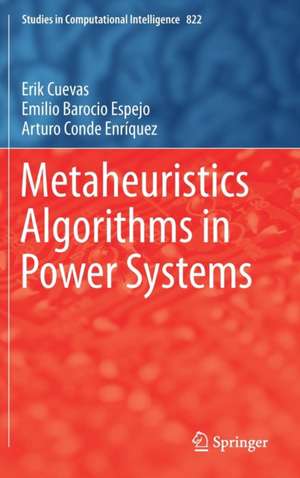
Metaheuristics Algorithms in Power Systems
Autor Erik Cuevas, Emilio Barocio Espejo, Arturo Conde Enríquezen Limba Engleză Hardback – 24 ian 2019
Preț: 671.62 lei
Preț vechi: 839.52 lei
-20%
Puncte Express: 1007
Carte tipărită la comandă
Livrare economică 01-15 decembrie
Livrare prin curier în România Termenul estimat este afișat lângă disponibilitate.
Transport gratuit pentru acest produs Plată online sau ramburs, în funcție de opțiunile comenzii.
Retur gratuit în 14 zile Comandă securizată și suport în română.
Specificații
ISBN-13: 9783030115920
ISBN-10: 3030115925
Pagini: 236
Ilustrații: XII, 221 p.
Dimensiuni: 160 x 241 x 19 mm
Greutate: 0.47 kg
Ediția:1st ed. 2019
Editura: Springer
Locul publicării:Cham, Switzerland
ISBN-10: 3030115925
Pagini: 236
Ilustrații: XII, 221 p.
Dimensiuni: 160 x 241 x 19 mm
Greutate: 0.47 kg
Ediția:1st ed. 2019
Editura: Springer
Locul publicării:Cham, Switzerland
V-ar putea interesa
-
 -20%Preț: 675.79 lei844.74 lei
 -
 -20%Preț: 675.79 lei844.74 lei
 -
 -20%Preț: 1033.34 lei1291.68 lei
 -
 -20%Preț: 673.57 lei841.97 lei
 -
 -20%Preț: 674.70 lei843.38 lei
 -
 -20%Preț: 670.48 lei838.11 lei
 -
 -20%Preț: 669.16 lei836.45 lei
 -
 -20%Preț: 669.07 lei836.34 lei
 -
 Engineering Applications of Soft ComputingMargarita-Arimatea Díaz-Cortés-20%Preț: 673.79 lei842.25 lei
 -
 -20%Preț: 671.39 lei839.24 lei
 -
 AI*IA 2003: Advances in Artificial IntelligenceAmedeo Cappelli-20%Preț: 336.29 lei420.36 lei
 -
 Affective Dialogue SystemsElisabeth André-20%Preț: 337.17 lei421.47 lei
 -
 An Approach to Knowledge Base ManagementNelson M. Mattos-20%Preț: 292.91 lei366.13 lei
 -
 Advances in Artificial IntelligenceDibio L. Borges-20%Preț: 320.32 lei400.41 lei
 -
 -20%Preț: 323.39 lei404.23 lei
 -
 -20%Preț: 335.69 lei419.60 lei
 -
 Simulated Evolution and LearningXin Yao-20%Preț: 332.26 lei415.32 lei
 -
 Agent Computing and Multi-Agent SystemsAditya Ghose-20%Preț: 345.68 lei432.09 lei
 -
 -20%Preț: 621.81 lei777.27 lei
 -
 Transfer in Reinforcement Learning DomainsMatthew Taylor-20%Preț: 624.02 lei780.02 lei
 -
 Automated Deduction in GeometryTetsuo Ida-20%Preț: 301.38 lei376.72 lei
 -
 Flexible Query Answering SystemsHenrik Legind Larsen-20%Preț: 356.98 lei446.22 lei
 -
 Frontiers of Combining SystemsPascal Fontaine-20%Preț: 338.85 lei423.56 lei
 -
 Discovery ScienceJohannes Fürnkranz-20%Preț: 339.07 lei423.84 lei
 -
 Algorithmic Learning TheorySanjay Jain-20%Preț: 341.23 lei426.53 lei
 -
 KI 2013: Advances in Artificial IntelligenceIngo J. Timm-20%Preț: 336.96 lei421.20 lei
 -
 Hybrid ClassifiersMichal Wozniak-20%Preț: 671.62 lei839.52 lei
 -
 -20%Preț: 361.03 lei451.28 lei
 -
 Rough Sets and Knowledge TechnologyPawan Lingras-20%Preț: 328.72 lei410.89 lei
Cuprins
Chapter 1. Introduction to metaheuristics methods.- Chapter 2. Metaheuristic schemes for parameter estimation in induction motors.- Chapter 3. Non-conventional overcurrent relays coordination.- Chapter 4. Overcurrent relay coordination, robustness and fast solutions etc.
Textul de pe ultima copertă
This book discusses the use of efficient metaheuristic algorithms to solve diverse power system problems, providing an overview of the various aspects of metaheuristic methods to enable readers to gain a comprehensive understanding of the field and of conducting studies on specific metaheuristic algorithms related to power-system applications. By bridging the gap between recent metaheuristic techniques and novel power system methods that benefit from the convenience of metaheuristic methods, it offers power system practitioners who are not metaheuristic computation researchers insights into the techniques, which go beyond simple theoretical tools and have been adapted to solve important problems that commonly arise. On the other hand, members of the metaheuristic computation community learn how power engineering problems can be translated into optimization tasks, and it is also of interest to engineers and application developers. Further, since each chapter can be read independently, the relevant information can be quickly found. Power systems is a multidisciplinary field that addresses the multiple approaches used for design and analysis in areas ranging from signal processing, and electronics to computational intelligence, including the current trend of metaheuristic computation.
Caracteristici
Provides an overview of the various aspects of metaheuristic methods useful for power systems Bridges the gap between recent metaheuristic optimization techniques and power system applications Written by experts in the field
Notă biografică
Erik Cuevas received his B.S. degree with distinction in Electronics and Communications Engineering from the University of Guadalajara, Mexico, in 1995, the M.Sc. degree in Industrial Electronics from ITESO, Mexico, in 2000, and the Ph.D. degree from Freie Universität Berlin, Germany in 2006. Since 2006 he has been with the University of Guadalajara, where he is currently a full-time Professor in the Department of Computer Science. Since 2008, he is a member of the Mexican National Research System (SNI III). He is the author of several books and articles. A list of his books and publications can be seen in the CV attached to this application. His current research interest includes Meta-heuristics, computer vision, and mathematical methods. He serves as an editor in Expert System with Applications, ISA Transactions, and Applied Soft Computing, Applied Mathematical Modeling and Mathematics and Computers in Simulation. Alberto Luque Chang graduated with a Bachelor's Degree in Communications and Electronics Engineering (2013), a Master of Science in Electronic Engineering and Computing (2016), and a Doctorate in Electronics and Computing Sciences (2021) in the University of Guadalajara (UdeG). He is currently a professor in the Division of Technologies for Cyber-Human Integration at the University Center for Exact Sciences and Engineering (CUCEI) of the UdeG. Likewise, since 2021, Dr. Luque is a member of the National System of Researchers, having the distinction of National Researcher Level 1. His areas of interest in research are Metaheuristic Algorithms, Artificial Intelligence, Optimization, Machine Learning and its applications. to Image Processing. Héctor Escobar received a B.S. degree with honors in Information Systems Engineering from the Autonomous University of Sinaloa, Mexico, in 2018 and an M.S. degree in Electronics and Computer Engineering from the University of Guadalajara, Mexico, in 2021. He is part of the Universityof Guadalajara, where he is a full-time Ph.D. student in the Electronics and Computer Science program. His current research interests include Metaheuristics, computer vision, artificial intelligence, and Agent-Based Modeling.