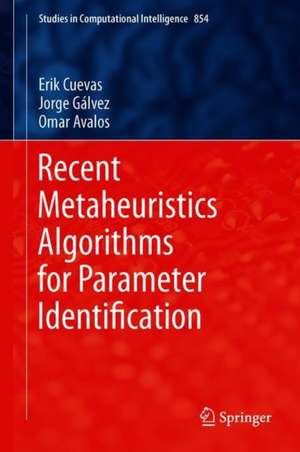
Recent Metaheuristics Algorithms for Parameter Identification
Autor Erik Cuevas, Jorge Gálvez, Omar Avalosen Limba Engleză Hardback – 20 sep 2019
This book presents new, alternative metaheuristic developments that have proved to be effective in various complex problems to help researchers, lecturers, engineers, and practitioners solve their own optimization problems. It also bridges the gap between recent metaheuristic techniques and interesting identification system methods that benefit from the convenience of metaheuristic schemes by explaining basic ideas of the proposed applications in ways that can be understood by readers new to these fields. As such it is a valuable resource for energy practitioners who are not researchers in metaheuristics. In addition, it offers members of the metaheuristic community insights into how system identification and energy problems can be translated into optimization tasks.
Preț: 630.09 lei
Preț vechi: 787.61 lei
-20%
Puncte Express: 945
Carte tipărită la comandă
Livrare economică 19 noiembrie-03 decembrie
Livrare prin curier în România Termenul estimat este afișat lângă disponibilitate.
Transport gratuit pentru acest produs Plată online sau ramburs, în funcție de opțiunile comenzii.
Retur gratuit în 14 zile Comandă securizată și suport în română.
Specificații
ISBN-13: 9783030289164
ISBN-10: 3030289168
Pagini: 312
Ilustrații: XIV, 297 p.
Dimensiuni: 160 x 241 x 23 mm
Greutate: 0.64 kg
Ediția:1st ed. 2020
Editura: Springer
Locul publicării:Cham, Switzerland
ISBN-10: 3030289168
Pagini: 312
Ilustrații: XIV, 297 p.
Dimensiuni: 160 x 241 x 23 mm
Greutate: 0.64 kg
Ediția:1st ed. 2020
Editura: Springer
Locul publicării:Cham, Switzerland
Cuprins
Introduction to optimization and metaheuristic methods.- Optimization techniques in parameters setting for Induction Motor.- An enhanced crow search algorithm applied to energy approaches.- Comparison of solar cells parameters estimation using several optimization algorithms.- Gravitational search algorithm for non-linear system identification using ANFIS-Hammerstein approach.- Fuzzy Logic Based Optimization Algorithm.- Neighborhood Based Optimization Algorithm.- Knowledge-Based Optimization Algorithm.
Textul de pe ultima copertă
This book presents new, alternative metaheuristic developments that have proved to be effective in various complex problems to help researchers, lecturers, engineers, and practitioners solve their own optimization problems. It also bridges the gap between recent metaheuristic techniques and interesting identification system methods that benefit from the convenience of metaheuristic schemes by explaining basic ideas of the proposed applications in ways that can be understood by readers new to these fields. As such it is a valuable resource for energy practitioners who are not researchers in metaheuristics. In addition, it offers members of the metaheuristic community insights into how system identification and energy problems can be translated into optimization tasks.