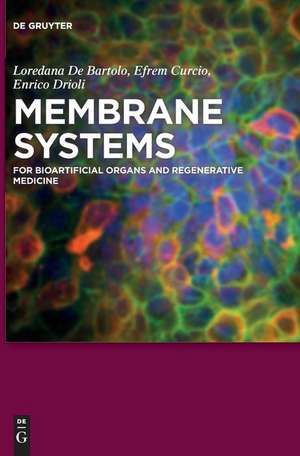
Membrane Systems
Autor Loredana De Bartolo, Enrico Drioli, Efrem Curcioen Limba Engleză Hardback – 12 iun 2017
This book reviews the latest developments in membrane systems for bioartificial organs and regenerative medicine, investigates how membrane technology can improve the quality and efficiency of biomedical devices, and highlights the design procedures for membrane materials covering the preparation, characterization, and sterilization steps as well as transport phenomena. The different strategies pursued for the development of membrane bioartifi cial organs, including crucial issues related to blood/cell-membrane interactions are described with the aim of opening new and exciting frontiers in the coming decades.
The book is a valuable tool for tissue engineers, clinicians, biomaterials scientists, membranologists as well as biologists and biotechnologists. It is also a source of reference for students, academic and industrial researchers in the topic of biotechnology, biomedical engineering, materials science and medicine.
Preț: 1307.68 lei
Preț vechi: 1376.50 lei
-5%
Puncte Express: 1962
Carte tipărită la comandă
Livrare economică 30 noiembrie-14 decembrie
Livrare prin curier în România Termenul estimat este afișat lângă disponibilitate.
Transport gratuit pentru acest produs Plată online sau ramburs, în funcție de opțiunile comenzii.
Retur gratuit în 14 zile Comandă securizată și suport în română.
Specificații
ISBN-13: 9783110267983
ISBN-10: 3110267985
Pagini: 274
Ilustrații: 200 schw.-w. u. 50 farb. Abb., 50 schw.-w. Tab.
Dimensiuni: 175 x 246 x 21 mm
Greutate: 0.59 kg
Ediția:1. Auflage
Editura: De Gruyter
Locul publicării:Berlin/Boston
ISBN-10: 3110267985
Pagini: 274
Ilustrații: 200 schw.-w. u. 50 farb. Abb., 50 schw.-w. Tab.
Dimensiuni: 175 x 246 x 21 mm
Greutate: 0.59 kg
Ediția:1. Auflage
Editura: De Gruyter
Locul publicării:Berlin/Boston
V-ar putea interesa
-
 -32%Preț: 1241.18 lei1824.94 lei
 -
 Membranes and Membrane ProcessesEnrico Drioli-18%Preț: 1289.00 lei1571.95 lei
 -
 -18%Preț: 1117.23 lei1362.47 lei
 -
 -5%Preț: 811.18 lei853.87 lei
 -
 Making Computerized Provider Order Entry WorkPhilip Smith-5%Preț: 383.58 lei403.77 lei
 -
 Computer Programs in Clinical and Laboratory MedicineD. John Doyle-5%Preț: 683.18 lei719.14 lei
 -
 Computers in Private Practice ManagementByron B. Oberst-5%Preț: 717.26 lei755.01 lei
 -
 Dental InformaticsLouis M. Abbey-5%Preț: 723.41 lei761.48 lei
 -
 Mathematics of DNA Structure, Function and InteractionsCraig John Benham-5%Preț: 1140.87 lei1200.92 lei
 -
 Strategy and Architecture of Health Care Information SystemsMichael K. Bourke-5%Preț: 375.68 lei395.45 lei
 -
 MEMBRANE-ASSISTED CRYSTALLIZATION TECHNOLOGYDrioli Enrico-15%Preț: 689.54 lei811.23 lei
 -
 Biomedical CompositesJ. Paulo Davim-5%Preț: 1226.82 lei1291.39 lei
 -
 Prüf- und Bewertungsmethoden für KnieorthesenDavid Hochmann-5%Preț: 1198.61 lei1261.69 lei
 -
 -5%Preț: 848.73 lei893.39 lei
 -
 digitale OperationssaalWolfgang Niederlag-5%Preț: 740.47 lei779.44 lei
 -
 Einführung in die Technik selbsttätiger RegelungenWerner Zur Megede-23%Preț: 874.61 lei1135.86 lei
 -
 Theorie der Medizinischen InformatikH. -Jürgen Seelos-5%Preț: 455.01 lei478.95 lei
 -
 A Second Generation PACS ConceptMichel Osteaux-5%Preț: 374.50 lei394.22 lei
 -
 Medical Images: Formation, Handling and EvaluationAndrew E. Todd-Pokropek-5%Preț: 1130.22 lei1189.71 lei
 -
 Pictorial Information Systems in MedicineKarl H. Höhne-5%Preț: 371.77 lei391.34 lei
 -
 Fuzzy Systems in MedicinePiotr S. Szczepaniak-5%Preț: 396.49 lei417.36 lei
 -
 Encyclopedia of MembranesEnrico Drioli-18%Preț: 9095.65 lei11092.25 lei
 -
 Functional Nanostructured MembranesEnrico Drioli-18%Preț: 996.45 lei1215.17 lei
Notă biografică
Loredana De Bartolo,University of Calabria, Rende, Italy; Efrem Curcio, University of Calabria, Rende, Italy; Enrico Drioli, University of Calabria, Rende, Italy.
Cuprins
AD>
Biomedical Polymers
Preparation Techniques
Membrane Configurations
Characterization of Membrane Properties
Sterilization Procedures
2. Basic Issues in Membrane Separation for Biomedical Devices
Driving Forces in Molecular Separation
Transport through Microporous Membranes
Transport through Dense Membranes
Performance Parameters
3. Membrane Artificial Organs
Bioengineering Principles
Hemodialyser
Hemofilters
Plasmafilters
Blood Oxygenator
4. Biocompatibility Assessment
Membrane Trombogenicity
Complement Activation
Activation of Leukocytes
Inflammation Reaction
Bioincompatibility Aspects
5. Engineering of Membrane Biohybrid Organs
Modelling of Mass Transfer
Computational Fluid Dynamics Analysis
Analysis of Metabolic Kinetics
Configuration of Membrane Devices
6. Membrane Biohybrid Organs
Design Concepts
Liver
Pancreas
Kidney
Lung
Cardio-vascular devices
7. Citocompatibility Assessment
Cell Response
Protein Adsorption
Cell-Membrane Interactions
Role of Membrane Properties on Cell Arrangement and Organization
Evaluation of Tissue Compatibility
8. Regulatory and Ethical Issues
Regulatory of Biomedical Membrane Devices
Ethical Issues
Biomedical Polymers
Preparation Techniques
Membrane Configurations
Characterization of Membrane Properties
Sterilization Procedures
2. Basic Issues in Membrane Separation for Biomedical Devices
Driving Forces in Molecular Separation
Transport through Microporous Membranes
Transport through Dense Membranes
Performance Parameters
3. Membrane Artificial Organs
Bioengineering Principles
Hemodialyser
Hemofilters
Plasmafilters
Blood Oxygenator
4. Biocompatibility Assessment
Membrane Trombogenicity
Complement Activation
Activation of Leukocytes
Inflammation Reaction
Bioincompatibility Aspects
5. Engineering of Membrane Biohybrid Organs
Modelling of Mass Transfer
Computational Fluid Dynamics Analysis
Analysis of Metabolic Kinetics
Configuration of Membrane Devices
6. Membrane Biohybrid Organs
Design Concepts
Liver
Pancreas
Kidney
Lung
Cardio-vascular devices
7. Citocompatibility Assessment
Cell Response
Protein Adsorption
Cell-Membrane Interactions
Role of Membrane Properties on Cell Arrangement and Organization
Evaluation of Tissue Compatibility
8. Regulatory and Ethical Issues
Regulatory of Biomedical Membrane Devices
Ethical Issues
Descriere
Descriere de la o altă ediție sau format:
The worldwide demand for organ transplants exceeds available donor organs by far. Understanding and controlling membrane material biocompatibility and transport phenomena currently opens new opportunities for the improvement of artificial organs (e.g., hemodialysis devices, hemofilters, blood oxygenator, etc.) and the design of bioartificial organs such as the bioartificial liver or pancreas.
The book covers the design and development of membranes and devices to be used as bio/artificial organs and in vitro growth of human cells as tissue engineered constructs, describes clinical applications of various membrane devices, bioengineering principles, materials and designs used in bio/artificial organs, and reviews the concepts, cell techniques, membrane scaffold materials and applications of tissue engineering.
An invaluable resource to researchers, scientists and academics involved in the advancement of membrane bio/artificial organs and tissues!
The worldwide demand for organ transplants exceeds available donor organs by far. Understanding and controlling membrane material biocompatibility and transport phenomena currently opens new opportunities for the improvement of artificial organs (e.g., hemodialysis devices, hemofilters, blood oxygenator, etc.) and the design of bioartificial organs such as the bioartificial liver or pancreas.
The book covers the design and development of membranes and devices to be used as bio/artificial organs and in vitro growth of human cells as tissue engineered constructs, describes clinical applications of various membrane devices, bioengineering principles, materials and designs used in bio/artificial organs, and reviews the concepts, cell techniques, membrane scaffold materials and applications of tissue engineering.
An invaluable resource to researchers, scientists and academics involved in the advancement of membrane bio/artificial organs and tissues!