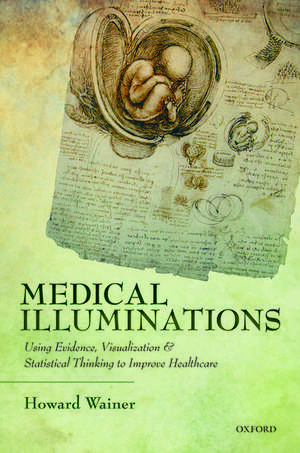
Medical Illuminations: Using Evidence, Visualization and Statistical Thinking to Improve Healthcare
Autor Howard Waineren Limba Engleză Hardback – 10 oct 2013
Remarcăm în Medical Illuminations o resursă esențială pentru clinicianul modern, oferind instrumentele necesare pentru a naviga prin ambiguitatea datelor medicale cotidiene. După parcurgerea acestui volum, cititorul va putea evalua critic necesitatea unui screening de rutină sau validitatea unei hărți epidemiologice, transformând informația brută în decizii clinice fundamentate. Autorul Howard Wainer demonstrează că înțelegerea riscului nu necesită neapărat calcule matematice complexe, ci o structură riguroasă a gândirii vizuale.
Descoperim aici o analiză aplicată pe treisprezece studii de caz, de la valoarea reală a mamografiilor până la momentul optim pentru o artroplastie de șold. Stilul este precis și clinic, axat pe claritate, fiind susținut de cele 73 de diagrame și ilustrații care servesc drept dovezi vizuale ale argumentației. Apreciem modul în care Howard Wainer reușește să explice concepte de epidemiologie și statistică fără a sacrifica rigoarea științifică, facilitând o comunicare mai transparentă între medic și pacient.
Această lucrare reprezintă o evoluție firească a operei autorului, integrând expertiza sa din A History of Data Visualization and Graphic Communication și Picturing the Uncertain World într-un format dedicat exclusiv sănătății publice. Dacă în Visual Revelations autorul explora diverse dispozitive grafice, aici se concentrează pe aplicabilitatea lor în medicina bazată pe dovezi. Medical Illuminations este un manual de referință comparabil cu Calculated Risks de Gerd Gigerenzer, dar actualizat pentru a răspunde provocărilor contemporane din sistemele de sănătate, oferind o perspectivă mai tehnică asupra reprezentării grafice față de lucrarea lui Gigerenzer, rămânând totodată accesibilă non-specialiștilor.
Preț: 294.18 lei
Preț vechi: 361.09 lei
-19%
Carte disponibilă
Livrare economică 14-20 mai
Specificații
ISBN-10: 0199668795
Pagini: 192
Ilustrații: 39 b/w line drawings, 30 colour line drawings, 2 b/w halftones, 2 colour halftones
Dimensiuni: 169 x 235 x 16 mm
Greutate: 0.48 kg
Editura: OUP OXFORD
Colecția OUP Oxford
Locul publicării:Oxford, United Kingdom
V-ar putea interesa
-
 Statistics in MedicineRobert H. Riffenburgh-29%Preț: 504.26 lei714.37 lei
 -
 Reckoning with RiskGerd Gigerenzer-20%Preț: 60.65 lei75.67 lei
 -
 Preț: 103.01 lei
 -
 The Art of Statistics: Learning from DataDavid Spiegelhalter-32%Preț: 60.99 lei89.10 lei
 -
 The Art of UncertaintyDavid SpiegelhalterPreț: 152.98 lei
 -
 Sabiston Textbook of Surgery: The Biological Basis of Modern Surgical PracticeDouglas Scott Tyler-30%Preț: 1092.91 lei1567.58 leiRecomandat
 -
 Kumar and Clark's Clinical MedicineDavid Randall-27%Preț: 456.34 lei627.74 leiRecomandat
 -
 Less Medicine, More HealthH Gilbert Welch-5%Preț: 84.93 lei89.40 lei
 -
 Preț: 328.38 lei
 -
 Preț: 435.75 lei
 -
 Statistics at Square OneMichael J CampbellPreț: 227.63 lei
 -
 Medical StatisticsStephen J Walters-5%Preț: 313.42 lei329.91 lei
 -
 How to Read a PaperTrisha M Greenhalgh-5%Preț: 292.19 lei307.56 lei
 -
 Visualize ThisNathan Yau-20%Preț: 221.80 lei277.24 lei
 -
 -27%Preț: 85.37 lei117.12 lei
 -
 Diseases of the Breast 5eJay R. Harris MD-22%Preț: 2294.89 lei2952.89 lei
 -
 -17%Preț: 279.65 lei336.27 lei
 -
 The Complete Guide to Breast CancerLiz O'RiordanPreț: 99.49 lei
 -
 Blind SpotsMarty Makary-20%Preț: 93.32 lei116.69 lei
 -
 -20%Preț: 54.78 lei68.74 lei
De ce să citești această carte
Recomandăm această carte oricărui profesionist din domeniul sănătății care dorește să își rafineze capacitatea de a interpreta riscurile și beneficiile tratamentelor. Cititorul câștigă o metodă clară de a vizualiza incertitudinea, esențială în consimțământul informat al pacientului. Este o investiție în gândirea critică, oferind soluții vizuale pentru probleme statistice care par adesea insurmontabile în practica medicală de zi cu zi.
Despre autor
Dr. Howard Wainer este un cercetător de renume mondial, activând ca Distinguished Research Scientist în cadrul National Board of Medical Examiners. De asemenea, este profesor adjunct de statistică la prestigioasa Wharton School a Universității din Pennsylvania. Cu o carieră dedicată vizualizării datelor și comunicării grafice, Wainer a publicat numeroase lucrări fundamentale care explorează intersecția dintre statistică și viața cotidiană. Expertiza sa în testarea medicală și analiza datelor epidemiologice face din acest volum o autoritate în domeniul statisticii aplicate în medicină.
Descriere
Recenzii
On the journey from factual knowledge to conceptual understanding, Howard Wainer is an able guide and a most amiable companion.
His sensitivities are well aligned with the huge upswing in interest in these topics, but once again he leads the way with fresh ideas, compelling examples, wise generalizations, and clever phrases.