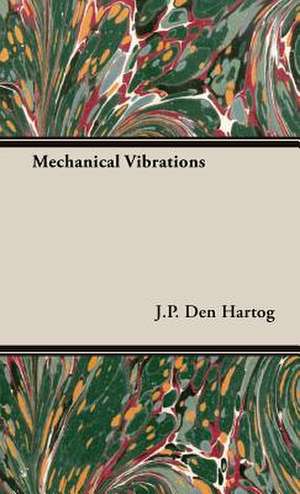
Mechanical Vibrations
Autor J. P. Den Hartogen Limba Engleză Hardback – 4 noi 2008
Notăm cu interes prezența acestui volum fundamental în bibliografia de referință pentru cursurile de mecanică și inginerie mecanică. Publicat inițial pentru a susține predarea disciplinei la Harvard, Mechanical Vibrations s-a impus ca un text standard datorită capacității autorului Den Hartog de a traduce rigoarea academică în soluții inginerești aplicabile. În programul de studiu al dinamicii structurilor, această lucrare ocupă un loc central, oferind baza teoretică necesară pentru înțelegerea fenomenelor de oscilație în sisteme complexe. Suntem de părere că forța acestui manual rezidă în echilibrul dintre teorie și practică. Spre deosebire de abordările pur analitice, Den Hartog utilizează cel mai simplu aparat matematic posibil pentru a explica cinematica vibrațiilor, gradele de libertate și efectele giroscopice. Experiența sa industrială este evidentă în secțiunile dedicate vibrațiilor torsionale la motoarele diesel sau problemelor de aeroelasticitate ale aripilor de avion. Cartea extinde cadrul propus de Vibration Problems in Engineering de S. Timoshenko prin accentul pus pe intuiția fizică și pe utilizarea modelelor vizuale ca instrumente de diagnosticare. În contextul operei sale, volumul completează viziunea prezentată în Mechanics, păstrând stilul discursiv și clar care l-a consacrat pe autor. Dacă în Advanced Strength of Materials accentul cade pe rezistența materialelor sub sarcini statice și dinamice intermediare, aici atenția este focalizată strict pe controlul și predicția vibrațiilor. Structura didactică este susținută de cele 233 de probleme rezolvate, transformând textul dintr-o simplă monografie într-un instrument de lucru indispensabil pentru viitorii ingineri.
Preț: 346.70 lei
Carte tipărită la comandă
Livrare economică 20 noiembrie-04 decembrie
Specificații
ISBN-10: 1443725366
Pagini: 496
Dimensiuni: 145 x 222 x 33 mm
Greutate: 0.83 kg
Editura: CRASTRE PR
V-ar putea interesa
-
 Theory of Elastic StabilityStephen P. Timoshenko-22%Preț: 202.43 lei257.93 lei
 -
 Mathematical PhysicsDonald H. MenzelPreț: 110.74 lei
 -
 Preț: 158.29 lei
 -
 MechanicsJ. P. Den HartogPreț: 104.74 lei
 -
 Strength of MaterialsJacob P. Den HartogPreț: 128.60 lei
 -
 The Variational Principles of MechanicsCornelius Lanczos-24%Preț: 147.24 lei192.49 lei
 -
 I Fired My Doctors and Saved My LifeSam And Bunny SewellPreț: 88.05 lei
 -
 Seeing the WorldRichard ClementPreț: 290.45 lei
 -
 -20%Preț: 1010.48 lei1263.10 lei
 -
 -33%Preț: 568.58 lei845.13 lei
 -
 Mechanical Vibrations in SI UnitsSingiresu Rao-9%Preț: 638.76 lei701.93 lei
 -
 Process Machinery HandbookRobert X Perez-23%Preț: 1946.55 lei2527.99 lei
 -
 Preț: 201.52 lei
 -
 The Hindu-Yogi Science of BreathYogi RamacharakaPreț: 51.65 lei
 -
 A Chapter of Hopkins Genealogy; 1735-1905: Their Management, Treatment and DiseasesArchibald Wilson HopkinsPreț: 203.80 lei
 -
 -23%Preț: 411.78 lei535.90 lei
 -
 Classical MechanicsJohn R. Taylor-18%Preț: 897.34 lei1094.30 lei
 -
 Theory of VibrationAhmed A. Shabana-19%Preț: 578.82 lei714.60 lei
 -
 General Physics IMehdi Rahmani-AndebiliPreț: 377.42 lei
 -
 Springer Handbook of Mechanical EngineeringKarl-Heinrich Grote-18%Preț: 2092.64 lei2552.00 lei
 -
 Preț: 139.06 lei
 -
 Engineering Mechanics 1Dietmar GrossPreț: 274.96 lei
 -
 MechanicsStefan Roth-11%Preț: 401.93 lei451.60 lei
 -
 Preț: 408.21 lei
De ce să citești această carte
Recomandăm această ediție studenților și inginerilor practicieni care au nevoie de o înțelegere intuitivă, nu doar matematică, a vibrațiilor mecanice. Cititorul câștigă acces la expertiza unui profesor de la MIT care a lucrat direct cu sisteme navale și aeronautice. Este o resursă esențială pentru pregătirea examenelor de profil, oferind o colecție vastă de formule și probleme rezolvate care acoperă de la sisteme simple la vibrații ale membranelor și plăcilor.
Despre autor
J. P. Den Hartog a fost un distins profesor de inginerie mecanică la Massachusetts Institute of Technology (MIT) și un pionier în studiul vibrațiilor în Statele Unite. Cu o carieră ce a îmbinat cercetarea academică la Harvard și MIT cu experiența practică dobândită în industria privată și în cadrul Biroului de Nave al Marinei SUA, Den Hartog a redefinit modul în care mecanica este predată. Este recunoscut pentru stilul său pedagogic care pune accent pe claritatea conceptuală, transformând subiecte tehnice aride în lecții accesibile, fapt care a consacrat lucrările sale ca titluri de referință în seria Dover Books on Engineering.
Descriere scurtă
Notă biografică
Descriere
Classic textbook offers lucid explanations and illustrative models, applying theories of vibrations to a variety of practical industrial engineering problems. Numerous figures. 233 problems, solutions. Appendix. Index.