Cantitate/Preț
Produs

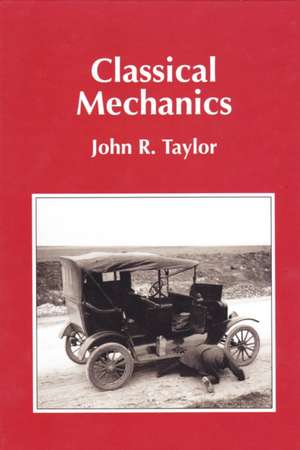
Taylor, J: Classical Mechanics


en Limba Engleză Hardback – 15 sep 2004

Apreciem modul în care John R. Taylor reușește să transforme un subiect tradițional într-o resursă modernă și accesibilă pentru învățământul universitar superior. Classical Mechanics aduce un suflu nou prin prioritizarea clarității conceptuale, o trăsătură pe care autorul a perfecționat-o în lucrarea sa de referință despre analiza erorilor. Observăm că această ediție reușește să pună bazele fundamentale ale fizicii prin 180 de ilustrații detaliate care facilitează înțelegerea fenomenelor descrise matematic. Lucrarea extinde cadrul propus de Introduction to Classical Mechanics de David Morin prin includerea unor secțiuni extinse despre haos și dinamica neliniară, oferind o tranziție mai lină de la fizica newtoniană elementară la mecanica analitică avansată. În timp ce Morin se concentrează pe un volum masiv de probleme rezolvate, Taylor pune accent pe narațiunea logică a principiilor fizice. Structura cărții este riguros organizată: începe cu legile mișcării, conservarea impulsului și a energiei, pentru ca în a doua jumătate să introducă calculul variațional și ecuațiile lui Lagrange. De asemenea, considerăm esențială includerea unor capitole despre cadre de referință neinerțiale și mișcarea corpurilor rigide, finalizând cu o introducere solidă în relativitate. Deși autorul a explorat anterior subiecte diverse, de la istorie militară în A Few Brave Men până la sănătate, această monografie de fizică reprezintă nucleul expertizei sale academice, fiind concepută special pentru a ghida studenții prin complexitatea teoretică a sistemelor cuplate și a mecanicii mediilor continue.

Citește tot Restrânge

Preț: 90286 lei

Preț vechi: 110105 lei
-18%

Puncte Express: 1354

Carte disponibilă

Livrare economică 14-28 noiembrie

Livrare prin curier în România Termenul estimat este afișat lângă disponibilitate.
Transport gratuit pentru acest produs Plată online sau ramburs, în funcție de opțiunile comenzii.
Retur gratuit în 14 zile Comandă securizată și suport în română.

Specificații

ISBN-13: 9781891389221
ISBN-10: 189138922X
Pagini: 786
Ilustrații: 180 Illustrations
Dimensiuni: 184 x 261 x 43 mm
Greutate: 1.57 kg
Editura: Scion Publishing Ltd - IPSUK
Locul publicării:Sausalito, United States

De ce să citești această carte

Recomandăm acest volum studenților la fizică și inginerie care caută o expunere logică și extrem de clară a mecanicii. Față de alte manuale tehnice, Taylor reușește să explice formalismul lagrangian și hamiltonian fără a pierde din vedere intuiția fizică. Este un instrument esențial pentru pregătirea examenelor, oferind o bază solidă pentru studiul ulterior al mecanicii cuantice și al electrodinamicii.


Despre autor

John R. Taylor este profesor emerit de fizică la University of Colorado, Boulder, recunoscut la nivel internațional pentru contribuțiile sale în pedagogia științifică. Deși interesele sale editoriale au acoperit ocazional domenii precum istoria militară sau analiza socială, el rămâne o figură centrală în literatura academică de fizică. Experiența sa îndelungată în predare se reflectă în modul în care structurează informația complexă, transformând manualele sale în standarde universitare pentru studenții din întreaga lume.


Cuprins

Part I: THE ESSENTIALS1. Newton's Laws of Motion1.1 Classical Mechanics1.2 Space and Time1.3 Mass and Force1.4 Newton's First and Second Laws; Inertial Frames1.5 The Third Law and Conservation of the Momentum1.6 Newton's Second Law in Cartesian Coordinates1.7 Two-Dimensional Polar Coordinates1.8 Problems for Chapter 12. Projectiles and Charged Particles2.1 Air Resistance2.2 Linear Air Resistance2.3 Trajectory and Range in a Linear Motion2.4 Quadratic Air Resistance2.5 Motion of a Charge in a Uniform Magnetic Field2.6 Complex Exponentials2.7 Solution for the Charge in a B Field2.8 Problems for Chapter 23. Momentum and Angular Momentum3.1 Conservation of Momentum3.2 Rockets3.3 The Center of Mass3.4 Angular Momentum for a Single Particle3.5 Angular Momentum for Several Particles3.6 Problems for Chapter 34. Energy4.1 Kinetic Energy and Work4.2 Potential Energy and Conservative Forces4.3 Force as the Gradient of Potential Energy4.4 The Second Condition that F be Conservative4.5 Time-Dependent Potential Energy4.6 Energy for Linear One-Dimensional Systems4.7 Curvilinear One-Dimensional Systems4.8 Central Forces4.9 Energy of Interaction of Two Particles4.10 The Energy of a Multiparticle System4.11 Problems for Chapter 45. Oscillations5.1 Hooke's Law5.2 Simple Harmonic Motion5.3 Two-Dimensional Oscillators5.4 Damped Oscillators5.5 Driven Damped Oscillations5.6 Resonance5.7 Fourier Series5.8 Fourier Series Solution for the Driven Oscillator5.9 The RMS Displacement; Parseval's Theorem5.10 Problems for Chapter 56. Calculus of Variations6.1 Two Examples6.2 The Euler-Lagrange Equation6.3 Applications of the Euler-Lagrange Equation6.4 More than Two Variables6.5 Problems for Chapter 67. Lagrange's Equations7.1 Lagrange's Equations for Unconstrained Motion7.2 Constrained Systems; an Example7.3 Constrained Systems in General7.4 Proof of Lagrange's Equations with Constraints7.5 Examples of Lagrange's Equations7.6 Conclusion7.7 Conservation Laws in Lagrangian Mechanics7.8 Lagrange's Equations for Magnetic Forces7.9 Lagrange Multipliers and Constraint Forces7.10 Problems for Chapter 78. Two-Body Central Force Problems8.1 The Problem8.2 CM and Relative Coordinates; Reduced Mass8.3 The Equations of Motion8.4 The Equivalent One-Dimensional Problems8.5 The Equation of the Orbit8.6 The Kepler Orbits8.7 The Unbonded Kepler Orbits8.8 Changes of Orbit8.9 Problems for Chapter 89. Mechanics in Noninertial Frames9.1 Acceleration without Rotation9.2 The Tides9.3 The Angular Velocity Vector9.4 Time Derivatives in a Rotating Frame9.5 Newton's Second Law in a Rotating Frame9.6 The Centrifugal Force9.7 The Coriolis Force9.8 Free Fall and The Coriolis Force9.9 The Foucault Pendulum9.10 Coriolis Force and Coriolis Acceleration9.11 Problems for Chapter 910. Motion of Rigid Bodies10.1 Properties of the Center of Mass10.2 Rotation about a Fixed Axis10.3 Rotation about Any Axis; the Inertia Tensor10.4 Principal Axes of Inertia10.5 Finding the Principal Axes; Eigenvalue Equations10.6 Precession of a Top Due to a Weak Torque10.7 Euler's Equations10.8 Euler's Equations with Zero Torque10.9 Euler Angles10.10 Motion of a Spinning Top10.11 Problems for Chapter 1011. Coupled Oscillators and Normal Modes11.1 Two Masses and Three Springs11.2 Identical Springs and Equal Masses11.3 Two Weakly Coupled Oscillators11.4 Lagrangian Approach; the Double Pendulum11.5 The General Case11.6 Three Coupled Pendulums11.7 Normal Coordinates11.8 Problems for Chapter 11Part II: FURTHER TOPICS12. Nonlinear Mechanics and Chaos12.1 Linearity and Nonlinearity12.2 The Driven Damped Pendulum or DDP12.3 Some Expected Features of the DDP12.4 The DDP; Approach to Chaos12.5 Chaos and Sensitivity to Initial Conditions12.6 Bifurcation Diagrams12.7 State-Space Orbits12.8 Poincare Sections12.9 The Logistic Map12.10 Problems for Chapter 1213. Hamiltonian Mechanics13.1 The Basic Variables13.2 Hamilton's Equations for One-Dimensional Systems13.3 Hamilton's Equations in Several Dimensions13.4 Ignorable Coordinates13.5 Lagrange's Equations vs. Hamilton's Equations13.6 Phase-Space Orbits13.7 Liouville's Theorem13.8 Problems for Chapter 1314. Collision Theory14.1 The Scattering Angle and Impact Parameter14.2 The Collision Cross Section14.3 Generalizations of the Cross Section14.4 The Differential Scattering Cross Section14.5 Calculating the Differential Cross Section14.6 Rutherford Scattering14.7 Cross Sections in Various Frames14.8 Relation of the CM and Lab Scattering Angles14.9 Problems for Chapter 1415. Special Relativity15.1 Relativity15.2 Galilean Relativity15.3 The Postulates of Special Relativity15.4 The Relativity of Time; Time Dilation15.5 Length Contraction15.6 The Lorentz Transformation15.7 The Relativistic Velocity-Addition Formula15.8 Four-Dimensional Space-Time; Four-Vectors15.9 The Invariant Scalar Product15.10 The Light Cone15.11 The Quotient Rule and Doppler Effect15.12 Mass, Four-Velocity, and Four-Momentum15.13 Energy, the Fourth Component of Momentum15.14 Collisions15.15 Force in Relativity15.16 Massless Particles; the Photon15.17 Tensors15.18 Electrodynamics and Relativity15.19 Problems for Chapters 1516. Continuum Mechanics16.1 Transverse Motion of a Taut String16.2 The Wave Equation16.3 Boundary Conditions; Waves on a Finite String16.4 The Three-Dimensional Wave Equation16.5 Volume and Surface Forces16.6 Stress and Strain: the Elastic Moduli16.7 The Stress Tensor16.8 The Strain Tensor for a Solid16.9 Relation between Stress and Strain: Hooke's Law16.10 The Equation of Motion for an Elastic Solid16.11 Longitudinal and Transverse Waves in a Solid16.12 Fluids: Description of the Motion16.13 Waves in a Fluid16.14 Problems for Chapter 16Appendix: Diagonalizing Real Symmetric Matrices

Caracteristici

1 Covers the core information required for a superb mechanics course
2 Comprehensive in its content but without overwhelming the student with excessive detail
3 Written with great clarity - a quality that many comparable texts lack
4 Popular and respected author

Descriere

John Taylor has brought to his new book, Classical Mechanics, all of the clarity and insight that made his introduction to Error Analysis a best-selling text.