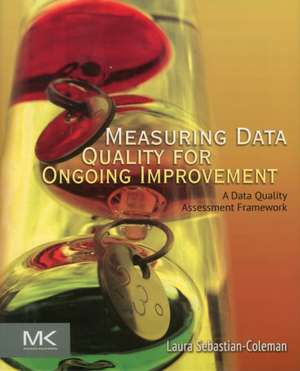
Measuring Data Quality for Ongoing Improvement: A Data Quality Assessment Framework: The Morgan Kaufmann Series on Business Intelligence
Autor Laura Sebastian-Colemanen Limba Engleză Paperback – 20 feb 2013
Publicul țintă principal al acestui volum este format din ingineri și manageri de date, analiști de conformitate și profesioniști în Business Intelligence, care primesc un instrumentar metodologic pentru transformarea datelor în active de încredere. Descoperim aici o abordare pragmatică a guvernanței, centrată pe cadrul DQAF (Data Quality Assessment Framework), menit să pună în acord limbajul tehnic al departamentelor IT cu prioritățile strategice de business. Notăm cu interes faptul că Laura Sebastian-Coleman nu tratează calitatea datelor ca pe un proiect cu termen de finalizare, ci ca pe un proces de îmbunătățire continuă, integrat în fluxul operațional.
Subliniem structura riguroasă a celor șase secțiuni, care ghidează cititorul de la definiții conceptuale și modele de metadate, până la scenarii complexe de evaluare și strategii de implementare. În comparație cu Data Quality de Carlo Batini, care oferă o perspectivă teoretică și sistematică asupra reglementărilor internaționale, lucrarea de față este mult mai orientată spre practică, oferind peste trei duzini de tipuri de măsurători specifice pentru dimensiuni precum integritatea și validitatea. De asemenea, dacă The Practitioner's Guide to Data Quality Improvement de David Loshin se concentrează pe socializarea și planificarea programelor de date, Measuring Data Quality for Ongoing Improvement merge în profunzime cu algoritmi de calcul și comparații pentru detectarea anomaliilor.
Această lucrare consolidează expertiza autoarei, fiind o continuare firească a temelor explorate în Navigating the Labyrinth și Meeting the Challenges of Data Quality Management. În timp ce lucrările anterioare puneau accent pe comunicarea cu liderii organizațiilor, volumul de față oferă detaliile tehnice și logice necesare pentru execuția propriu-zisă a strategiei de date.
Preț: 267.62 lei
Preț vechi: 331.21 lei
-19%
Carte tipărită la comandă
Livrare economică 21 noiembrie-05 decembrie
Specificații
ISBN-10: 0123970334
Pagini: 376
Dimensiuni: 191 x 235 x 23 mm
Greutate: 0.75 kg
Editura: ELSEVIER SCIENCE
Seria The Morgan Kaufmann Series on Business Intelligence
V-ar putea interesa
-
 -12%Preț: 118.66 lei135.04 lei
 -
 Thinking, Fast and SlowDaniel Kahneman-27%Preț: 90.73 lei123.57 leiRecomandat
 -
 Key Performance Indicators (KPI)Bernard MarrPreț: 260.25 lei
 -
 Preț: 255.86 lei
 -
 Preț: 204.99 lei
 -
 How to Measure Anything WorkbookDouglas W HubbardPreț: 178.63 lei
 -
 -20%Preț: 974.76 lei1218.45 lei
 -
 Preț: 183.32 lei
 -
 Comptia Data+ Study GuideMike Chapple-20%Preț: 289.53 lei361.92 lei
 -
 Data Quality - Empowering Businesses with Analytics and AIPrashanth Southekal-20%Preț: 198.22 lei247.77 lei
 -
 Quality Measurement in HealthcareHelen Burstin-5%Preț: 377.52 lei397.39 lei
 -
 How to Measure Anything in Project ManagementDouglas W. HubbardPreț: 357.24 lei
 -
 Data Analytics & Visualization All-in-One For DummiesJack A. HymanPreț: 307.59 lei
 -
 Data & AI ImperativeLillian Pierson-20%Preț: 172.87 lei216.09 lei
 -
 Storytelling with DataCole Nussbaumer KnaflicPreț: 250.36 lei
 -
 The Data Hero PlaybookMalcolm HawkerPreț: 202.67 lei
 -
 Keeping Score: Using the Right Metrics to Drive World Class PerformanceMark Graham BrownPreț: 241.61 lei
 -
 Data CultureAlex VailPreț: 108.10 lei
 -
 -5%Preț: 393.72 lei414.44 lei
 -
 Preț: 139.76 lei
Public țintă
Data quality engineers, managers and analysts, application program managers and developers, data stewards, data managers and analysts, compliance analysts, Business intelligence professionals, Database designers and administrators, Business and IT managersDe ce să citești această carte
Studenții și practicienii dobândesc o metodologie independentă de tehnologie pentru monitorizarea activelor de date. Cititorul câștigă capacitatea de a prioritiza măsurătorile și de a genera rapoarte de trend relevante, esențiale pentru orice sistem modern de Business Intelligence. Este recomandată celor care doresc să depășească etapa corecțiilor ad-hoc și să implementeze un sistem de monitorizare care detectează erorile înainte ca acestea să afecteze deciziile de afaceri.
Descriere scurtă
- Demonstrates how to leverage a technology independent data quality measurement framework for your specific business priorities and data quality challenges
- Enables discussions between business and IT with a non-technical vocabulary for data quality measurement
- Describes how to measure data quality on an ongoing basis with generic measurement types that can be applied to any situation
Cuprins
Chapter 1: Data
Chapter 2: Data, People, and Systems
Chapter 3: Data Management, Models, and Metadata
Chapter 4: Data Quality and Measurement
Section Two: DQAF Concepts and Measurement Types
Chapter 5: DQAF Concepts
Chapter 6: DQAF Measurement Types
Section Three: Data Assessment Scenarios
Chapter 7: Initial Data Assessment
Chapter 8 Assessment in Data Quality Improvement Projects
Chapter 9: Ongoing Measurement
Section Four: Applying the DQAF to Data Requirements
Chapter 10: Requirements, Risk, Criticality
Chapter 11: Asking Questions
Section Five: A Strategic Approach to Data Quality
Chapter 12: Data Quality Strategy
Chapter 13: Quality Improvement and Data Quality
Chapter 14: Directives for Data Quality Strategy
Section Six: The DQAF in Depth
Chapter 15: Functions of Measurement: Collection, Calculation, Comparison
Chapter 16: Features of the DQAF Measurement Logical
Chapter 17: Facets of the DQAF Measurement Types
Appendix A: Measuring the Value of Data
Appendix B: Data Quality Dimensions
Appendix C: Completeness, Consistency, and Integrity of the Data Model
Appendix D: Prediction, Error, and Shewhart’s lost disciple, Kristo Ivanov
Glossary
Bibliography
Recenzii
"The framework she describes is a set of 48 generic measurement types based on five dimensions of data quality: completeness, timeliness, validity, consistency, and integrity. The material is for people who are charged with improving, monitoring, or ensuring data quality." --Reference and Research Book News, August 2013
"If you are intent on improving the quality of the data at your organization you would do well to read Measuring Data Quality for Ongoing Improvement and adopt the DQAF offered up in this fine book." --Data and Technology Today blog, July 2013