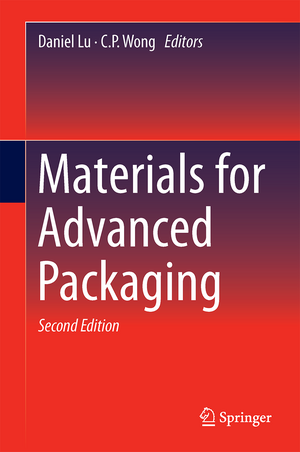
Materials for Advanced Packaging
Editat de Daniel Lu, C. P. Wongen Limba Engleză Hardback – 30 dec 2016
Cititorul care a aplicat ideile din Semiconductor Advanced Packaging de John H. Lau va găsi în volumul de față o extindere necesară a bazei materiale, axată pe proprietățile fizico-chimice ale compușilor care permit miniaturizarea extremă. În timp ce lucrarea lui Lau pune accent pe arhitecturile de tip fan-out și chiplets, Materials for Advanced Packaging se concentrează pe substratul tehnologic: de la compuși de turnare epoxidici la adezivii de atașare a pastilei de siliciu. Ne-a atras atenția modul în care această ediție a doua integrează capitole noi dedicate electronicelor flexibile și straturilor de acoperire funcționale, precum cele anti-amprentă, esențiale pentru noua generație de dispozitive mobile. Considerăm că abordarea este una riguros tehnică, organizată pentru a facilita tranziția de la procese consacrate la tehnologii emergente. Structura cărții urmărește o progresie logică, pornind de la tehnologiile de integrare 3D și bonding, trecând prin studiul aliajelor fără plumb și al materialelor de interfață termică, până la aplicații de nișă în biomedical și fotovoltaic. Merită menționat că editorii Daniel Lu și C.P. Wong au reușit să aducă împreună experți care tratează nu doar performanța electrică, ci și fiabilitatea mecanică a pachetelor MEMS și LED. Această lucrare consolidează temele explorate de C.P. Wong în alte proiecte editoriale, precum Electrical Conductive Adhesives with Nanotechnologies. Dacă lucrările anterioare se concentrau pe nanotehnologie ca soluție de nișă, volumul curent o integrează într-un context industrial larg, oferind specificații clare pentru procesele de fabricație la nivel de wafer. Tonul este factual și aplicat, fiind un instrument de lucru pentru inginerul care trebuie să aleagă între diferite soluții de underfill sau tehnici de wire bonding în funcție de constrângerile termice și de spațiu ale proiectului.
Preț: 1925.15 lei
Preț vechi: 2347.75 lei
-18%
Carte tipărită la comandă
Livrare economică 07-21 decembrie
Specificații
ISBN-10: 3319450972
Pagini: 988
Ilustrații: XVI, 969 p. 700 illus., 440 illus. in color.
Dimensiuni: 160 x 241 x 58 mm
Greutate: 1.57 kg
Ediția:2nd edition 2017
Editura: Springer
Locul publicării:Cham, Switzerland
V-ar putea interesa
-
 Biomaterials Science: An Introduction to Materials in MedicineWilliam R Wagner-28%Preț: 950.47 lei1311.52 lei
 -
 -11%Preț: 668.13 lei750.70 lei
 -
 Atlas of Orthoses and Assistive DevicesDouglas P. Murphy-28%Preț: 1169.10 lei1618.81 leiRecomandat
 -
 Introduction to Microfabrication 2eSami Franssila-19%Preț: 493.30 lei609.01 lei
 -
 Advances in Materials Science and TechnologySrikari Srinivasan-15%Preț: 506.89 lei596.35 lei
 -
 -30%Preț: 97.81 lei139.80 lei
 -
 Nano-Bio- Electronic, Photonic and MEMS PackagingC. P. (Ching-Ping) Wong-18%Preț: 1111.31 lei1355.25 lei
 -
 Interconnect Reliability in Advanced Memory Device PackagingChong Leong Gan-20%Preț: 1322.14 lei1652.68 lei
 -
 -14%Preț: 1026.95 lei1194.13 lei
 -
 -14%Preț: 883.53 lei1027.36 lei
 -
 -18%Preț: 718.89 lei876.70 lei
 -
 -24%Preț: 1014.03 lei1334.24 lei
 -
 Advanced Materials and ManufacturingJitendra Kumar Katiyar-18%Preț: 1402.65 lei1710.55 lei
 -
 -18%Preț: 1457.43 lei1777.35 lei
 -
 -18%Preț: 1452.91 lei1771.85 lei
 -
 Handbook of Emerging Materials for Semiconductor IndustryYoung Suh Song-18%Preț: 5149.36 lei6279.70 lei
De ce să citești această carte
Recomandăm această resursă profesioniștilor din industria semiconductorilor și ingineriei materialelor care au nevoie de o bază de date actualizată despre materialele de încapsulare. Veți câștiga o înțelegere profundă a modului în care adezivii conductori, materialele termice și noile straturi de protecție influențează durata de viață a dispozitivelor moderne. Este un ghid esențial pentru tranziția către electronica flexibilă și integrarea 3D.
Despre autor
Daniel Lu și C.P. Wong sunt autorități recunoscute în domeniul ingineriei materialelor electronice. C.P. Wong, în special, este cunoscut pentru cercetările sale de pionierat în domeniul polimerilor pentru aplicații electronice și al nanotehnologiei, fiind editorul unor lucrări fundamentale precum Nano-Bio- Electronic, Photonic and MEMS Packaging. Experiența sa academică și industrială se reflectă în selecția riguroasă a temelor abordate, punând accent pe soluții practice pentru eliminarea plumbului din procesele de lipire și pe dezvoltarea adezivilor conductori, teme recurente în întreaga sa carieră de editor și cercetător.
Descriere scurtă
Cuprins
Notă biografică
Textul de pe ultima copertă
- Lead-free solders
- Flip chip underfills
- Epoxy molding compounds
- Conductive adhesives
- Die attach adhesives/films
- Thermal interface materials (TIMS)
- Materials for fabricating embedded passives including capacitors, inductors, and resistors
- Materials and processing aspects on wafer-level chip scale package (CSP) and MicroElectroMechanical system (MEMS)