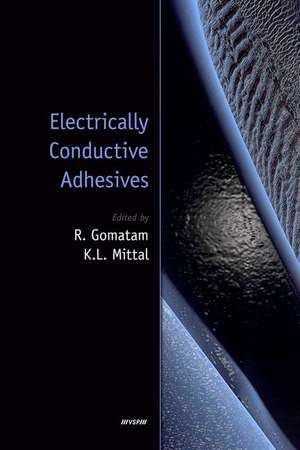
Electrically Conductive Adhesives
Autor Rajesh Gomatam, Kash L. Mittalen Limba Engleză Hardback – 23 dec 2008
Preț: 2230.71 lei
Preț vechi: 2451.34 lei
-9%
Puncte Express: 3346
Carte disponibilă
Livrare economică 28 octombrie-11 noiembrie
Livrare express 13-17 octombrie pentru 30.63 lei
Livrare prin curier în România Termenul estimat este afișat lângă disponibilitate.
Transport gratuit pentru acest produs Plată online sau ramburs, în funcție de opțiunile comenzii.
Retur gratuit în 14 zile Comandă securizată și suport în română.
Specificații
ISBN-13: 9789004165922
ISBN-10: 9004165924
Pagini: 426
Dimensiuni: 156 x 234 x 23 mm
Greutate: 0.4 kg
Ediția:1
Editura: CRC Press
Colecția CRC Press
ISBN-10: 9004165924
Pagini: 426
Dimensiuni: 156 x 234 x 23 mm
Greutate: 0.4 kg
Ediția:1
Editura: CRC Press
Colecția CRC Press
V-ar putea interesa
-
 Contact Angle, Wettability and Adhesion, Volume 5Kash L. Mittal-15%Preț: 523.74 lei616.17 lei
 -
 Catalysis and Surface Properties of Liquid Metals and AlloysYoshisada Ogino-18%Preț: 2313.81 lei2821.71 lei
 -
 Chemical Reaction Networks: A Graph-Theoretical ApproachOleg N. Temkin-18%Preț: 1695.15 lei2067.25 lei
 -
 Liquid-Liquid InterfacesTheory and MethodsAlexander G. Volkov-18%Preț: 2659.83 lei3243.69 lei
 -
 Electroactive MaterialsJürgen O. Besenhard-20%Preț: 617.49 lei771.87 lei
 -
 Li-Mg ... Nd-ZrK. Schäfer-27%Preț: 11408.88 lei15628.60 lei
 -
 Ni-Np ... Pt-ZrB. Predel-27%Preț: 11187.02 lei15324.69 lei
 -
 Qualitätskontrolle von ImpfstoffenPatric U. B. VogelPreț: 123.72 lei
 -
 Topological Indices and Related Descriptors in QSAR and QSPRJames Devillers-23%Preț: 3779.62 lei4908.60 lei
 -
 Chemical Physics of Molecular Condensed MatterKazuya Saito-18%Preț: 914.76 lei1115.56 lei
Cuprins
Preface, Part 1: Introduction and Recent Developments Using Electrically Conductive Inks and Adhesives as a Means to Satisfy European PCB Manufacturing Directives, Part 2: Mechanical Durability and Reliability Aspects Reliability of Anisotropic Conductive Adhesive Joints in Electronic Packaging Applications Y. C. Lin and X. Chen Drop Test Performance of Isotropic Electrically Conductive Adhesives, Part 3: Characterization and Properties Novel Techniques for Characterization of Fast-Cure Anisotropic Conductive and Non-conductive Adhesives M. Teo Chemorheology of Epoxy/Nickel Conductive Adhesives During Processing and Cure
Descriere
Environmentally-friendly ECAs offer many advantages vis-a-vis solder, such as simple and low-temperature processing conditions, better thermo mechanical performance and finer pitch. This book is based on the two Special Issues of the Journal of Adhesion Science and Technology (JAST vol. 22, no. 8-9 and vol. 22, no. 14) dedicated to this topic. The book contains a total of 21 papers (reflecting overviews and original research) and is divided into three parts as follows: Part 1: Introduction and Recent Developments, Part 2: Mechanical, Durability and Reliability Aspects and Part 3: Characterization and Properties.