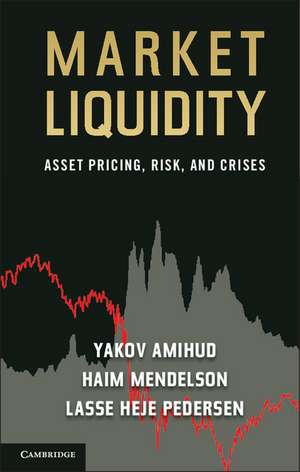
Market Liquidity: Asset Pricing, Risk, and Crises
Autor Yakov Amihud, Haim Mendelson, Lasse Heje Pedersenen Limba Engleză Paperback – 11 noi 2012
În climatul economic actual, marcat de volatilitate și de o reevaluare drastică a riscurilor sistemice, înțelegerea mecanismelor care guvernează lichiditatea nu mai este doar o opțiune academică, ci o necesitate strategică pentru orice profesionist din finanțe. Suntem de părere că Market Liquidity reprezintă o resursă esențială pentru a descifra cum costurile de tranzacționare și timpul necesar pentru descărcarea unei poziții mari influențează direct evaluarea activelor. Premisa cărții este clară și autoritară: nelichiditatea nu este doar un inconvenient operațional, ci un factor determinant de preț care solicită o primă de risc specifică.
Ca și Craig Holden în The Empirical Analysis of Liquidity, autorii distilează experiență reală în principii acționabile, însă Yakov Amihud, Haim Mendelson și Lasse Heje Pedersen merg mai departe, oferind un cadru teoretic robust care leagă lichiditatea activelor individuale de lichiditatea de finanțare a întregii piețe. Cartea este structurată riguros în trei părți: începe cu impactul bid-ask spread-ului asupra prețurilor, avansează către modelele de risc de lichiditate și culminează cu o analiză a crizelor financiare. Această progresie permite cititorului să înțeleagă nu doar 'ce' se întâmplă cu prețurile, ci și 'de ce' apar spiralele de lichiditate în momente de stres, precum cel din 1987. Apreciem în mod deosebit echilibrul dintre rigoarea matematică (susținută de tabele și ilustrații) și aplicabilitatea practică, trăsătură care definește întreaga operă a lui Amihud, vizibilă și în lucrările sale anterioare despre fuziuni bancare sau volatilitatea cursului de schimb.
Preț: 328.62 lei
Carte tipărită la comandă
Livrare economică 08-22 iunie
Specificații
ISBN-10: 0521139651
Pagini: 292
Ilustrații: 32 b/w illus. 27 tables
Dimensiuni: 17 x 229 x 152 mm
Greutate: 0.39 kg
Ediția:New.
Editura: Cambridge University Press
Colecția Cambridge University Press
Locul publicării:Cambridge, United Kingdom
V-ar putea interesa
-
 Crisis Economics: A Crash Course in the Future of FinanceNouriel Roubini-20%Preț: 60.82 lei75.89 lei
 -
 Market Liquidity: Theory, Evidence, and PolicyThierry Foucault-10%Preț: 314.14 lei350.82 lei
 -
 Risk and LiquidityHyun Song Shin-22%Preț: 228.57 lei292.91 lei
 -
 Market Liquidity: Theory, Evidence, and PolicyThierry Foucault-33%Preț: 517.48 lei775.17 lei
 -
 The Most Important ThingHoward MarksPreț: 157.53 lei
 -
 Most Important Thing IlluminatedHoward MarksPreț: 157.45 lei
 -
 Macroeconomics in Times of Liquidity CrisesGuillermo A. CalvoPreț: 272.31 lei
 -
 Intermediate Financial TheoryJean-Pierre Danthine-34%Preț: 425.40 lei646.34 lei
 -
 Irrational ExuberanceRobert J. ShillerPreț: 115.07 lei
 -
 Adaptive MarketsAndrew W. LoPreț: 139.68 lei
 -
 The Economics of Over-the-Counter MarketsBenjamin LesterPreț: 348.97 lei
 -
 Asset-Liability and Liquidity ManagementPooya FarahvashPreț: 347.91 lei
 -
 Asset AllocationMark P KritzmanPreț: 228.13 lei
 -
 The Little Book of Market MythsKen FisherPreț: 141.56 lei
 -
 Liquidity, Interest Rates & BankingJeffrey Morrey-30%Preț: 997.47 lei1426.43 lei
 -
 -26%Preț: 924.03 lei1242.10 lei
 -
 How to Listen When Markets SpeakLawrence McDonaldPreț: 88.30 lei
 -
 The (Mis)Behaviour of Markets: A Fractal View of Risk, Ruin and RewardBenoit B. Mandelbrot-20%Preț: 70.68 lei88.83 lei
 -
 Capital WarsMichael J. Howell-17%Preț: 395.09 lei476.01 lei
De ce să citești această carte
Recomandăm această carte analiștilor financiari și investitorilor instituționali care doresc să cuantifice riscul de lichiditate în portofoliile lor. Veți învăța cum să ajustați modelele de evaluare a activelor pentru a include costurile de tranzacționare și cum să identificați semnalele unei crize de lichiditate iminente. Este un instrument indispensabil pentru a transforma un concept abstract într-un avantaj competitiv în gestionarea riscului.
Despre autor
Yakov Amihud este profesor de finanțe (Ira Rennert Chair) la Stern School of Business, New York University, fiind unul dintre cei mai respectați cercetători în domeniul microstructurii pieței. Expertiza sa este recunoscută la nivel mondial, servind drept consultant pentru burse majore precum NYSE și Chicago Board of Trade. În lucrările sale anterioare, cum ar fi Bank Mergers & Acquisitions sau Exchange Rates and Corporate Performance, Amihud a explorat modul în care structura pieței și factorii macroeconomici influențează deciziile corporative, consolidându-și reputația de autoritate în evaluarea activelor și designul sistemelor de tranzacționare.
Descriere scurtă
Cuprins
Recenzii
'Over the past quarter century, the research contributions of Amihud, Mendelson, and Pedersen have been central to an understanding of the determinants and pricing of market liquidity and liquidity risk. This collection places the best available work on the topic between two covers. It must be read by anyone following this subject area.' Darrell Duffie, Stanford University
'The liquidity of financial markets has never been a more important topic of research and policy and this book gives a very accessible way to understand both the traditional and current research. The book reproduces eight papers that range from the seminal work that defined the field starting in the 1980s to the recent research based on the analysis of the financial crisis. A particular feature of the book is the series of extended introductions to each of the papers, written nontechnically to summarize each paper and how it fits into future research - they will transport you to a first rate graduate classroom.' Robert Engle, Nobel Laureate and Director, Volatility Institute, New York University
'The term 'market liquidity' means different things to different people at different times. Distinguishing, defining, and measuring the different meanings is an important activity, especially now, after four years of financial crises. This collection of scientific papers by eminent scholars is an important contribution to understanding market frictions and arrangements to manage them.' Thomas Sargent, Nobel Laureate, New York University
'The authors have made substantial contributions in microstructure, and especially in the understanding of liquidity, for years. This collection of their best articles on liquidity is particularly timely given the growing realization of the macro pathology caused by a financial-crisis-induced recession. They present strong evidence that a liquidity spiral hurts post-recession real investment.' David Whitcomb, author of Securities Market Microstructure and Founder, Automated Trading Desk