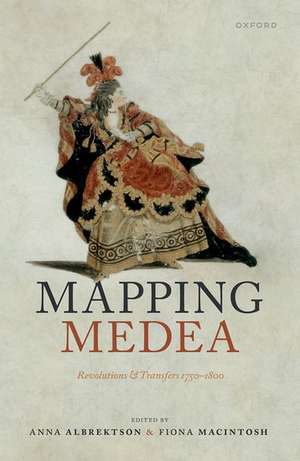
Mapping Medea: Revolutions and Transfers 1750-1800
Editat de Anna Albrektson, Fiona Macintoshen Limba Engleză Hardback – 25 sep 2023
Preț: 613.31 lei
Preț vechi: 843.32 lei
-27%
Puncte Express: 920
Carte disponibilă
Livrare economică 12-18 noiembrie
Livrare express 27-31 octombrie pentru 90.53 lei
Livrare prin curier în România Termenul estimat este afișat lângă disponibilitate.
Transport gratuit pentru acest produs Plată online sau ramburs, în funcție de opțiunile comenzii.
Retur gratuit în 14 zile Comandă securizată și suport în română.
Specificații
ISBN-13: 9780192884190
ISBN-10: 0192884190
Pagini: 272
Ilustrații: 50 black and white illustrations
Dimensiuni: 162 x 241 x 18 mm
Greutate: 0.59 kg
Editura: OUP OXFORD
Colecția OUP Oxford
Locul publicării:Oxford, United Kingdom
ISBN-10: 0192884190
Pagini: 272
Ilustrații: 50 black and white illustrations
Dimensiuni: 162 x 241 x 18 mm
Greutate: 0.59 kg
Editura: OUP OXFORD
Colecția OUP Oxford
Locul publicării:Oxford, United Kingdom
V-ar putea interesa
-
 -30%Preț: 754.63 lei1084.78 lei
 -
 -30%Preț: 933.51 lei1339.10 lei
 -
 Seamus Heaney and the Classics: Bann Valley MusesStephen Harrison-18%Preț: 728.04 lei887.05 lei
 -
 Performing Epic or Telling TalesFiona Macintosh-29%Preț: 542.37 lei767.51 lei
 -
 -33%Preț: 1394.45 lei2075.08 lei
 -
 Agamemnon in Performance 458 BC to AD 2004Fiona Macintosh-31%Preț: 1019.12 lei1475.99 lei
 -
 -22%Preț: 529.41 lei680.61 lei
 -
 The Oxford Handbook of Greek Drama in the AmericasKathryn Bosher-32%Preț: 875.76 lei1281.11 lei
 -
 Choruses, Ancient and ModernJoshua Billings-31%Preț: 856.83 lei1241.81 lei
 -
 Ben JonsonJames Loxley-18%Preț: 1117.60 lei1362.94 lei
 -
 Women and Race in Early Modern TextsJoyce Green MacDonald-14%Preț: 678.82 lei789.33 lei
 -
 Literature and Utopian Politics in Seventeenth-Century EnglandRobert Appelbaum-14%Preț: 680.40 lei791.16 lei
 -
 Preț: 316.31 lei
 -
 Gothic writing 1750-1820Robert MilesPreț: 222.99 lei
 -
 Before the Boom: Latin American Revolutionary Novels of the 1920sElizabeth Coonrod Martínez-25%Preț: 361.48 lei480.81 lei
 -
 -15%Preț: 437.99 lei515.28 lei
 -
 -15%Preț: 454.86 lei535.12 lei
 -
 Staging the Superstitions of Early Modern EuropeAndrew D. McCarthy-15%Preț: 444.50 lei522.94 lei
 -
 -15%Preț: 473.40 lei556.94 lei
 -
 -15%Preț: 439.90 lei517.54 lei
 -
 Masculinity and Marian Efficacy in Shakespeare's EnglandRuben Espinosa-15%Preț: 473.86 lei557.49 lei
 -
 Carnival and Literature in Early Modern EnglandJennifer C. Vaught-15%Preț: 437.26 lei514.43 lei
 -
 -15%Preț: 483.17 lei568.43 lei
 -
 -15%Preț: 473.04 lei556.51 lei
 -
 Renaissance Drama on the EdgeLisa HopkinsPreț: 357.72 lei
 -
 Ovid and the Renaissance BodyGoran StanivukovicPreț: 431.43 lei
Recenzii
The importance of the volume lies in its detailed investigation of a period and its versions and aspects of the Medea story that are not well known. It thus sheds light on a part of modern reception history that has hitherto been rather overshadowed. The volume is amply illustrated in black and white. This is helpful, especially in Dotlačilová's 'Visual Narrative: The Role of Costumes in Noverre's ballet d'action, Médée et Jason'. There is an index and a useful list of manuscript sources.
Notă biografică
Anna Albrektson (FKA Cullhed) is Professor of Literature at Stockholm University. She has published on eighteenth- and nineteenth-century European poetics, and Swedish sentimental literature. Her current research concerns ecocriticism and Swedish literature, 1780-1840. Her project 'Moving Medea: The Transcultural stage in the Eighteenth Century' was funded by the Swedish Foundation for Humanities and Social Sciences. Albrektson is a former President of the Swedish Society for Eighteenth-Century Studies.Fiona Macintosh is Professor of Classical Reception, Director of the Archive of Performances of Greek and Roman Drama (APGRD), and Fellow of St Hilda's College, University of Oxford. She is the author of Dying Acts (1994), Greek Tragedy and the British Theatre 1660-1914 (OUP, 2005--with Edith Hall), Sophocles' Oedipus Tyrannus (2009), and Performing Epic or Telling Tales (OUP, 2020--with Justine McConnell). She has edited nine APGRD volumes, most recently Epic Performances from the Middle Ages into the Twenty-First Century (OUP, 2018) and Seamus Heaney and the Classics (OUP, 2019).
Cuprins
- 1: Anna Albrektson and Fiona Macintosh: Mapping Medea: Revolutions and Transfers 1750-1800
- I: Medea in an Expanding Eighteenth-Century World
- 2: Edith Hall: Pushing the Boundaries of Operatic Convention and European Identity: Generic and Historical Perspectives on Georg Benda's 1775 Medea
- 3: Larisa Nikiforova: Medea's Russian Images on Stage and in Literature: The Politics and Poetics of Female Characters
- 4: Anthony John Lappin: An Imperial Medea: Spain, Portugal, the Colonies
- 5: Anna Albrektson: Inverting the Barbarian: Estrangement and Excess in the Eighteenth-Century Medea
- II: Local Interpretations and Global Issues: Ontology and Form
- 6: Fiona Macintosh: From Hearth to Hades: Breaking Boundaries with Medea and ballet d'action
- 7: Jörg Krämer: Shaping Complexity: Medea in the German-Language Theatre of the Eighteenth Century
- 8: Petra Dotläilová: Visual Narrative: The Role of Costumes in Noverre's ballet d'action, Médée et Jason
- 9: Zoé Schweitzer: Medea as Infanticidal Mother in the Late Eighteenth-Century Theatre
- 10: Roland Lysell: Medea--Sorceress or Woman? c.1750 and Beyond
- Bibliography
- Index