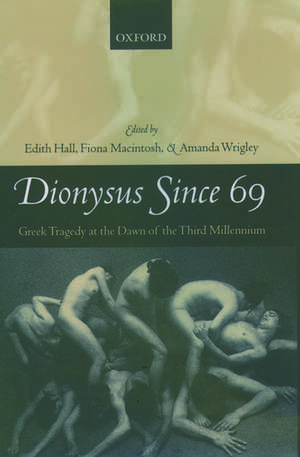
Dionysus Since 69: Greek Tragedy at the Dawn of the Third Millennium
Editat de Edith Hall, Fiona Macintosh, Amanda Wrigleyen Limba Engleză Hardback – 8 ian 2004
Preț: 1394.45 lei
Preț vechi: 2075.08 lei
-33%
Puncte Express: 2092
Carte tipărită la comandă
Livrare economică 27 noiembrie-08 decembrie
Livrare prin curier în România Termenul estimat este afișat lângă disponibilitate.
Transport gratuit pentru acest produs Plată online sau ramburs, în funcție de opțiunile comenzii.
Retur gratuit în 14 zile Comandă securizată și suport în română.
Specificații
ISBN-13: 9780199259144
ISBN-10: 0199259143
Pagini: 500
Ilustrații: numerous halftones
Dimensiuni: 145 x 223 x 32 mm
Greutate: 0.84 kg
Editura: OUP OXFORD
Colecția OUP Oxford
Locul publicării:Oxford, United Kingdom
ISBN-10: 0199259143
Pagini: 500
Ilustrații: numerous halftones
Dimensiuni: 145 x 223 x 32 mm
Greutate: 0.84 kg
Editura: OUP OXFORD
Colecția OUP Oxford
Locul publicării:Oxford, United Kingdom
V-ar putea interesa
-
 The Oxford Anthology of Roman LiteraturePeter E. Knox-9%Preț: 406.63 lei446.93 lei
 -
 -30%Preț: 933.51 lei1339.10 lei
 -
 Seamus Heaney and the Classics: Bann Valley MusesStephen Harrison-19%Preț: 709.97 lei871.66 lei
 -
 Pindar's Songs for Young Athletes of AiginaAnne Pippin Burnett-31%Preț: 867.29 lei1261.69 lei
 -
 -31%Preț: 1026.10 lei1493.77 lei
 -
 Chaucer and Italian TextualityK. P. Clarke-31%Preț: 960.65 lei1399.77 lei
 -
 -22%Preț: 529.41 lei680.61 lei
 -
 The Oxford Handbook of Greek Drama in the AmericasKathryn Bosher-32%Preț: 875.76 lei1281.11 lei
 -
 -31%Preț: 967.46 lei1408.61 lei
 -
 Choruses, Ancient and ModernJoshua Billings-31%Preț: 856.83 lei1241.81 lei
 -
 -14%Preț: 660.59 lei768.13 lei
 -
 -31%Preț: 692.16 lei1006.20 lei
 -
 -34%Preț: 659.96 lei1005.82 lei
 -
 -34%Preț: 742.83 lei1123.92 lei
 -
 The War with God: Theomachy in Roman Imperial PoetryPramit Chaudhuri-34%Preț: 670.11 lei1011.96 lei
 -
 Ovid (Routledge Revivals)J. Binns-18%Preț: 1412.81 lei1722.93 lei
 -
 Remaking the Classics: Literature, Genre and Media in Britain 1800-2000Dr. Christopher Stray-33%Preț: 959.84 lei1430.83 lei
 -
 Iambic Poetics in the Roman EmpireTom Hawkins-14%Preț: 745.31 lei866.64 lei
 -
 Essays on Eddic PoetryJohn Mckinnell-29%Preț: 218.02 lei307.50 lei
 -
 Dante's Journey to PolyphonyFrancesco Ciabattoni-24%Preț: 199.05 lei262.87 lei
 -
 Life in WordsJill Mann-26%Preț: 409.87 lei557.19 lei
 -
 Diachrony and Synchrony in English Corpus LinguisticsAlejandro Alcaraz-Sintes-27%Preț: 720.58 lei987.10 lei
 -
 Fabulous Ireland. Ibernia FabulosaEric Haywood-23%Preț: 491.70 lei638.57 lei
 -
 Ancient EthicsProf. Dr. Jörg Hardy-9%Preț: 564.02 lei619.80 lei
Recenzii
Hall's 46-page introduction to the volume is one of the best pieces that have been written so far in the area of Reception Studies of classical texts, and ought to be mandatory reading for anyone interested in this area.
...a major contribution to the year's work
...reveals a wealth of understanding concerning the ways Greek tragedy has been read, received, interpreted and shared in recent decades, and points the way forward to other studies in this ever-increasing field.
The quality of the contributions is uniformly high ... The range of methods is appealingly wide, providing readers with fascinating material ... Collectively, the volume gives an extremely stimulating up-to-date account of Greek tragedy in the last thirty or forty years ... deserves a wide readership ... The writing is accessible; illustrations are well selected ... index and bibliography are very detailed.
...a major contribution to the year's work
...reveals a wealth of understanding concerning the ways Greek tragedy has been read, received, interpreted and shared in recent decades, and points the way forward to other studies in this ever-increasing field.
The quality of the contributions is uniformly high ... The range of methods is appealingly wide, providing readers with fascinating material ... Collectively, the volume gives an extremely stimulating up-to-date account of Greek tragedy in the last thirty or forty years ... deserves a wide readership ... The writing is accessible; illustrations are well selected ... index and bibliography are very detailed.
Notă biografică
Edith Hall is Leverhulme Professor of Greek Cultural History at the University of Durham and Co-Director of the Archive of Performances of Greek and Roman Drama, University of OxfordFiona Macintosh is Senior Research Fellow at the Archive of Performances of Greek and Roman Drama, University of OxfordAmanda Wrigley is Researcher at the Archive of Performances of Greek and Roman Drama, University of Oxford
Cuprins
- 1: Edith Hall: Introduction: Why Greek tragedy since the late 1960s?
- 1. Dionysus and the Sex War
- 2: Froma Zeitlin: Dionysus in '69
- 3: Helene Foley: Bad women: gender politics in late twentieth-century performance and revision of Greek tragedy
- 4: Kathleen Riley: Heracles as Dr Strangelove and GI Joe: male heroism deconstructed
- 2. Dionysus in Politics
- 5: Oliver Taplin: Sophocles' Philoctetes, Seamus Heaney's, and some other recent half-rhymes
- 6: Edith Hall: Aeschylus, race, class, and war in the 1990s
- 7: Pantelis Michelakis: Greek tragedy in cinema: theatre, politics, history
- 8: Lorna Hardwick: Greek drama and anti-colonialism: decolonising Classics
- 3. Dionysus and the Aesthetics of Performance
- 9: David Wiles: The use of masks in modern performances of Greek tragedy
- 10: Katharine Worth: Greek notes in Samuel Beckett's theatre art
- 11: Peter Brown: Greek Tragedy in late twentieth-century opera
- 4. Dionysus and the Life of the Mind
- 12: Fiona Macintosh: Oedipus in the East End: from Freus to Berkoff
- 13: Erika Fischer-Lichte: Thinking about the origins of theatre in the 1970s
- 14: Timberlake Wertenbaker: The voices we hear
- 15: Amanda Wrigley: Details of productions discussed