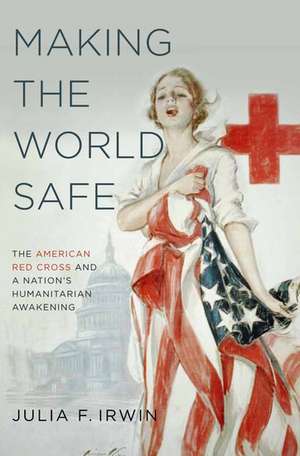
Making the World Safe: The American Red Cross and a Nation's Humanitarian Awakening
Autor Julia F. Irwinen Limba Engleză Paperback – 20 apr 2017
Preț: 338.29 lei
Preț vechi: 417.99 lei
-19%
Puncte Express: 507
Carte tipărită la comandă
Livrare economică 27 noiembrie-08 decembrie
Livrare prin curier în România Termenul estimat este afișat lângă disponibilitate.
Transport gratuit de la 400.00 lei Plată online sau ramburs, în funcție de opțiunile comenzii.
Retur gratuit în 14 zile Comandă securizată și suport în română.
Specificații
ISBN-13: 9780190610746
ISBN-10: 0190610743
Pagini: 290
Ilustrații: 15 illus.
Dimensiuni: 155 x 231 x 18 mm
Greutate: 0.43 kg
Editura: Oxford University Press
Colecția OUP USA
Locul publicării:New York, United States
ISBN-10: 0190610743
Pagini: 290
Ilustrații: 15 illus.
Dimensiuni: 155 x 231 x 18 mm
Greutate: 0.43 kg
Editura: Oxford University Press
Colecția OUP USA
Locul publicării:New York, United States
V-ar putea interesa
-
 America, Empire of LibertyDavid Reynolds-18%Preț: 113.82 lei138.24 lei
 -
 Rise to GlobalismStephen E. AmbrosePreț: 122.06 lei
 -
 -27%Preț: 445.47 lei610.17 lei
 -
 -28%Preț: 370.24 lei512.85 lei
 -
 -16%Preț: 138.65 lei164.29 lei
 -
 -15%Preț: 220.00 lei260.01 lei
 -
 -21%Preț: 424.24 lei535.75 lei
 -
 -16%Preț: 189.22 lei225.96 lei
 -
 Challenging US Foreign PolicyB. SewellPreț: 396.85 lei
 -
 America since 1945: The American MomentPaul Levine-23%Preț: 252.20 lei327.56 lei
 -
 Tejano Journey, 1770-1850Gerald E. PoyoPreț: 160.93 lei
 -
 The American Civil WarJohn Keegan-18%Preț: 88.26 lei108.17 lei
 -
 The Long Road to BaghdadLloyd C GardnerPreț: 190.13 lei
 -
 George S. PattonSteven J. Zaloga-33%Preț: 75.54 lei113.10 lei
 -
 Roughshod Through Dixie: Grierson’s Raid 1863Mark Lardas-31%Preț: 84.55 lei123.13 lei
 -
 ConquistadorsMichael Wood-29%Preț: 84.20 lei118.99 lei
Recenzii
Irwin shows that the Red Cross did more than change itself. In effect it used the war and the aftermath in which American power and prestige grew to reshape European society and the global Red Cross movement as a proactive charity.... Exhaustive and fresh in its research, and mature in its judgments, the book is notable in part because it fills a major gap in our knowledge.... Irwin provides an important contribution to the reinterpretation of the Progressive Era's international engagement and to the study of twentieth-century international organizations.
Julia F. Irwin's Making the World Safe, only the second book-length treatment of the American Red Cross (arc), provides a welcome update to the historical record. Irwin makes a convincing case that the story of the arc is inextricable from the story of international relations in the United States: we cannot hope to understand either American interventionism or isolationism by focusing on the political realm alone.
Irwin has provided a textured and needed perspective on a critical and overlooked piece of the U.S. humanitarian establishment by explaining the years that were a formative forge for the American Red Cross.... Rather than a simple institutional history of a crucial actor Irwin has provided us a textured view of a critical agent in the evolution of humanitarianism in the United States that illuminates a diverse set of historical themes.
Julia F. Irwin shows that the Red Cross's rapid growth during World War I is a significant event that raises deep questions about the role charities should play in our country's diplomatic efforts... Irwin reminds us that the role Americans play overseas is complex and deeply rooted in our nation's history.
Irwin, in a crisply written and stimulating book, has made a persuasive case that to understand fully the development of international humanitarianism later in the 20th century we must look to the American Red Cross overseas relief work during World War I. Students of American Foreign Relations and humanitarianism alike will be rewarded by reading this book.
Focusing on the American Red Cross, Julia Irwin traces a tradition of international humanitarianism in the United States from the late nineteenth century through World War II. Her work provides a significant building-block in understanding how the ARC assisted the state in waging war and also built capacity for efforts of international civilian relief.
In Making the World Safe, Julia Irwin offers an impressive history of a new form of American humanitarianism by tracing the rise of the American Red Cross. She convincingly shows how, in close concert with government officials at home and abroad, the Red Cross both encouraged and channeled a new kind of global humanitarianism. Deeply researched and full of personal stories of Red Cross rank-and-file, Irwin offers an impressive social history of American internationalism in the nineteenth and twentieth centuries.
Though focused on the American Red Cross and its international civilian relief efforts in the early twentieth century, this book is about far more than emergency housing, food provisioning, health care, and hygienic education. It is about the growing conviction that the United States people-and increasingly their government-should provide overseas humanitarian assistance for moral and political reasons. Covering a pivotal period in the history of U.S. aid, Irwin shows how an organization founded to assist the wounded became a progressive force for peace as well as an instrument of national policy. This is a book of both contemporary relevance and lasting significance.
Making the World Safe uses the untold history of the Red Cross to explore how the generation of Americans who lived through the Great War responded to the global devastation that surrounded them. Written with clarity and a humane sensibility, it is a model of the most exciting new scholarship about America and the world.
In Making the World Safe, Julia Irwin shows the way American civilians facilitated the projection of American global power through Red Cross humanitarian efforts. Fascinating, deeply researched, and effective.
A very moving book about the American Red Cross and the excellent work that they perform.
Julia F. Irwin's Making the World Safe, only the second book-length treatment of the American Red Cross (arc), provides a welcome update to the historical record. Irwin makes a convincing case that the story of the arc is inextricable from the story of international relations in the United States: we cannot hope to understand either American interventionism or isolationism by focusing on the political realm alone.
Irwin has provided a textured and needed perspective on a critical and overlooked piece of the U.S. humanitarian establishment by explaining the years that were a formative forge for the American Red Cross.... Rather than a simple institutional history of a crucial actor Irwin has provided us a textured view of a critical agent in the evolution of humanitarianism in the United States that illuminates a diverse set of historical themes.
Julia F. Irwin shows that the Red Cross's rapid growth during World War I is a significant event that raises deep questions about the role charities should play in our country's diplomatic efforts... Irwin reminds us that the role Americans play overseas is complex and deeply rooted in our nation's history.
Irwin, in a crisply written and stimulating book, has made a persuasive case that to understand fully the development of international humanitarianism later in the 20th century we must look to the American Red Cross overseas relief work during World War I. Students of American Foreign Relations and humanitarianism alike will be rewarded by reading this book.
Focusing on the American Red Cross, Julia Irwin traces a tradition of international humanitarianism in the United States from the late nineteenth century through World War II. Her work provides a significant building-block in understanding how the ARC assisted the state in waging war and also built capacity for efforts of international civilian relief.
In Making the World Safe, Julia Irwin offers an impressive history of a new form of American humanitarianism by tracing the rise of the American Red Cross. She convincingly shows how, in close concert with government officials at home and abroad, the Red Cross both encouraged and channeled a new kind of global humanitarianism. Deeply researched and full of personal stories of Red Cross rank-and-file, Irwin offers an impressive social history of American internationalism in the nineteenth and twentieth centuries.
Though focused on the American Red Cross and its international civilian relief efforts in the early twentieth century, this book is about far more than emergency housing, food provisioning, health care, and hygienic education. It is about the growing conviction that the United States people-and increasingly their government-should provide overseas humanitarian assistance for moral and political reasons. Covering a pivotal period in the history of U.S. aid, Irwin shows how an organization founded to assist the wounded became a progressive force for peace as well as an instrument of national policy. This is a book of both contemporary relevance and lasting significance.
Making the World Safe uses the untold history of the Red Cross to explore how the generation of Americans who lived through the Great War responded to the global devastation that surrounded them. Written with clarity and a humane sensibility, it is a model of the most exciting new scholarship about America and the world.
In Making the World Safe, Julia Irwin shows the way American civilians facilitated the projection of American global power through Red Cross humanitarian efforts. Fascinating, deeply researched, and effective.
A very moving book about the American Red Cross and the excellent work that they perform.
Notă biografică
Julia F. Irwin is Associate Professor of History at the University of South Florida.