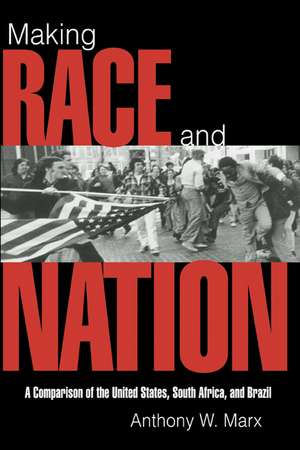
Making Race and Nation
Autor Anthony W. Marx Editat de Peter Lange, Robert H. Batesen Limba Engleză Paperback – oct 1998
Preț: 215.61 lei
Puncte Express: 323
Carte disponibilă
Livrare economică 02-16 noiembrie
Livrare prin curier în România Termenul estimat este afișat lângă disponibilitate.
Transport gratuit de la 400.00 lei Plată online sau ramburs, în funcție de opțiunile comenzii.
Retur gratuit în 14 zile Comandă securizată și suport în română.
Specificații
ISBN-13: 9780521585903
ISBN-10: 0521585902
Pagini: 412
Dimensiuni: 152 x 229 x 24 mm
Greutate: 0.67 kg
Ediția:Pbk.
Editura: Cambridge University Press
Locul publicării:New York, United States
ISBN-10: 0521585902
Pagini: 412
Dimensiuni: 152 x 229 x 24 mm
Greutate: 0.67 kg
Ediția:Pbk.
Editura: Cambridge University Press
Locul publicării:New York, United States
V-ar putea interesa
-
 EU Consumer Law and Human RightsIris Benöhr-31%Preț: 899.88 lei1313.46 lei
 -
 Beyond Disagreement: Open Remedies in Human Rights AdjudicationAruna Sathanapally-31%Preț: 978.34 lei1424.12 lei
 -
 Genocide and the EuropeansKaren E Smith-19%Preț: 177.02 lei219.77 lei
 -
 Human Rights, State Compliance, and Social ChangeRyan GoodmanPreț: 249.91 lei
 -
 The Legacies of LawJens MeierhenrichPreț: 347.97 lei
 -
 Mobilizing for Human RightsBeth A. SimmonsPreț: 311.21 lei
 -
 Creating CapabilitiesMartha C. NussbaumPreț: 171.18 lei
 -
 Shadow Lives: The Forgotten Women of the War on TerrorVictoria BrittainPreț: 171.69 lei
 -
 DispossessionJudith ButlerPreț: 147.32 lei
 -
 Collective RightsMiodrag A. Jovanovic-14%Preț: 753.98 lei876.72 lei
 -
 -14%Preț: 741.54 lei862.25 lei
 -
 René Cassin and Human RightsJay WinterPreț: 224.23 lei
 -
 -27%Preț: 1000.00 lei1362.72 lei
 -
 Iran & Iraq: Human Rights ReportsKyle T Hunt-27%Preț: 999.12 lei1362.16 lei
 -
 Afghanistan & Pakistan: Human Rights ReportsClarence J Peters-27%Preț: 998.68 lei1361.87 lei
 -
 Venezuela: Profiles, Foreign Relations & Human RightsTyler M Rutledge-27%Preț: 888.52 lei1210.34 lei
 -
 The LandgrabbersFred Pearce-55%Preț: 59.61 lei133.53 lei
Cuprins
Preface and acknowledgements; 1. Introduction; Part I. Historical and Cultural Legacies: 2. Trajectories from colonialism; 3. Lessons from slavery; 4. The uncertain legacy of miscegenation; Implications; Part II. Racial Domination and the Nation-State: 5. 'Wee for thee, South Africa': the racial state; 6. 'To bind up the nation's wounds': the United States after the Civil War; 7. 'Order and progress': inclusive nation-state building in Brazil; Comparative racial domination: an overview; Part III. Race Making from Below: 8. 'We are a rock': Black racial identity, mobilization and the new South Africa; 9. Burying Jim Crow: Black racial identity, mobilization and reform in the United States; 10. Breaching Brazil's pact of silence; 11. Conclusion; Notes; Bibliography; Index.
Recenzii
'… Marx's book is the only systematic and detailed comparison of race and racism in all three countries yet to appear … his bold and provocative argument illuminates an important and previously neglected facet of the comparative history of race relations. He has brought the state into the discussion of how race is made in a way that will make it impossible to ignore in the future'. The New York Review
Descriere
This book uses comparisons of South Africa, the United States, and Brazil to reveal patterns about race, nation, state and class dynamics.