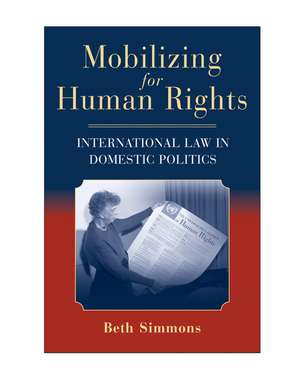
Mobilizing for Human Rights: International Law in Domestic Politics
Autor Beth A. Simmonsen Limba Engleză Paperback – 30 aug 2009
Ceea ce aduce nou Mobilizing for Human Rights în peisajul literaturii juridice și politice este o demonstrație riguroasă a modului în care dreptul internațional influențează direct politica internă, dincolo de simpla diplomație între state. Ne-a atras atenția abordarea inovatoare a autoarei Beth A. Simmons, care refuză viziunea pesimistă conform căreia tratatele internaționale ar fi simple bucăți de hârtie fără impact real. În loc să se concentreze pe mecanismele de sancționare ale ONU, volumul explorează modul în care ratificarea unui tratat devine un instrument de mobilizare pentru cetățeni și organizațiile locale.
Prin utilizarea a 23 de tabele și a unei analize statistice complexe, lucrarea oferă dovezi clare că, în medie, statele care ratifică tratate de drepturile omului înregistrează progrese în protecția libertăților civile. Cititorii familiarizați cu Irrational Human Rights? an Examination of International Human Rights Treaties de Naiade El-Khoury vor aprecia aici trecerea de la critica teoriilor raționale la un model empiric care validează utilitatea angajamentelor legale. În timp ce alte lucrări se concentrează pe „angajamentele nesincere”, Simmons demonstrează cum chiar și o ratificare strategică poate crea deschideri pentru schimbări democratice.
Această cercetare se integrează perfect în opera autoarei, completând temele abordate în International Law and International Relations și The Global Diffusion of Markets and Democracy. Dacă în lucrările anterioare Simmons analiza difuzia modelelor economice și politice, în acest volum publicat de Cambridge University Press ea rafinează mecanismul prin care normele juridice internaționale sunt „domesticite” și transformate în pârghii de putere pentru societatea civilă.
Preț: 286.36 lei
Carte tipărită la comandă
Livrare economică 08-22 iunie
Specificații
ISBN-10: 0521712327
Pagini: 472
Ilustrații: 30 b/w illus. 23 tables
Dimensiuni: 156 x 234 x 24 mm
Greutate: 0.68 kg
Ediția:New.
Editura: Cambridge University Press
Colecția Cambridge University Press
Locul publicării:New York, United States
V-ar putea interesa
-
 The Politics of Human RightsAndrew Vincent-8%Preț: 332.25 lei360.63 lei
 -
 -13%Preț: 351.49 lei402.16 lei
 -
 International Human Rights Law in AfricaFrans Viljoen-25%Preț: 656.84 lei874.34 lei
 -
 -22%Preț: 367.54 lei470.57 lei
 -
 Human Rights in the 21st CenturyM. GoodhartPreț: 382.91 lei
 -
 Getting It DoneTom DaschlePreț: 228.35 lei
 -
 Genocide and the EuropeansKaren E Smith-18%Preț: 165.52 lei201.15 lei
 -
 Preț: 243.30 lei
 -
 Preț: 328.84 lei
 -
 Collective Rights: A Legal TheoryMiodrag A. Jovanović-14%Preț: 737.41 lei857.45 lei
 -
 Islam and English Law: Rights, Responsibilities and the Place of Shari'aRobin Griffith-JonesPreț: 304.75 lei
 -
 Preț: 220.02 lei
 -
 Nothing to EnvyBarbara DemickPreț: 93.00 lei
 -
 Understanding the environment and social policyTony FitzpatrickPreț: 213.05 lei
 -
 Preț: 278.48 lei
De ce să citești această carte
Recomandăm această carte cercetătorilor și studenților la științe politice sau drept care doresc să înțeleagă impactul real al tratatelor internaționale. Cititorul câștigă o perspectivă bazată pe date, nu doar pe teorie, despre cum dreptul internațional poate deveni un instrument de schimbare socială. Este un contra-argument solid în fața cinismului politic, demonstrând că angajamentele legale ale statelor contează în lupta pentru drepturile omului.
Despre autor
Beth A. Simmons este profesor de afaceri internaționale „Clarence Dillon” și a condus Centrul Weatherhead pentru Afaceri Internaționale la Universitatea Harvard. Cu un doctorat obținut la Harvard, a predat la universități de prestigiu precum Duke și Berkeley. Expertiza sa acoperă relațiile internaționale, economia politică și dreptul internațional. Recunoașterea sa academică a fost confirmată încă din 1995, când volumul său despre politicile economice interbelice a fost premiat de American Political Science Association, Simmons fiind astăzi una dintre cele mai autoritare voci în studiul intersecției dintre lege și politică globală.
Descriere scurtă
Cuprins
Recenzii
'Mobilizing for Human Rights brilliantly combines theory and systematic empirical analysis to demonstrate how international human rights law affects state policies by altering the domestic political environment. Beth Simmons has written what will become a classic work integrating the study of international relations with that of domestic politics.' Robert O. Keohane, Woodrow Wilson School of Public and International Affairs, Princeton University
'This is a very powerful study of the impact of international law and the evolution of an international human rights regime. As Simmons notes, the development of such a regime has been a major change in world politics since World War II. Her book provides one of the most well articulated theories of why the human rights regime has evolved as an international treaty system. And it presents one of the most in depth empirical studies of the major elements of that regime. It advances the novel argument that governments sign and comply with human rights treaties because they mobilize domestic groups to demand such behavior. This book will make a major contribution to our study of world politics by showing that international law can matter and that the recognition of human rights can change the behavior of governments.' Helen V. Milner, Princeton University
'Simmons has written simply the most important new work by a social scientist on international law and human rights. This rigorous, persuasive, and theoretically eclectic book should be required reading for any scholar or graduate student interested in the topic.' Kathryn Sikkink, University of Minnesota
'This is one of the most important books on international human rights in decades. For more than thirty years, researchers have tried unsuccessfully to use regression analysis to show that human rights treaties make a difference. In this book, Harvard Professor Beth Simmons cracks the code, developing a well-grounded theory of political contexts in which signing a human rights treaty should yield improved human rights on the ground, and then offering rigorous statistical tests that confirm the theory. This book is a must read for anyone who wants to understand when and how human rights law works.' Professor Richard H. Steinberg, UCLA School of Law
'This book marshals theoretical arguments and empirical evidence to show that, under certain conditions, a state's public law-like commitment in the form of agreeing to an international human rights treaty has a noticeable positive impact on domestic human rights outcomes.' International Affairs