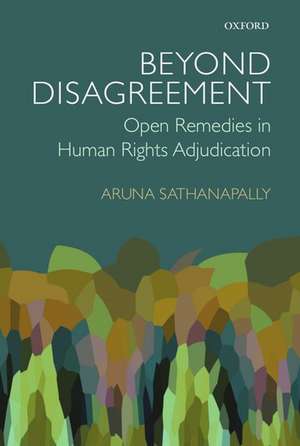
Beyond Disagreement: Open Remedies in Human Rights Adjudication
Autor Aruna Sathanapallyen Limba Engleză Hardback – 25 oct 2012
Preț: 978.34 lei
Preț vechi: 1424.12 lei
-31%
Puncte Express: 1468
Carte tipărită la comandă
Livrare economică 19-25 noiembrie
Livrare prin curier în România Termenul estimat este afișat lângă disponibilitate.
Transport gratuit pentru acest produs Plată online sau ramburs, în funcție de opțiunile comenzii.
Retur gratuit în 14 zile Comandă securizată și suport în română.
Specificații
ISBN-13: 9780199669301
ISBN-10: 0199669309
Pagini: 256
Dimensiuni: 162 x 241 x 22 mm
Greutate: 0.54 kg
Editura: OUP OXFORD
Colecția OUP Oxford
Locul publicării:Oxford, United Kingdom
ISBN-10: 0199669309
Pagini: 256
Dimensiuni: 162 x 241 x 22 mm
Greutate: 0.54 kg
Editura: OUP OXFORD
Colecția OUP Oxford
Locul publicării:Oxford, United Kingdom
V-ar putea interesa
-
 Blackstone's Guide to the Human Rights Act 1998John Wadham-26%Preț: 471.87 lei634.42 lei
 -
 Deference in Human Rights AdjudicationCora Chan-33%Preț: 614.35 lei911.04 lei
 -
 -18%Preț: 282.56 lei343.37 lei
 -
 -33%Preț: 649.58 lei963.89 lei
 -
 A Theory of Constitutional RightsRobert Alexy-22%Preț: 478.37 lei613.49 lei
 -
 Weak Courts, Strong RightsMark TushnetPreț: 255.00 lei
 -
 Equity and TrustsAlastair HudsonPreț: 383.22 leiRecomandat
 -
 Elliott & Quinn's English Legal SystemEmily AllbonPreț: 419.12 lei
 -
 Human Rights, Fourth EditionMichael FreemanPreț: 156.40 lei
 -
 At the Margins of the Modern StateSeyla BenhabibPreț: 158.97 lei
 -
 -32%Preț: 585.15 lei865.18 lei
 -
 -32%Preț: 665.13 lei979.22 lei
 -
 -32%Preț: 589.03 lei867.53 lei
 -
 Human RightsShami ChakrabartiPreț: 77.70 lei
 -
 Another EnglandCaroline LucasPreț: 86.03 lei
 -
 The Challenges of Democracy: And the Rule of LawJonathan Sumption-20%Preț: 62.76 lei77.99 lei
 -
 Defence and the UK ConstitutionNigel WhitePreț: 62.19 lei
 -
 -8%Preț: 462.69 lei502.93 lei
Notă biografică
Dr Aruna Sathanapally is lawyer who completed her doctorate in law at the University of Oxford, as a Menzies Scholar and a John Monash Scholar. She clerked for the President of the NSW Court of Appeal and has worked on a wide range of human rights matters.