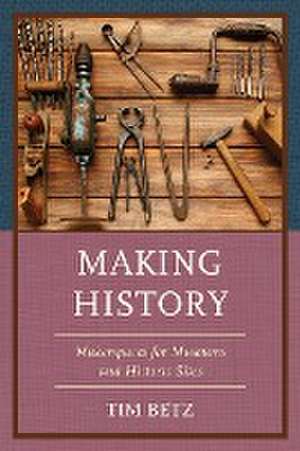
Making History: Makerspaces for Museums and Historic Sites: American Association for State and Local History
Autor Tim Betzen Limba Engleză Paperback – 15 apr 2023
Highlights include:
Why museums and makerspaces are a natural fit togetherWays to organize and create a makerspace in a museum of any budgetCreating a makerspace and culture of making that is inclusive and for the entirety of the communityStrategies for researching historic making techniques and adapting them to the modern worldCreating meaningful makerspace-centered programming The processes and methods explored in this book will help produce a sustainable makerspace that will help the museum or historic site that adopts it reach new audiences, creating growth and new museums stakeholders. Likewise, through calling for a recalibration of living history through the language of the makerspace, this project calls for new approaches to living history. Thus, it is a call for a disruption to the status quo and a push towards sustainable and meaningful living history.
Din seria American Association for State and Local History
- 33%
 Preț: 813.15 lei
 - 22%
 Preț: 209.66 lei
 - 22%
 Preț: 317.46 lei
 - 19%
 Preț: 316.09 lei
 - 11%
 Preț: 398.39 lei
 - 30%
 Preț: 355.61 lei
 - 19%
 Preț: 331.43 lei
 - 23%
 Preț: 286.27 lei
 - 24%
 Preț: 255.41 lei
 - 27%
 Preț: 501.00 lei
 - 25%
 Preț: 216.46 lei
 - 24%
 Preț: 254.02 lei
 - 19%
 Preț: 313.39 lei
 - 34%
 Preț: 951.06 lei
 - 19%
 Preț: 322.24 lei
 - 24%
 Preț: 384.05 lei
 - 31%
 Preț: 569.03 lei
 - 18%
 Preț: 334.84 lei
 - 24%
 Preț: 222.59 lei
 - 23%
 Preț: 282.98 lei
 -
 Preț: 421.53 lei
 - 21%
 Preț: 305.14 lei
 - 20%
 Preț: 373.68 lei
 - 30%
 Preț: 576.05 lei
 - 19%
 Preț: 323.58 lei
 - 25%
 Preț: 286.61 lei
 - 21%
 Preț: 365.17 lei
 - 23%
 Preț: 276.66 lei
 - 35%
 Preț: 619.19 lei
 - 31%
 Preț: 534.98 lei
 - 24%
 Preț: 255.02 lei
 - 31%
 Preț: 569.81 lei
 - 29%
 Preț: 522.70 lei
 - 19%
 Preț: 322.03 lei
 - 19%
 Preț: 322.16 lei
Preț: 217.97 lei
Preț vechi: 291.33 lei
-25%
Puncte Express: 327
Carte tipărită la comandă
Livrare economică 26 octombrie-09 noiembrie
Livrare prin curier în România Termenul estimat este afișat lângă disponibilitate.
Transport gratuit de la 400.00 lei Plată online sau ramburs, în funcție de opțiunile comenzii.
Retur gratuit în 14 zile Comandă securizată și suport în română.
Specificații
ISBN-13: 9781538169025
ISBN-10: 1538169029
Pagini: 134
Ilustrații: 2 tables
Dimensiuni: 155 x 222 x 10 mm
Greutate: 0.2 kg
Editura: Bloomsbury Publishing
Colecția Rowman & Littlefield
Seria American Association for State and Local History
Locul publicării:New York, United States
ISBN-10: 1538169029
Pagini: 134
Ilustrații: 2 tables
Dimensiuni: 155 x 222 x 10 mm
Greutate: 0.2 kg
Editura: Bloomsbury Publishing
Colecția Rowman & Littlefield
Seria American Association for State and Local History
Locul publicării:New York, United States
V-ar putea interesa
-
 How to Manage Your Workforce in the Digital AgeColin BeamesPreț: 205.64 lei
 -
 Preț: 151.04 lei
 -
 Place management The Ultimate Step-By-Step GuideGerardus Blokdyk-19%Preț: 486.54 lei600.65 lei
 -
 Virtual appliance A Complete GuideGerardus Blokdyk-19%Preț: 481.04 lei593.87 lei
 -
 E-Commerce SaaS A Complete GuideGerardus Blokdyk-19%Preț: 481.04 lei593.87 lei
 -
 Video Visits Second EditionGerardus Blokdyk-19%Preț: 481.04 lei593.87 lei
 -
 Cgroups Standard RequirementsGerardus Blokdyk-19%Preț: 481.04 lei593.87 lei
 -
 Incentive system Second EditionGerardus Blokdyk-19%Preț: 481.04 lei593.87 lei
 -
 BPM Platform Complete Self-Assessment GuideGerardus Blokdyk-19%Preț: 481.04 lei593.87 lei
 -
 Product measure Complete Self-Assessment GuideGerardus Blokdyk-19%Preț: 481.04 lei593.87 lei
 -
 Content Migration A Clear and Concise ReferenceGerardus Blokdyk-19%Preț: 481.04 lei593.87 lei
 -
 Google Fiber A Complete GuideGerardus Blokdyk-19%Preț: 481.04 lei593.87 lei
 -
 Becoming a PassionpreneurRyan C GreenePreț: 161.60 lei
 -
 Preț: 129.38 lei
 -
 Preț: 161.03 lei
 -
 The Do's & Don'ts of Business MealsJerry GleasonPreț: 59.81 lei
 -
 A Guide to International EconomicsShahruz MohtadiPreț: 132.12 lei
 -
 Preț: 125.64 lei
 -
 Devastations in the Garden of EdenAbisai TembaPreț: 182.45 lei
 -
 AI-nabledAmit JnagalPreț: 91.33 lei
 -
 How to Make Money Teaching OnlineEric FrickPreț: 71.81 lei
 -
 The Property Pension PlanPaul MahoneyPreț: 124.04 lei
 -
 FlourishBianca BestPreț: 142.20 lei
 -
 Action Guide for Diversity Beyond Lip ServiceLa'Wana HarrisPreț: 232.53 lei
 -
 Leading and Managing Strategic SuppliersRichard MoxhamPreț: 136.45 lei
 -
 Understanding Cyberrisks in IoTCarolina A. Adaros BoyePreț: 131.73 lei
 -
 Preț: 201.82 lei
Cuprins
Acknowledgements
Introduction
Chapter 1: Makerspaces and the Maker Movement
The Maker MovementA Genealogy of the Maker MovementA Place for Making: Makerspaces and HackerspacesCritiques of the Maker MovementThe Maker Movement and History MuseumsChapter 2: History and the Maker Movement
The Maker Movement at Historic SitesHistoric Making ManifestoThe Maker Movement and Living HistoryIf You Love It, Let it Go: Museums, Power, and MakingChapter 3: A Pedagogy of Museum Making
Just what is Pedagogy Anyway?Museum Education and Constructivist ThinkingMaking to Learn: the Makerspace and Museum EducationMeasuring Success in the Historic MakerspaceChapter 4: Making a Makerspace in Four (Somewhat Easy) Steps
AskingFundingLocatingMaintainingChapter 5: Putting the Makerspace to Work: Programming
Programming Your Historic MakerspaceProgramming Curiosity at Your MakerspaceThe Historical Makerspace and Regular ProgrammingWorkshopsMaker Programming Out of the MakerspaceThe Virtual Makerspace and Make From HomeChapter 6: Recreating the Past
Recreating the Past: a MethodologyA Hairy ExampleFriends in Historic PlacesChapter 7: Making as History
Experimental Archaeology and the Museum MakerspaceWhat Making Can Show UsProcess as Artifact: Interrogating Intangible Cultural HeritageWhere else but the Museum? Who else but Museum Professionals?Do!Appendices
Appendix A: Making and Your Site: Assessment WorksheetAppendix B: Your Mission and Your MakerspaceAppendix C: Historic Makerspace Sample BudgetAppendix D: Makerspace User AgreementAppendix E: InventoryAppendix F: Recipes and ProjectsWalnut InkVictorian Mourning JewelryEgg Tempera PaintOil Paint Appendix G: ProgramsDrop In WorkshopHistory Happy Hour
Introduction
Chapter 1: Makerspaces and the Maker Movement
The Maker MovementA Genealogy of the Maker MovementA Place for Making: Makerspaces and HackerspacesCritiques of the Maker MovementThe Maker Movement and History MuseumsChapter 2: History and the Maker Movement
The Maker Movement at Historic SitesHistoric Making ManifestoThe Maker Movement and Living HistoryIf You Love It, Let it Go: Museums, Power, and MakingChapter 3: A Pedagogy of Museum Making
Just what is Pedagogy Anyway?Museum Education and Constructivist ThinkingMaking to Learn: the Makerspace and Museum EducationMeasuring Success in the Historic MakerspaceChapter 4: Making a Makerspace in Four (Somewhat Easy) Steps
AskingFundingLocatingMaintainingChapter 5: Putting the Makerspace to Work: Programming
Programming Your Historic MakerspaceProgramming Curiosity at Your MakerspaceThe Historical Makerspace and Regular ProgrammingWorkshopsMaker Programming Out of the MakerspaceThe Virtual Makerspace and Make From HomeChapter 6: Recreating the Past
Recreating the Past: a MethodologyA Hairy ExampleFriends in Historic PlacesChapter 7: Making as History
Experimental Archaeology and the Museum MakerspaceWhat Making Can Show UsProcess as Artifact: Interrogating Intangible Cultural HeritageWhere else but the Museum? Who else but Museum Professionals?Do!Appendices
Appendix A: Making and Your Site: Assessment WorksheetAppendix B: Your Mission and Your MakerspaceAppendix C: Historic Makerspace Sample BudgetAppendix D: Makerspace User AgreementAppendix E: InventoryAppendix F: Recipes and ProjectsWalnut InkVictorian Mourning JewelryEgg Tempera PaintOil Paint Appendix G: ProgramsDrop In WorkshopHistory Happy Hour
Recenzii
Though makerspaces are frequently associated with STEM programs in the current landscape, museum professional Tim Betz argues that artists and historians have equal claims on makerspace facilities and services. To contextualize his argument, Betz begins with a brief history of making, highlighting its roots in the Arts and Crafts movement of the 19th century. He then looks at how resilient early-20th-century societies, with their emphasis on self-reliance and a do-it-yourself mentality, shaped the current maker models. Betz goes on to introduce his "Historic Making Manifesto" as a call and challenge to museum professionals to transform visitor experiences from passive observation to active engagement through tactile learning opportunities. Betz concludes with a pedagogical framework, including notes about space planning and budgetary concerns, for historians and museum leaders to use. Sample worksheets, program documentation, recipes, and project ideas are included as appendixes to facilitate discussions among practitioners. This book will be particularly valuable for museum professionals looking to integrate making experiences into their operations, but it is accessible and will be useful for a broad audience. Recommended. All readers.
Betz makes a compelling case for using makerspaces-usually connected with science museums and STEM education-to make historic sites more dynamic and engaging. Moving beyond historic sites' usual focus on demonstrations and finished pieces, Betz argues that makerspaces enhance empathy, connect past with present, and uncover untold stories.
By rooting living history museums, historic sites, and history organizations within maker culture and examining how makerspaces can (and should!) be a natural fit within the museum ecosystem, Betz demonstrates how the act of 'making' can serve as a gateway for learning as well as a form of research. After sharing an overview of the history and pedagogy of the maker movement and museum education and interpretation, Betz provides a roadmap for building a makerspace, from the ground up, which is supplemented by programming strategies to borrow or build upon and appendices with supplemental materials. He offers a playbook for museum leadership, staff, and emerging professionals seeking to build and sustain 'historic makerspaces.' This book is more than a brief history, critique, and guide - it is a manifesto that embraces 'historic making' as a form of research and practice yielding accessible, experiential lifelong learning and engagement at history museums and organizations.
Betz makes a compelling case for using makerspaces-usually connected with science museums and STEM education-to make historic sites more dynamic and engaging. Moving beyond historic sites' usual focus on demonstrations and finished pieces, Betz argues that makerspaces enhance empathy, connect past with present, and uncover untold stories.
By rooting living history museums, historic sites, and history organizations within maker culture and examining how makerspaces can (and should!) be a natural fit within the museum ecosystem, Betz demonstrates how the act of 'making' can serve as a gateway for learning as well as a form of research. After sharing an overview of the history and pedagogy of the maker movement and museum education and interpretation, Betz provides a roadmap for building a makerspace, from the ground up, which is supplemented by programming strategies to borrow or build upon and appendices with supplemental materials. He offers a playbook for museum leadership, staff, and emerging professionals seeking to build and sustain 'historic makerspaces.' This book is more than a brief history, critique, and guide - it is a manifesto that embraces 'historic making' as a form of research and practice yielding accessible, experiential lifelong learning and engagement at history museums and organizations.