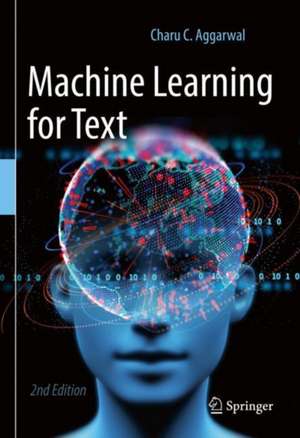
Machine Learning for Text
Autor Charu C. Aggarwalen Limba Engleză Hardback – 5 mai 2022
1. Basic algorithms: Chapters 1 through 7 discuss the classical algorithms for text analytics such as preprocessing, similarity computation, topic modeling, matrix factorization, clustering, classification, regression, and ensemble analysis.
2. Domain-sensitive learning and information retrieval: Chapters 8 and 9 discuss learning models in heterogeneous settings such as a combination of text with multimedia or Web links. The problem of information retrieval and Web search is also discussed in the context of its relationship with ranking and machine learning methods.
3. Natural language processing: Chapters 10 through 16 discuss various sequence-centric and natural language applications, such as feature engineering, neural language models, deep learning, transformers, pre-trained language models, text summarization, information extraction, knowledge graphs, question answering, opinion mining, text segmentation, and event detection. Compared to the first edition, this second edition textbook (which targets mostly advanced level students majoring in computer science and math) has substantially more material on deep learning and natural language processing. Significant focus is placed on topics like transformers, pre-trained language models, knowledge graphs, and question answering.
3. Natural language processing: Chapters 10 through 16 discuss various sequence-centric and natural language applications, such as feature engineering, neural language models, deep learning, transformers, pre-trained language models, text summarization, information extraction, knowledge graphs, question answering, opinion mining, text segmentation, and event detection. Compared to the first edition, this second edition textbook (which targets mostly advanced level students majoring in computer science and math) has substantially more material on deep learning and natural language processing. Significant focus is placed on topics like transformers, pre-trained language models, knowledge graphs, and question answering.
Preț: 472.97 lei
Puncte Express: 709
Carte tipărită la comandă
Livrare economică 30 noiembrie-14 decembrie
Livrare express 23-29 octombrie pentru 122.82 lei
Livrare prin curier în România Termenul estimat este afișat lângă disponibilitate.
Transport gratuit pentru acest produs Plată online sau ramburs, în funcție de opțiunile comenzii.
Retur gratuit în 14 zile Comandă securizată și suport în română.
Specificații
ISBN-13: 9783030966225
ISBN-10: 3030966224
Pagini: 592
Ilustrații: XXIII, 565 p. 92 illus., 5 illus. in color.
Dimensiuni: 183 x 260 x 38 mm
Greutate: 1.23 kg
Ediția:Second Edition 2022
Editura: Springer
Locul publicării:Cham, Switzerland
ISBN-10: 3030966224
Pagini: 592
Ilustrații: XXIII, 565 p. 92 illus., 5 illus. in color.
Dimensiuni: 183 x 260 x 38 mm
Greutate: 1.23 kg
Ediția:Second Edition 2022
Editura: Springer
Locul publicării:Cham, Switzerland
V-ar putea interesa
-
 Data Mining: Concepts and TechniquesJiawei Han-40%Preț: 434.30 lei721.87 lei
-
 Just Enough Data Science and Machine LearningMark LevenePreț: 352.28 lei
-
 Machine LearningKevin P. Murphy-20%Preț: 731.65 lei918.37 lei
-
 Introduction to Natural Language ProcessingJacob Eisenstein-29%Preț: 507.39 lei714.77 lei
-
 Probabilistic Machine LearningKevin P. Murphy-21%Preț: 854.63 lei1080.57 lei
-
 Understanding Deep LearningSimon J. D. Prince-20%Preț: 636.22 lei795.27 lei
-
 Modern Information RetrievalRicardo Baeza-Yates-20%Preț: 575.92 lei719.90 lei
-
 Pattern Recognition and Machine LearningChristopher M Bishop-20%Preț: 646.10 lei807.62 lei
-
 The Elements of Statistical LearningTrevor Hastie-20%Preț: 546.54 lei683.17 lei
-
 -39%Preț: 394.79 lei646.62 lei
-
 -31%Preț: 607.05 lei885.58 lei
-
 Machine Learning for Business AnalyticsGalit Shmueli-20%Preț: 879.21 lei1099.01 lei
-
 -23%Preț: 799.73 lei1038.62 lei
-
 Machine Learning For DummiesLuca Massaron-20%Preț: 149.88 lei187.36 lei
-
 Data Without LabelsVaibhav Verdhan-20%Preț: 343.10 lei428.88 lei
-
 Practical Deep Learning, 2nd Edition: A Python-Based IntroductionRonald T. Kneusel-35%Preț: 333.73 lei515.68 lei
-
 Materials Data ScienceStefan Sandfeld-15%Preț: 591.20 lei695.53 lei
-
 Multivariate Analysis and Machine Learning TechniquesSrikrishnan Sundararajan-20%Preț: 560.93 lei701.16 lei
-
 Mastering Text AnalyticsShailendra Kadre-20%Preț: 283.12 lei353.90 lei
Cuprins
1 An Introduction to Text Analytics.- 2 Text Preparation and Similarity Computation.- 3 Matrix Factorization and Topic Modeling.- 4 Text Clustering.- 5 Text Classification: Basic Models.- 6 Linear Models for Classification and Regression.- 7 Classifier Performance and Evaluation.- 8 Joint Text Mining with Heterogeneous Data.- 9 Information Retrieval and Search Engines.- 10 Language Modeling and Deep Learning.- 11 Attention Mechanisms and Transformers.- 12 Text Summarization.- 13 Information Extraction and Knowledge Graphs.- 14 Question Answering.- 15 Opinion Mining and Sentiment Analysis.- 16 Text Segmentation and Event Detection.
Notă biografică
Charu C. Aggarwal is a Distinguished Research Staff Member (DRSM) at the IBM T. J. Watson Research Center in Yorktown Heights, New York. He completed his undergraduate degree in Computer Science from the Indian Institute of Technology at Kanpur in 1993 and his Ph.D. in Operations Research from the Massachusetts Institute of Technology in 1996. He has published more than 300 papers in refereed conferences and journals, and has applied for or been granted more than 80 patents. He is author or editor of 16 books, including textbooks on data mining, recommender systems, and outlier analysis. Because of the commercial value of his patents, he has thrice been designated a Master Inventor at IBM. He has received several internal and external awards, including the EDBT Test-of-Time Award (2014) and the IEEE ICDM Research Contributions Award (2015). He has also served as program or general chair of many major conferences in data mining. He is a fellow of the SIAM, ACM, and the IEEE, for '"contributions to knowledge discovery and data mining algorithms."
Saket Sathe has worked at IBM Research (Australia/United States) since 2013. Saket received a Ph.D. degree in Computer Science from EPFL (Lausanne) in 2013. Before that he received a Master's (M.Tech.) degree in Electrical Engineering from the Indian Institute of Technology at Bombay and also spent one year working for a startup. His primary areas of interest are data mining and data management. Saket has served on program committees of several top-ranked conferences and has been invited to review papers for prominent peer-reviewed journals. His research has led to more than 20 papers and 5 patents. His work on sensor data management received the runner-up best-paper award in IEEE CollaborateCom 2014. He is a member of the ACM, IEEE, and the SIAM.
Textul de pe ultima copertă
This second edition textbook covers a coherently organized framework for text analytics, which integrates material drawn from the intersecting topics of information retrieval, machine learning, and natural language processing. Particular importance is placed on deep learning methods. The chapters of this book span three broad categories:
1. Basic algorithms: Chapters 1 through 7 discuss the classical algorithms for text analytics such as preprocessing, similarity computation, topic modeling, matrix factorization, clustering, classification, regression, and ensemble analysis.
2. Domain-sensitive learning and information retrieval: Chapters 8 and 9 discuss learning models in heterogeneous settings such as a combination of text with multimedia or Web links. The problem of information retrieval and Web search is also discussed in the context of its relationship with ranking and machine learning methods.
3. Natural language processing: Chapters 10 through 16 discuss various sequence-centric and natural language applications, such as feature engineering, neural language models, deep learning, transformers, pre-trained language models, text summarization, information extraction, knowledge graphs, question answering, opinion mining, text segmentation, and event detection. Compared to the first edition, this second edition textbook (which targets mostly advanced level students majoring in computer science and math) has substantially more material on deep learning and natural language processing. Significant focus is placed on topics like transformers, pre-trained language models, knowledge graphs, and question answering.
3. Natural language processing: Chapters 10 through 16 discuss various sequence-centric and natural language applications, such as feature engineering, neural language models, deep learning, transformers, pre-trained language models, text summarization, information extraction, knowledge graphs, question answering, opinion mining, text segmentation, and event detection. Compared to the first edition, this second edition textbook (which targets mostly advanced level students majoring in computer science and math) has substantially more material on deep learning and natural language processing. Significant focus is placed on topics like transformers, pre-trained language models, knowledge graphs, and question answering.
Caracteristici
Integrates treatment of text mining/learning, information retrieval and natural language processing Has a strong focus on deep learning, transformers and pre-trained language models Simplifies the mathematical presentation with intuitive explanations Request lecturer material: sn.pub/lecturer-material
Recenzii
“The book discusses many key technologies used today in social media, such as opinion mining or event detection. One of the most promising new technologies, deep learning, is discussed as well. This book is an excellent resource for programmers and graduate students interested in becoming experts in the text mining field. … Summing Up: Recommended. Graduate students, researchers, and professionals.” (J. Brzezinski, Choice, Vol. 56 (04), December, 2018)