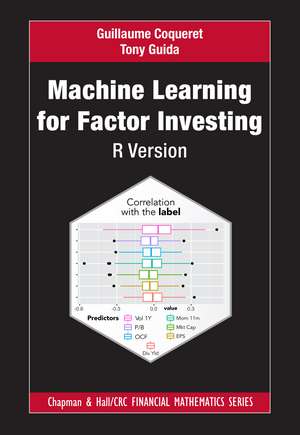
Machine Learning for Factor Investing: R Version: Chapman and Hall/CRC Financial Mathematics Series
Autor Guillaume Coqueret, Tony Guidaen Limba Engleză Paperback – sep 2020
The book covers a wide array of subjects which range from economic rationales to rigorous portfolio back-testing and encompass both data processing and model interpretability. Common supervised learning algorithms such as tree models and neural networks are explained in the context of style investing and the reader can also dig into more complex techniques like autoencoder asset returns, Bayesian additive trees, and causal models.
All topics are illustrated with self-contained R code samples and snippets that are applied to a large public dataset that contains over 90 predictors. The material, along with the content of the book, is available online so that readers can reproduce and enhance the examples at their convenience. If you have even a basic knowledge of quantitative finance, this combination of theoretical concepts and practical illustrations will help you learn quickly and deepen your financial and technical expertise.
Din seria Chapman and Hall/CRC Financial Mathematics Series
- 9%
 Preț: 1618.56 lei
 - 9%
 Preț: 984.40 lei
 - 14%
 Preț: 814.66 lei
 -
 Preț: 449.39 lei
 - 15%
 Preț: 569.15 lei
 -
 Preț: 451.70 lei
 - 9%
 Preț: 992.86 lei
 -
 Preț: 477.59 lei
 - 18%
 Preț: 939.28 lei
 - 18%
 Preț: 790.39 lei
 - 15%
 Preț: 698.16 lei
 - 18%
 Preț: 1428.40 lei
 - 18%
 Preț: 799.39 lei
 - 18%
 Preț: 1017.90 lei
 - 18%
 Preț: 715.44 lei
 - 18%
 Preț: 936.51 lei
 - 18%
 Preț: 922.61 lei
 - 15%
 Preț: 678.95 lei
 - 15%
 Preț: 609.13 lei
 - 18%
 Preț: 1082.71 lei
 - 18%
 Preț: 766.85 lei
 - 15%
 Preț: 548.53 lei
 - 20%
 Preț: 1439.36 lei
 - 15%
 Preț: 524.83 lei
 - 20%
 Preț: 697.14 lei
 - 18%
 Preț: 815.78 lei
 - 18%
 Preț: 1028.65 lei
 -
 Preț: 437.63 lei
 - 15%
 Preț: 542.78 lei
 -
 Preț: 484.25 lei
 - 15%
 Preț: 662.66 lei
 - 8%
 Preț: 438.84 lei
 - 18%
 Preț: 872.44 lei
 - 15%
 Preț: 617.81 lei
 - 18%
 Preț: 804.52 lei
 - 15%
 Preț: 650.97 lei
 - 18%
 Preț: 1428.74 lei
 - 18%
 Preț: 803.23 lei
 - 18%
 Preț: 721.58 lei
 - 15%
 Preț: 627.80 lei
 - 18%
 Preț: 699.41 lei
 - 18%
 Preț: 893.94 lei
Preț: 632.90 lei
Preț vechi: 687.93 lei
-8%
Puncte Express: 949
Carte disponibilă
Livrare economică 05-19 noiembrie
Livrare express 21-27 octombrie pentru 41.21 lei
Livrare prin curier în România Termenul estimat este afișat lângă disponibilitate.
Transport gratuit pentru acest produs Plată online sau ramburs, în funcție de opțiunile comenzii.
Retur gratuit în 14 zile Comandă securizată și suport în română.
Specificații
ISBN-13: 9780367545864
ISBN-10: 0367545861
Pagini: 342
Dimensiuni: 178 x 254 x 22 mm
Greutate: 0.66 kg
Ediția:1
Editura: CRC Press
Colecția Chapman and Hall/CRC
Seria Chapman and Hall/CRC Financial Mathematics Series
ISBN-10: 0367545861
Pagini: 342
Dimensiuni: 178 x 254 x 22 mm
Greutate: 0.66 kg
Ediția:1
Editura: CRC Press
Colecția Chapman and Hall/CRC
Seria Chapman and Hall/CRC Financial Mathematics Series
V-ar putea interesa
-
 Just Enough Data Science and Machine LearningMark LevenePreț: 342.01 lei
 -
 Machine Learning for EconometricsChristophe Gaillac-11%Preț: 277.17 lei312.68 lei
 -
 The Elements of Statistical LearningTrevor Hastie-20%Preț: 546.54 lei683.17 lei
 -
 -39%Preț: 394.79 lei646.62 lei
 -
 Advances in Financial Machine LearningMarcos Lopez de PradoPreț: 327.22 lei
 -
 Equity Smart Beta and Factor Investing for PractitionersKhalid GhayurPreț: 209.63 lei
 -
 Practical Machine Learning in RFred Nwanganga-20%Preț: 216.52 lei270.65 lei
 -
 Advanced Portfolio Management - A Quant¿s Guide for Fundamental InvestorsGiuseppe A. PaleologoPreț: 249.07 lei
 -
 Preț: 300.57 lei
 -
 Quantitative Portfolio ManagementMichael IsichenkoPreț: 325.01 lei
 -
 -19%Preț: 440.31 lei543.60 lei
 -
 Factor Investing for DummiesJames MaendelPreț: 155.72 lei
 -
 Reproducible Finance with R: Code Flows and Shiny Apps for Portfolio AnalysisJonathan K. Regenstein, Jr.-8%Preț: 561.57 lei610.40 lei
 -
 The Elements of Quantitative InvestingGiuseppe A. Paleologo-8%Preț: 450.09 lei489.23 lei
 -
 Generative AI for Trading and Asset ManagementHamlet Jesse Medina RuizPreț: 326.12 lei
 -
 Hands-On AI Trading with Python, QuantConnect and AWSErnest P. ChanPreț: 330.07 lei
 -
 -23%Preț: 799.73 lei1038.62 lei
 -
 -20%Preț: 242.09 lei302.62 lei
 -
 Your Perfect PortfolioCullen RochePreț: 157.40 lei
 -
 -20%Preț: 249.86 lei312.33 lei
Public țintă
Postgraduate, Professional, and Professional Practice & DevelopmentCuprins
1. Preface 2. Notations and data 3. Introduction 4. Factor investing and asset pricing anomalies 5. Data preprocessing 6. Penalized regressions and sparse hedging for minimum variance portfolios 8. Neural networks 7. Tree-based methods 9. Support vector machines 10. Bayesian methods 11. Validating and tuning 12. Ensemble models 13. Portfolio backtesting 14. Interpretability 15. Two key concepts: causality and non-stationarity 16. Unsupervised learning 17. Reinforcement learning
Notă biografică
Guillaume Coqueret is associate professor of finance and data science at EMLYON Business School. His recent research revolves around applications of machine learning tools in financial economics.
Tony Guida is executive director at RAM Active Investments. He serves as chair of the machineByte think tank and is the author of Big Data and Machine Learning in Quantitative Investment.
Tony Guida is executive director at RAM Active Investments. He serves as chair of the machineByte think tank and is the author of Big Data and Machine Learning in Quantitative Investment.
Recenzii
"This book is the perfect one for any data scientist on financial markets. It is well written, with lots of illustrations, examples, pieces of code, tips on the different statistical package available to perform the various algos. This book requires for sure a strong knowledge in quantitative finance and Machine Learning, so it cannot be put in any hands. But for those who are familiar with quantitative finance, this book can be a reference, as Hull's book is as regards to derivatives products. I liked the good and detailed analysis of the different Machine Learning algos, and the different examples used throughout the book. This book is perfect for assets managers having to run backtests and searching for innovative ways to enhance the return of their portfolios. I spent quite a good time reading this manuscript, and I would recommend it." (Frédéric Girod, Union of European Football Associations)
Descriere
The aim of the book is to give an interpretation of ML tools through the lens of factor investing. Concepts illustrated with examples on the same (public) dataset throughout the book. Provides code samples and the corresponding results so that anybody can reproduce the steps.