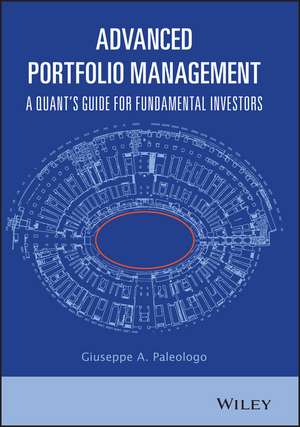
Advanced Portfolio Management: John Wiley & Sons Inc
Autor Giuseppe A. Paleologoen Limba Engleză Hardback – 4 oct 2021
Observăm în literatura financiară o prăpastie între rigoarea matematică a „quanților” și intuiția analiștilor fundamentali. Advanced Portfolio Management vine să acopere exact acest gol. Cititorul care a studiat Quantitative Equity Portfolio Management de Edward E. Qian va găsi aici puntea de legătură necesară: în timp ce Qian oferă tratamentul matematic sistematic, Giuseppe A Paleologo traduce aceste concepte în decizii zilnice de tranzacționare pentru cei care pariază pe valoarea intrinsecă a companiilor. Descoperim în această carte o metodologie riguroasă de construcție a portofoliului care nu cere cititorului să devină matematician, ci să gândească strategic despre risc. Autorul, bazându-se pe experiența sa în optimizarea portofoliilor de miliarde de dolari, explică cum să izolezi sursa profitului (alpha) de zgomotul pieței (beta). Găsim în capitolele dedicate riscului o abordare extrem de pragmatică: de la cum să măsori și să descompui riscul, până la utilizarea diversificării ca avantaj competitiv real, nu doar ca simplă metodă de protecție. Structura cărții este concepută pentru progresie logică, pornind de la problema transformării ideilor în profit și avansând spre modele multi-factor complexe. Un element distinctiv este includerea unui apendice cantitativ, care permite echipelor mixte (fundamentale și cantitative) să utilizeze același limbaj tehnic. Spre deosebire de Investment Theory and Risk Management de Steven Peterson, care se concentrează pe perspectiva fondurilor de pensii, lucrarea de față este un ghid de „tranșee” pentru managerii de portofolii de acțiuni care au nevoie să gestioneze pierderile maxime și să își calibreze levierul în funcție de volatilitatea reală a ideilor lor.
Din seria John Wiley & Sons Inc
-
 Preț: 141.90 lei
 - 19%
 Preț: 452.95 lei
 - 20%
 Preț: 158.90 lei
 - 19%
 Preț: 405.26 lei
 -
 Preț: 154.83 lei
 -
 Preț: 234.05 lei
 -
 Preț: 155.93 lei
 -
 Preț: 150.55 lei
 -
 Preț: 152.41 lei
 -
 Preț: 171.23 lei
 -
 Preț: 168.66 lei
 -
 Preț: 151.70 lei
 -
 Preț: 150.05 lei
 -
 Preț: 212.72 lei
 -
 Preț: 195.94 lei
 - 19%
 Preț: 431.77 lei
 -
 Preț: 161.86 lei
 -
 Preț: 148.42 lei
 -
 Preț: 161.41 lei
 -
 Preț: 170.22 lei
 -
 Preț: 138.84 lei
 - 19%
 Preț: 562.19 lei
 -
 Preț: 149.28 lei
 -
 Preț: 140.24 lei
 -
 Preț: 135.13 lei
 -
 Preț: 141.94 lei
 -
 Preț: 144.11 lei
 -
 Preț: 131.78 lei
 -
 Preț: 420.82 lei
 - 8%
 Preț: 511.33 lei
 -
 Preț: 210.10 lei
 - 20%
 Preț: 142.41 lei
 -
 Preț: 155.93 lei
 -
 Preț: 157.58 lei
 -
 Preț: 135.43 lei
 - 19%
 Preț: 561.97 lei
 -
 Preț: 323.20 lei
 -
 Preț: 148.37 lei
 -
 Preț: 236.72 lei
 -
 Preț: 152.41 lei
 -
 Preț: 187.36 lei
 -
 Preț: 395.05 lei
 - 20%
 Preț: 168.75 lei
 -
 Preț: 134.49 lei
 -
 Preț: 163.16 lei
 -
 Preț: 200.03 lei
 -
 Preț: 150.59 lei
 -
 Preț: 119.87 lei
 -
 Preț: 142.70 lei
Preț: 241.94 lei
Carte disponibilă
Livrare economică 05-19 septembrie
Livrare express 22-28 august pentru 42.45 lei
Specificații
ISBN-10: 1119789796
Pagini: 208
Dimensiuni: 160 x 233 x 16 mm
Greutate: 0.48 kg
Editura: Wiley
Colecția John Wiley & Sons Inc
Seria John Wiley & Sons Inc
Locul publicării:Hoboken, United States
V-ar putea interesa
-
 -32%Preț: 958.68 lei1416.07 lei
 -
 Preț: 230.69 lei
 -
 Machine Learning for Factor Investing: Python VersionGuillaume Coqueret-15%Preț: 569.15 lei669.60 lei
 -
 In Pursuit of the Perfect PortfolioAndrew W. LoPreț: 131.98 lei
 -
 The Behavioral PortfolioPhillip ToewsPreț: 225.95 lei
 -
 A Wealth of Common SenseBen CarlsonPreț: 239.94 lei
 -
 Positional Option TradingEuan Sinclair-8%Preț: 392.92 lei427.08 lei
 -
 Risk ParityAlex ShahidiPreț: 141.59 lei
 -
 Asset AllocationDavid TurkingtonPreț: 235.30 lei
 -
 Modern Portfolio ManagementTodd E PetzelPreț: 360.85 lei
 -
 Quantitative Portfolio ManagementMichael IsichenkoPreț: 314.61 lei
 -
 Reproducible Finance with R: Code Flows and Shiny Apps for Portfolio AnalysisJonathan K. Regenstein, Jr.-8%Preț: 552.89 lei600.97 lei
 -
 -13%Preț: 122.37 lei140.16 lei
 -
 -17%Preț: 541.70 lei652.88 lei
 -
 The Elements of Quantitative InvestingGiuseppe A. Paleologo-8%Preț: 435.87 lei473.78 lei
 -
 Quantitative Portfolio OptimizationAlberto Bueno Guerrero-8%Preț: 479.41 lei521.10 lei
 -
 The Little Book of Hedge FundsAnthony ScaramucciPreț: 150.59 lei
 -
 The Bogleheads' Guide to the Three-Fund PortfolioTaylor LarimorePreț: 92.27 lei
 -
 -49%Preț: 146.79 lei288.09 lei
 -
 Your Perfect PortfolioCullen RochePreț: 151.80 lei
De ce să citești această carte
Recomandăm această carte analiștilor de equity și managerilor de portofoliu care doresc să își profesionalizeze procesul de construcție a portofoliului. Veți câștiga un set de reguli practice pentru dimensionarea pozițiilor și controlul riscului de coadă (tail risk), transformând intuiția investițională într-o strategie rezilientă și profitabilă. Este instrumentul esențial pentru a trece de la simpla selecție de acțiuni la managementul științific al capitalului.
Despre autor
Giuseppe A. Paleologo este un expert recunoscut în managementul cantitativ al riscului, cu o carieră solidă construită în colaborare cu unii dintre cei mai importanți selecționeri de acțiuni din lume. A gestionat și optimizat portofolii de zeci de miliarde de dolari, specializându-se în strategii de hedging și navigarea prin perioade de retragere masivă a pieței (drawdowns). Experiența sa îmbină rigoarea academică cu pragmatismul necesar în sălile de tranzacționare, fiind un consultant și educator apreciat în industria financiară globală.
Descriere
You have great investment ideas. If you turn them into highly profitable portfolios, this book is for you.
Advanced Portfolio Management: A Quant’s Guide for Fundamental Investors is for fundamental equity analysts and portfolio managers, present, and future. Whatever stage you are at in your career, you have valuable investment ideas but always need knowledge to turn them into money. This book will introduce you to a framework for portfolio construction and risk management that is grounded in sound theory and tested by successful fundamental portfolio managers. The emphasis is on theory relevant to fundamental portfolio managers that works in practice, enabling you to convert ideas into a strategy portfolio that is both profitable and resilient. Intuition always comes first, and this book helps to lay out simple but effective "rules of thumb" that require little effort to implement and understand. At the same time, the book shows how to implement sophisticated techniques in order to meet the challenges a successful investor faces as his or her strategy grows in size and complexity. Advanced Portfolio Management also contains more advanced material and a quantitative appendix, which benefit quantitative researchers who are members of fundamental teams.
You will learn how to:
- Separate stock-specific return drivers from the investment environment’s return drivers
- Understand current investment themes
- Size your cash positions based on
- Your investment ideas
- Understand your performance
- Measure and decompose risk
- Hedge the risk you don’t want
- Use diversification to your advantage
- Manage losses and control tail risk
- Set your leverage
Author Giuseppe A. Paleologo has consulted, collaborated, taught, and drank strong wine with some of the best stock-pickers in the world; he has traded tens of billions of dollars hedging and optimizing their books and has helped them navigate through big drawdowns and even bigger recoveries. Whether or not you have access to risk models or advanced mathematical background, you will benefit from the techniques and the insights contained in the book—and won't find them covered anywhere else.