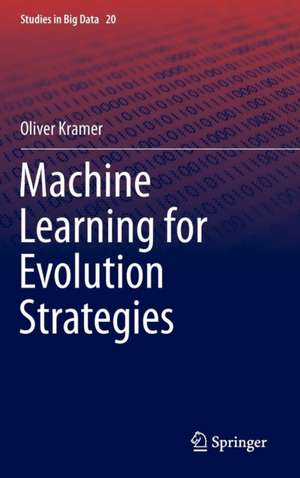
Machine Learning for Evolution Strategies: Studies in Big Data, cartea 20
Autor Oliver Krameren Limba Engleză Hardback – 6 iun 2016
Din seria Studies in Big Data
- 20%
 Preț: 966.30 lei
 - 20%
 Preț: 671.45 lei
 - 18%
 Preț: 1038.28 lei
 - 20%
 Preț: 1208.06 lei
 - 20%
 Preț: 1023.73 lei
 - 20%
 Preț: 1676.16 lei
 - 20%
 Preț: 1202.10 lei
 - 20%
 Preț: 1523.35 lei
 - 20%
 Preț: 1222.48 lei
 - 20%
 Preț: 1213.74 lei
 - 20%
 Preț: 1200.85 lei
 - 20%
 Preț: 1094.69 lei
 - 20%
 Preț: 1019.01 lei
 - 20%
 Preț: 1210.28 lei
 - 18%
 Preț: 1156.74 lei
 - 18%
 Preț: 1165.74 lei
 - 18%
 Preț: 1271.28 lei
 - 18%
 Preț: 1151.98 lei
 - 20%
 Preț: 1024.96 lei
 - 15%
 Preț: 659.55 lei
 - 24%
 Preț: 836.13 lei
 - 24%
 Preț: 902.25 lei
 - 20%
 Preț: 676.02 lei
 - 20%
 Preț: 679.34 lei
 - 20%
 Preț: 927.75 lei
 - 20%
 Preț: 1045.95 lei
 - 20%
 Preț: 1615.47 lei
 - 18%
 Preț: 725.05 lei
 - 20%
 Preț: 1051.73 lei
 - 20%
 Preț: 1165.44 lei
 - 20%
 Preț: 982.28 lei
 - 20%
 Preț: 1115.43 lei
 - 20%
 Preț: 1809.50 lei
 - 20%
 Preț: 344.91 lei
 - 20%
 Preț: 1043.84 lei
 - 20%
 Preț: 972.87 lei
 - 20%
 Preț: 1138.32 lei
Preț: 666.07 lei
Preț vechi: 832.58 lei
-20%
Puncte Express: 999
Carte tipărită la comandă
Livrare economică 03-17 decembrie
Livrare prin curier în România Termenul estimat este afișat lângă disponibilitate.
Transport gratuit pentru acest produs Plată online sau ramburs, în funcție de opțiunile comenzii.
Retur gratuit în 14 zile Comandă securizată și suport în română.
Specificații
ISBN-13: 9783319333816
ISBN-10: 331933381X
Pagini: 136
Ilustrații: IX, 124 p. 38 illus. in color.
Dimensiuni: 160 x 241 x 14 mm
Greutate: 0.33 kg
Ediția:1st edition 2016
Editura: Springer
Colecția Studies in Big Data
Seria Studies in Big Data
Locul publicării:Cham, Switzerland
ISBN-10: 331933381X
Pagini: 136
Ilustrații: IX, 124 p. 38 illus. in color.
Dimensiuni: 160 x 241 x 14 mm
Greutate: 0.33 kg
Ediția:1st edition 2016
Editura: Springer
Colecția Studies in Big Data
Seria Studies in Big Data
Locul publicării:Cham, Switzerland
V-ar putea interesa
-
 Machine LearningKevin P. Murphy-20%Preț: 731.65 lei918.37 lei
 -
 Bayesian Reasoning and Machine LearningDavid Barber-20%Preț: 547.92 lei684.90 lei
 -
 Machine Learning Methods in the Environmental SciencesWilliam W. Hsieh-14%Preț: 706.56 lei821.58 lei
 -
 Human and Machine HearingRichard F. Lyon-20%Preț: 558.70 lei698.37 lei
 -
 Machine LearningPeter Flach-20%Preț: 386.84 lei483.55 lei
 -
 Multi-Agent Machine LearningH M Schwartz-20%Preț: 675.81 lei844.77 lei
 -
 Advances in Biometrics for Secure Human Authentication and RecognitionDakshina Ranjan Kisku-20%Preț: 496.15 lei620.19 lei
 -
 Machine Learning: An Algorithmic Perspective, Second EditionStephen Marsland-20%Preț: 625.22 lei781.53 lei
 -
 -20%Preț: 1060.49 lei1325.62 lei
 -
 -20%Preț: 312.60 lei390.74 lei
 -
 Genetic Algorithm EssentialsOliver Kramer-20%Preț: 890.82 lei1113.52 lei
 -
 Self-Adaptive Heuristics for Evolutionary ComputationOliver Kramer-20%Preț: 665.99 lei832.49 lei
 -
 Computational IntelligenceOliver Kramer-20%Preț: 175.14 lei218.91 lei
 -
 -20%Preț: 327.54 lei409.42 lei
 -
 Multiobjective Genetic Algorithms for ClusteringUjjwal Maulik-20%Preț: 350.32 lei437.90 lei
 -
 -20%Preț: 663.18 lei828.98 lei
 -
 -20%Preț: 331.30 lei414.13 lei
 -
 -20%Preț: 313.42 lei391.77 lei
 -
 -20%Preț: 402.28 lei502.84 lei
 -
 -20%Preț: 1289.64 lei1612.05 lei
 -
 -15%Preț: 661.49 lei778.23 lei
 -
 Preț: 366.19 lei
Cuprins
Part I Evolution Strategies.- Part II Machine Learning.- Part III Supervised Learning.
Textul de pe ultima copertă
This bookintroduces numerous algorithmic hybridizations between both worlds that showhow machine learning can improve and support evolution strategies. The set ofmethods comprises covariance matrix estimation, meta-modeling of fitness andconstraint functions, dimensionality reduction for search and visualization ofhigh-dimensional optimization processes, and clustering-based niching. Aftergiving an introduction to evolution strategies and machine learning, the bookbuilds the bridge between both worlds with an algorithmic and experimentalperspective. Experiments mostly employ a (1+1)-ES and are implemented in Pythonusing the machine learning library scikit-learn. The examples are conducted ontypical benchmark problems illustrating algorithmic concepts and theirexperimental behavior. The book closes with a discussion of related lines ofresearch.
Caracteristici
State of the art presentation of Machine Learning in Evolution Strategies Condensed presentation Short introduction and recent research Includes supplementary material: sn.pub/extras
Notă biografică
Oliver Kramer is Professor of Computational Intelligence at the University of Oldenburg, Germany. His research focuses on evolutionary computation, machine learning, and large language model–based cognitive architectures, with applications in optimization, bioinformatics, and artificial general intelligence. He has authored numerous books and articles and has presented his work at leading conferences such as GECCO, CEC, and ESANN. His interdisciplinary projects explore connections between AI, biology, and cognitive science.