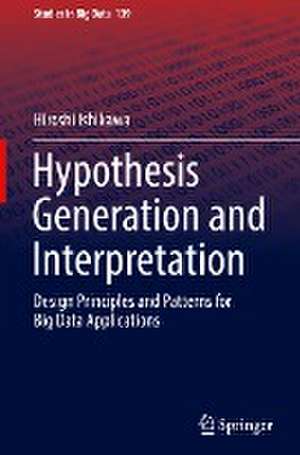
Hypothesis Generation and Interpretation: Design Principles and Patterns for Big Data Applications: Studies in Big Data, cartea 139
Autor Hiroshi Ishikawaen Limba Engleză Hardback – 2 feb 2024
Autorul Hiroshi Ishikawa aduce în acest volum o vastă experiență în gestionarea sistemelor de date la scară largă, expertiză reflectată anterior în coordonarea unor lucrări de referință precum Transactions on Large-Scale Data- and Knowledge-Centered Systems XLV. În lucrarea de față, Hypothesis Generation and Interpretation, Ishikawa depășește simpla analiză descriptivă, propunând un set de principii de design și tipare (patterns) destinate arhitecților de aplicații Big Data. Reținem abordarea sa riguroasă care nu se limitează la algoritmi, ci integrează managementul datelor cu tehnici avansate de machine learning pentru a automatiza procesul de formulare a ipotezelor.
Subliniem structura logică a volumului, care ghidează cititorul de la fundamentele științifice ale ipotezei și regresie, către metode complexe de generare a ipotezelor prin diferențiere. Un element distinctiv îl reprezintă dualitatea interpretării: autorul combină micro-explicațiile (deciziile individuale din cadrul modelelor) cu macro-explicațiile (procesele globale de generare), oferind o transparență necesară în sistemele de decizie automatizate. Cititorul care a aplicat strategiile de implementare din Data Science in Engineering and Management va găsi aici completarea teoretică și practică necesară pentru a trece de la simpla extracție de date la validarea științifică a acestora prin studii de caz concrete, de la gestionarea bolilor infecțioase la explorarea lunară.
Spre deosebire de lucrările anterioare ale autorului din domeniul viziunii computerizate, precum Computer Vision - ACCV 2020, acest titlu din seria Studies in Big Data se concentrează pe mecanismele cognitive și computaționale de rezolvare a problemelor complexe. Recomandăm acest volum pentru modul în care ancorează tehnologiile moderne în contextul istoric al metodei științifice, oferind o perspectivă matură asupra modului în care datele masive pot accelera descoperirea în infrastructura socială.
Din seria Studies in Big Data
- 20%
 Preț: 966.30 lei
 - 20%
 Preț: 626.57 lei
 - 18%
 Preț: 996.90 lei
 - 20%
 Preț: 1125.52 lei
 - 20%
 Preț: 991.80 lei
 - 20%
 Preț: 1615.85 lei
 - 20%
 Preț: 1163.34 lei
 - 20%
 Preț: 1474.83 lei
 - 20%
 Preț: 1183.94 lei
 - 20%
 Preț: 1163.04 lei
 - 20%
 Preț: 1060.39 lei
 - 20%
 Preț: 987.25 lei
 - 20%
 Preț: 1127.60 lei
 - 18%
 Preț: 1077.62 lei
 - 18%
 Preț: 1086.05 lei
 - 20%
 Preț: 949.94 lei
 - 15%
 Preț: 615.47 lei
 - 24%
 Preț: 836.13 lei
 - 20%
 Preț: 927.75 lei
 - 20%
 Preț: 901.15 lei
 - 24%
 Preț: 902.25 lei
 - 20%
 Preț: 630.78 lei
 - 20%
 Preț: 633.88 lei
 - 20%
 Preț: 1045.95 lei
 - 20%
 Preț: 1615.47 lei
 - 18%
 Preț: 725.05 lei
 - 20%
 Preț: 1051.73 lei
 - 20%
 Preț: 1165.44 lei
 - 20%
 Preț: 982.28 lei
 - 20%
 Preț: 1115.43 lei
 - 20%
 Preț: 1750.03 lei
 - 20%
 Preț: 328.37 lei
 - 20%
 Preț: 1043.84 lei
 - 20%
 Preț: 972.87 lei
 - 20%
 Preț: 1138.32 lei
Preț: 1125.07 lei
Preț vechi: 1406.35 lei
-20%
Carte disponibilă
Livrare economică 19 octombrie-02 noiembrie
Specificații
ISBN-10: 3031435397
Pagini: 372
Ilustrații: XII, 372 p. 177 illus., 125 illus. in color.
Dimensiuni: 155 x 235 mm
Greutate: 0.77 kg
Ediția:1st ed. 2024
Editura: Springer International Publishing
Colecția Springer
Seria Studies in Big Data
Locul publicării:Cham, Switzerland
V-ar putea interesa
-
 -33%Preț: 634.15 lei944.40 lei
 -
 Just Enough Data Science and Machine LearningMark LevenePreț: 342.01 lei
 -
 -22%Preț: 348.77 lei444.48 lei
 -
 Veridical Data ScienceBin Yu-20%Preț: 543.69 lei679.61 lei
 -
 Data ScienceBrendan Tierney-37%Preț: 76.76 lei122.33 lei
 -
 -39%Preț: 385.64 lei636.10 lei
 -
 Notes on the Synthesis of FormChristopher AlexanderPreț: 228.57 lei
 -
 Data Science and Big Data AnalyticsEmc Education Services-20%Preț: 393.67 lei492.09 lei
 -
 -20%Preț: 192.78 lei240.98 lei
 -
 -9%Preț: 571.23 lei627.73 lei
 -
 Data Analytics & Visualization All-in-One For DummiesJack A. HymanPreț: 302.29 lei
 -
 Data & AI ImperativeLillian Pierson-20%Preț: 171.62 lei214.52 lei
 -
 Storytelling with DataCole Nussbaumer KnaflicPreț: 246.25 lei
 -
 Data Science Essentials for DummiesLillian Pierson-20%Preț: 76.12 lei95.16 lei
 -
 The Data Hero PlaybookMalcolm HawkerPreț: 202.67 lei
 -
 -15%Preț: 530.61 lei624.25 lei
 -
 Big Data Big DesignHelen Armstrong-12%Preț: 137.61 lei155.68 lei
 -
 Statistics for ScientistsUmberto Michelucci-20%Preț: 275.88 lei344.84 lei
 -
 -20%Preț: 458.54 lei573.18 lei
 -
 The Data Science Design ManualSteven S. Skiena-20%Preț: 411.65 lei514.56 lei
De ce să citești această carte
Recomandăm această carte profesioniștilor care doresc să transforme fluxurile masive de date în ipoteze de lucru verificabile. Cititorul câștigă acces la un cadru metodologic inovator care explică nu doar 'ce' spun datele, ci și 'de ce' prin integrarea micro și macro-explicațiilor. Este o resursă esențială pentru inginerii de date care lucrează în domenii critice precum managementul dezastrelor sau sănătatea publică, unde interpretarea corectă a modelelor este vitală.
Despre autor
Hiroshi Ishikawa este un cercetător recunoscut în domeniul informaticii, cu o activitate axată pe baze de date, sisteme de cunoștințe și analiza datelor la scară largă. A coordonat volume importante în seria LNCS, contribuind la dezvoltarea standardelor în managementul datelor și viziunea computerizată. Prin publicațiile sale, Ishikawa a explorat intersecția dintre ingineria sistemelor și știința aplicată, fiind un promotor al metodelor inovatoare de interpretare a modelelor complexe. În prezent, este o voce autoritară în comunitatea academică internațională, facilitând dialogul între teoria computațională și aplicațiile practice în infrastructura socială și explorarea spațială.
Cuprins
Notă biografică
He received the Sakai Memorial Distinguished Award from the Information Processing Society of Japan (IPSJ) in 1994, Commendation by the Director General of Science and Technology Agency of Japan in 1997, Commendation for Science and Technology by the Minister of Education, Culture, Sports, Science and Technology of Japan in 2021, and Commendation from the Database Society of Japan in 2022. He was twice an invited professor at the Polytechnic School of the University of Nantes, France. He was a trustee board member of the Database Society of Japan, an editorial board member of The VLDB Journal, the chairman of the SIG on Database Systems of IPSJ, and an editor-in-chief of IPSJ Trans. on Databases. He is a co-founder of ACM MEDES conference. He is a Fellow of the IPSJ and the Institute of Electronics, Information and Communication Engineers (IEICE) and a member of both the ACM and the IEEE.
Textul de pe ultima copertă
Academic investigators and practitioners working on the further development and application of hypothesis generation and interpretation in big data computing, with backgrounds in data science and engineering, or the study of problem solving and scientific methods or who employ those ideas in fields like machine learning will find this book of considerable interest.
Caracteristici
Descriere
This book focuses in detail on data science and data analysis and emphasizes the importance of data engineering and data management in the design of big data applications.