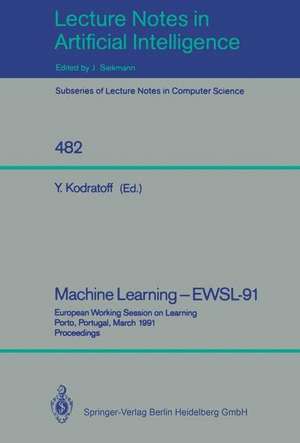
Machine Learning - EWSL-91
Editat de Yves Kodratoffen Limba Engleză Paperback – 20 feb 1991
Preț: 374.35 lei
Preț vechi: 467.93 lei
-20%
Puncte Express: 562
Carte tipărită la comandă
Livrare economică 27 noiembrie-03 decembrie
Livrare prin curier în România Termenul estimat este afișat lângă disponibilitate.
Transport gratuit de la 400.00 lei Plată online sau ramburs, în funcție de opțiunile comenzii.
Retur gratuit în 14 zile Comandă securizată și suport în română.
Specificații
ISBN-13: 9783540538165
ISBN-10: 354053816X
Pagini: 556
Ilustrații: XI, 541 p.
Dimensiuni: 165 x 241 x 30 mm
Greutate: 0.91 kg
Ediția:1991
Editura: Springer
Locul publicării:Berlin, Heidelberg, Germany
ISBN-10: 354053816X
Pagini: 556
Ilustrații: XI, 541 p.
Dimensiuni: 165 x 241 x 30 mm
Greutate: 0.91 kg
Ediția:1991
Editura: Springer
Locul publicării:Berlin, Heidelberg, Germany
V-ar putea interesa
-
 Discrete MathematicsNorman L. Biggs-20%Preț: 520.25 lei651.10 lei
 -
 -38%Preț: 675.36 lei1081.20 lei
 -
 Machine LearningKevin P. Murphy-20%Preț: 731.65 lei918.37 lei
 -
 Gaussian Processes for Machine LearningCarl Edward Rasmussen-26%Preț: 350.95 lei477.34 lei
 -
 Bayesian Networks and Decision GraphsThomas Dyhre Nielsen-18%Preț: 768.51 lei937.21 lei
 -
 The Elements of Statistical LearningTrevor Hastie-20%Preț: 547.10 lei683.87 lei
 -
 Bayesian Reasoning and Machine LearningDavid Barber-20%Preț: 547.92 lei684.90 lei
 -
 Machine Learning Methods in the Environmental SciencesWilliam W. Hsieh-14%Preț: 706.56 lei821.58 lei
 -
 Multi-Agent Machine LearningSchwartz-20%Preț: 675.81 lei844.77 lei
 -
 Activity LearningDiane J Cook-9%Preț: 717.08 lei788.00 lei
 -
 Machine Learning for HackersDrew Conway-20%Preț: 258.29 lei322.85 lei
 -
![INTRO GENETIC ALGOR SCI [W/ CD]](https://i2.books-express.ro/bt/9789810236021/intro-genetic-algor-sci-w-cd.jpg) INTRO GENETIC ALGOR SCI [W/ CD]Coley David APreț: 363.53 lei
INTRO GENETIC ALGOR SCI [W/ CD]Coley David APreț: 363.53 lei
Public țintă
ResearchCuprins
Abstracting background knowledge for concept learning.- A multistrategy learning approach to domain modeling and knowledge acquisition.- Using plausible explanations to bias empirical generalization in weak theory domains.- The replication problem: A constructive induction approach.- Integrating an explanation-based learning mechanism into a general problem-solver.- Analytical negative generalization and empirical negative generalization are not cumulative: A case study.- Evaluating and changing representation in concept acquisition.- Application of empirical discovery in knowledge acquisition.- Using accuracy in scientific discovery.- KBG : A generator of knowledge bases.- On estimating probabilities in tree pruning.- Rule induction with CN2: Some recent improvements.- On changing continuous attributes into ordered discrete attributes.- A method for inductive cost optimization.- When does overfitting decrease prediction accuracy in induced decision trees and rule sets?.- Semi-naive bayesian classifier.- Description contrasting in incremental concept formation.- System FLORA: Learning from time-varying training sets.- Message-based bucket brigade: An algorithm for the apportionment of credit problem.- Acquiring object-knowledge for learning systems.- Learning nonrecursive definitions of relations with linus.- Extending explanation-based generalization by abstraction operators.- Static learning for an adaptative theorem prover.- Explanation-based generalization and constraint propagation with interval labels.- Learning by explanation of failures.- PANEL : Logic and learnability.- Panel on : Causality and learning.- Seed space and version space: Generalizing from approximations.- Integrating EBL with automatic text analysis.- Abduction for explanation-based learning.- Consistent term mappings, term partitions, and inverse resolution.- Learning by analogical replay in prodigy: First results.- Analogical reasoning for logic programming.- Case-based learning of strategicknowledge.- Learning in distributed systems and multi-agent environments.- Learning to relate terms in a multiple agent environment.- Extending learning to multiple agents: Issues and a model for multi-agent machine learning (MA-ML).- Applications of machine learning: Notes from the panel members.- Evaluation of learning systems : An artificial data-based approach.- Shift of bias in learning from drug compounds: The fleming project.- Learning features by experimentation in chess.- Representation and induction of musical structures for computer assisted composition.- IPSA: Inductive protein structure analysis.- Four stances on knowledge acquisition and machine learning.- Programme of EWSL-91.