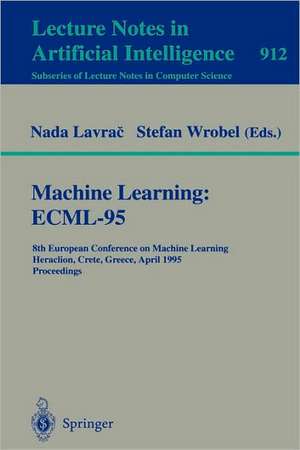
Machine Learning: ECML-95
Editat de Nada Lavra¿, Stefan Wrobelen Limba Engleză Paperback – 5 apr 1995
Besides four invited papers the volume presents revised versions of 14 long papers and 26 short papers selected from a total of 104 submissions. The papers address all current aspects in the area of machine learning; also logic programming, planning, reasoning, and algorithmic issues are touched upon.
Preț: 326.68 lei
Preț vechi: 408.36 lei
-20%
Puncte Express: 490
Carte tipărită la comandă
Livrare economică 27 noiembrie-11 decembrie
Livrare prin curier în România Termenul estimat este afișat lângă disponibilitate.
Transport gratuit de la 400.00 lei Plată online sau ramburs, în funcție de opțiunile comenzii.
Retur gratuit în 14 zile Comandă securizată și suport în română.
Specificații
ISBN-13: 9783540592860
ISBN-10: 3540592865
Pagini: 388
Ilustrații: XII, 376 p.
Dimensiuni: 155 x 235 x 21 mm
Greutate: 0.59 kg
Ediția:1995
Editura: Springer
Locul publicării:Berlin, Heidelberg, Germany
ISBN-10: 3540592865
Pagini: 388
Ilustrații: XII, 376 p.
Dimensiuni: 155 x 235 x 21 mm
Greutate: 0.59 kg
Ediția:1995
Editura: Springer
Locul publicării:Berlin, Heidelberg, Germany
V-ar putea interesa
-
 Machine LearningKevin P. Murphy-20%Preț: 731.22 lei918.37 lei
 -
 Bayesian Reasoning and Machine LearningDavid Barber-20%Preț: 547.92 lei684.90 lei
 -
 Machine Learning Methods in the Environmental SciencesWilliam W. Hsieh-14%Preț: 706.56 lei821.58 lei
 -
 -20%Preț: 1328.51 lei1660.64 lei
 -
 Concept Formation and Knowledge RevisionStefan Wrobel-20%Preț: 1021.92 lei1277.40 lei
 -
 Learning from Good and Bad DataPhilip D Laird-20%Preț: 995.69 lei1244.61 lei
 -
 Human and Machine HearingRichard F. Lyon-20%Preț: 531.55 lei664.43 lei
 -
 Machine LearningPeter Flach-20%Preț: 386.84 lei483.55 lei
 -
 Multi-Agent Machine LearningSchwartz-20%Preț: 675.81 lei844.77 lei
 -
 Advances in Biometrics for Secure Human Authentication and RecognitionDakshina Ranjan Kisku-20%Preț: 496.15 lei620.19 lei
 -
 Machine Learning: An Algorithmic Perspective, Second EditionStephen Marsland-20%Preț: 625.22 lei781.53 lei
 -
 -20%Preț: 1060.49 lei1325.62 lei
 -
 Knowledge Discovery in Databases: PKDD 2003Nada Lavra¿-20%Preț: 635.55 lei794.44 lei
 -
 -20%Preț: 644.31 lei805.39 lei
 -
 Machine Learning - EWSL-91Yves Kodratoff-20%Preț: 374.35 lei467.93 lei
 -
 Inductive Logic ProgrammingNada Lavra¿-20%Preț: 323.60 lei404.50 lei
 -
 Inductive Logic ProgrammingFilip ¿Elezný-20%Preț: 325.83 lei407.29 lei
 -
 Engineering Applications of Neural NetworksDominic Palmer-Brown-20%Preț: 646.13 lei807.66 lei
 -
 Preference LearningJohannes Fürnkranz-20%Preț: 1095.83 lei1369.78 lei
 -
 -20%Preț: 332.10 lei415.13 lei
 -
 -20%Preț: 320.24 lei400.30 lei
 -
 Artificial Intelligence in MedicineMor Peleg-20%Preț: 339.07 lei423.84 lei
Public țintă
ResearchCuprins
Reasoning and learning in probabilistic and possibilistic networks: An overview.- Problem decomposition and the learning of skills.- Machine learning in the world wide web.- Abstract computer models: Towards a new method for theorizing about adaptive agents.- Learning abstract planning cases.- The role of prototypicality in exemplar-based learning.- Specialization of recursive predicates.- A distributed genetic algorithm improving the generalization behavior of neural networks.- Learning non-monotonic logic programs: Learning exceptions.- A comparative utility analysis of case-based reasoning and control-rule learning systems.- A minimization approach to propositional inductive learning.- On concept space and hypothesis space in case-based learning algorithms.- The power of decision tables.- Pruning multivariate decision trees by hyperplane merging.- Multiple-Knowledge Representations in concept learning.- The effect of numeric features on the scalability of inductive learning programs.- Analogical logic program synthesis from examples.- A guided tour through hypothesis spaces in ILP.- JIGSAW: Puzzling together RUTH and SPECTRE (Extended abstract).- Discovery of constraints and data dependencies in relational databases (Extended abstract).- Learning disjunctive normal forms in a dual classifier system (Extended abstract).- The effects of noise on efficient incremental induction (Extended abstract).- Analysis of Rachmaninoff's piano performances using inductive logic programming (Extended abstract).- Handling real numbers in ILP: A step towards better behavioural clones (Extended abstract).- Simplifying decision trees by pruning and grafting: New results (Extended abstract).- A tight integration of pruning and learning (Extended abstract).- Decision-tree based neural network (Extended abstract).- Learning recursion with iterative bootstrap induction (Extended abstract).- Patching proofs for reuse (Extended abstract).- Adapting to drift in continuous domains (Extendedabstract).- Parallel recombinative reinforcement learning (Extended abstract).- Learning to solve complex tasks for reactive systems (Extended abstract).- Co-operative Reinforcement Learning by payoff filters (Extended abstract).- Automatic synthesis of control programs by combination of learning and problem solving methods (Extended abstract).- Analytical learning guided by empirical technology: An approach to integration (Extended abstract).- A new MDL measure for robust rule induction (Extended abstract).- Class-driven statistical discretization of continuous attributes (Extended abstract).- Generating neural networks through the induction of threshold logic unit trees (Extended abstract).- Learning classification rules using lattices (Extended abstract).- Hybrid classification: Using axis-parallel and oblique subdivisions of the attribute space (Extended abstract).- An induction-based control for genetic algorithms (Extended abstract).- Fender: An approach to theory restructuring(extended abstract).- Language series revisited: The complexity of hypothesis spaces in ILP (Extended abstract).- Prototype, nearest neighbor and hybrid algorithms for time series classification (Extended abstract).