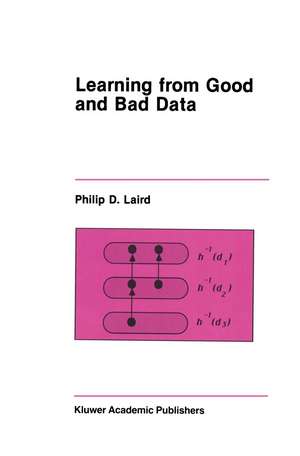
Learning from Good and Bad Data
Autor Philip D Lairden Limba Engleză Hardback – 31 mar 1988
Preț: 995.69 lei
Preț vechi: 1244.61 lei
-20%
Puncte Express: 1494
Carte tipărită la comandă
Livrare economică 23 noiembrie-07 decembrie
Livrare prin curier în România Termenul estimat este afișat lângă disponibilitate.
Transport gratuit pentru acest produs Plată online sau ramburs, în funcție de opțiunile comenzii.
Retur gratuit în 14 zile Comandă securizată și suport în română.
Specificații
ISBN-13: 9780898382631
ISBN-10: 0898382637
Pagini: 212
Ilustrații: XVIII, 212 p.
Dimensiuni: 158 x 236 x 18 mm
Greutate: 0.48 kg
Ediția:1988 edition
Editura: Springer Us
Locul publicării:New York, NY, United States
ISBN-10: 0898382637
Pagini: 212
Ilustrații: XVIII, 212 p.
Dimensiuni: 158 x 236 x 18 mm
Greutate: 0.48 kg
Ediția:1988 edition
Editura: Springer Us
Locul publicării:New York, NY, United States
V-ar putea interesa
-
 Machine LearningKevin P. Murphy-20%Preț: 731.22 lei918.37 lei
 -
 Bayesian Reasoning and Machine LearningDavid Barber-20%Preț: 538.41 lei673.00 lei
 -
 Machine Learning Methods in the Environmental SciencesWilliam W. Hsieh-14%Preț: 706.56 lei821.58 lei
 -
 Human and Machine HearingRichard F. Lyon-20%Preț: 531.55 lei664.43 lei
 -
 Machine LearningPeter Flach-20%Preț: 386.84 lei483.55 lei
 -
 Multi-Agent Machine LearningSchwartz-20%Preț: 658.33 lei822.91 lei
 -
 Advances in Biometrics for Secure Human Authentication and RecognitionDakshina Ranjan Kisku-20%Preț: 496.15 lei620.19 lei
 -
 Machine Learning: An Algorithmic Perspective, Second EditionStephen Marsland-20%Preț: 614.34 lei767.93 lei
 -
 -20%Preț: 1060.49 lei1325.62 lei
 -
 Machine Learning and Data Mining Approaches to Climate ScienceValliappa Lakshmanan-18%Preț: 983.18 lei1199.00 lei
 -
 Machine Learning in Complex NetworksThiago Christiano Silva-20%Preț: 1032.26 lei1290.32 lei
 -
 Outlooks and Insights on Group Decision and NegotiationBogumi¿ Kami¿ski-20%Preț: 343.97 lei429.96 lei
 -
 -20%Preț: 390.30 lei487.88 lei
 -
 -20%Preț: 394.21 lei492.75 lei
 -
 Machine Learning Meets Medical ImagingKanwal Bhatia-20%Preț: 257.86 lei322.33 lei
 -
 Higher-Order ComputabilityJohn Longley-20%Preț: 1104.35 lei1380.44 lei
Public țintă
ResearchCuprins
I Identification in the Limit from Indifferent Teachers.- 1 The Identification Problem.- 2 Identification by Refinement.- 3 How to Work With Refinements.- II Probabilistic Identification from Random Examples.- 4 Probabilistic Approximate Identification.- 5 Identification from Noisy Examples.- 6 Conclusions.