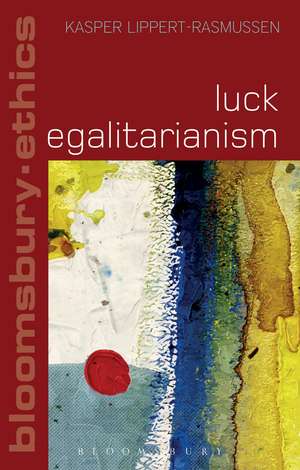
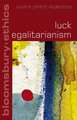
Luck Egalitarianism: Bloomsbury Ethics
Autor Kasper Lippert-Rasmussenen Limba Engleză Hardback – 8 oct 2015
This systematic, theoretical introduction illustrates the broader picture of distributive justice and enables the reader to understand the core intuitions underlying, or conflicting with, luck egalitarianism.


Preț: 630.25 lei
Preț vechi: 926.87 lei
-32%
Puncte Express: 945
Carte tipărită la comandă
Livrare economică 04-18 decembrie
Livrare prin curier în România Termenul estimat este afișat lângă disponibilitate.
Transport gratuit pentru acest produs Plată online sau ramburs, în funcție de opțiunile comenzii.
Retur gratuit în 14 zile Comandă securizată și suport în română.
Specificații
ISBN-13: 9781472570437
ISBN-10: 147257043X
Pagini: 280
Dimensiuni: 138 x 216 x 19 mm
Greutate: 0.47 kg
Editura: Bloomsbury Publishing
Colecția Bloomsbury Academic
Seria Bloomsbury Ethics
Locul publicării:London, United Kingdom
ISBN-10: 147257043X
Pagini: 280
Dimensiuni: 138 x 216 x 19 mm
Greutate: 0.47 kg
Editura: Bloomsbury Publishing
Colecția Bloomsbury Academic
Seria Bloomsbury Ethics
Locul publicării:London, United Kingdom
V-ar putea interesa
-
 In Praise of DesireNomy Arpaly-30%Preț: 591.47 lei842.13 lei
 -
 -12%Preț: 342.10 lei390.52 lei
 -
 Contractualism and the Foundations of MoralityNicholas Southwood-10%Preț: 368.43 lei411.30 lei
 -
 The Human ConditionJohn Kekes-12%Preț: 336.25 lei380.24 lei
 -
 Born Free and Equal?: A Philosophical Inquiry into the Nature of DiscriminationKasper Lippert-Rasmussen-31%Preț: 679.72 lei984.98 lei
 -
 From Individual to Collective Intentionality: New EssaysSara Rachel Chant-34%Preț: 647.17 lei977.00 lei
 -
 Rawls′s Political LiberalismThom BrooksPreț: 225.56 lei
 -
 What Money Can't BuyMichael J. Sandel-37%Preț: 58.42 lei92.70 lei
 -
 CourageBarbara Darling-SmithPreț: 188.76 lei
 -
 What Money Can't BuyMichael J. SandelPreț: 72.28 lei
 -
 The Values FactorJohn F DemartiniPreț: 114.43 lei
 -
 Justice for HedgehogsRonald DworkinPreț: 200.31 lei
 -
 Understanding EthicsTorbjörn Tännsjö-12%Preț: 159.91 lei181.78 lei
 -
 Congratulations, by the WayGeorge SaundersPreț: 86.98 lei
 -
 -14%Preț: 235.59 lei273.63 lei
 -
 Preț: 387.19 lei
 -
 Moral Matters: A Philosophy of HomecomingMark Dooley-10%Preț: 316.11 lei352.88 lei
 -
 The Bloomsbury Companion to EthicsDr Christian B. Miller-14%Preț: 281.47 lei326.83 lei
 -
 The Life-Giving Gift of AcknowledgmentMichael J. HydePreț: 195.18 lei
 -
 Human Subjects Research: Protecting ParticipantsJustin R Ward-27%Preț: 1600.51 lei2183.78 lei
 -
 50 Ethics Ideas You Really Need to KnowBen DuprePreț: 95.54 lei
 -
 After VirtueProfessor Alasdair MacIntyre-14%Preț: 170.05 lei197.15 lei
 -
 Beyond ReligionDalai Lama-35%Preț: 72.03 lei111.39 lei
 -
 Becoming BritishThom BrooksPreț: 106.90 lei
 -
 Assholes: A TheoryAaron James-41%Preț: 68.21 lei114.64 lei
Cuprins
Chapter 1. Luck egalitarianism and some close and distant relatives
1.1 Introduction
1.2 What is luck egalitarianism?
1.3 What is attractive about luck egalitarianism?
1.4 Three important luck egalitarians: Dworkin
1.5 Three important luck egalitarians: Arneson
1.6 Three important luck egalitarians: Cohen
1.7 Other distributive views
1.8 Summary
Chapter 2. Why equality?
2.1 Introduction
2.2 Formal equality
2.3 Equality of human beings
2.4 Williams on the idea of equality
2.5 Rawls on range properties
2.6 Respect and opaqueness
2.7 A different proposal
2.8 Summary
Chapter 3. Luck
3.1 Introduction
3.2 Different kinds of luck
3.3 Thin luck
3.4 Thick luck
3.5 Independent notions of luck
3.6 How much luck is there?
3.7 Constitutive luck
3.8 Option luck versus brute luck
3.9 Neutralizing luck and equality
3.10 Bad luck versus good luck
3.11 Summary
Chapter 4. Equality of what?
4.1 Introduction
4.2 Welfare
4.3 The specification objection
4.4 The disability objection
4.5 The offensive preference objection
4.6 The experience and snobbish tastes objection
4.7 The non-instrumental concern objection
4.8 Dworkin's resourcist view
4.9 Sen's capability metric
4.10 Summary
Chapter 5. Telic and deontic luck egalitarianism
5.1 Introduction
5.2 Some distinctions
5.3 Telic versus deontic and the scope of equality
5.4 The levelling down objection
5.5 Telic egalitarianism and the levelling down objection
5.6 Deontic egalitarianism and the levelling down objection
5.7 Egalitarian responses
5.8 Summary
Chapter 6. The scope of luck egalitarianism
6.1 Introduction
6.2 Whole lives
6.3 Generations
6.4 Groups
6.5 States
6.6 Individuals who are neither persons nor human beings
6.7 Summary
Chapter 7. Social relations egalitarianism versus luck egalitarianism
7.1 Introduction
7.2 Social relations egalitarianism
7.3 Anderson's democratic equality
7.4 Humiliation and harshness
7.5 What is at stake?
7.6 The source of the disagreement between social relations and luck egalitarians?
7.7 Summary
Chapter 8. Other values
8.1 Introduction
8.2 Freedom
8.3 Demandingness
8.4 Community
8.5 Publicity and stability
8.6 Reflections
8.7 Conclusion
Bibliography
Index
1.1 Introduction
1.2 What is luck egalitarianism?
1.3 What is attractive about luck egalitarianism?
1.4 Three important luck egalitarians: Dworkin
1.5 Three important luck egalitarians: Arneson
1.6 Three important luck egalitarians: Cohen
1.7 Other distributive views
1.8 Summary
Chapter 2. Why equality?
2.1 Introduction
2.2 Formal equality
2.3 Equality of human beings
2.4 Williams on the idea of equality
2.5 Rawls on range properties
2.6 Respect and opaqueness
2.7 A different proposal
2.8 Summary
Chapter 3. Luck
3.1 Introduction
3.2 Different kinds of luck
3.3 Thin luck
3.4 Thick luck
3.5 Independent notions of luck
3.6 How much luck is there?
3.7 Constitutive luck
3.8 Option luck versus brute luck
3.9 Neutralizing luck and equality
3.10 Bad luck versus good luck
3.11 Summary
Chapter 4. Equality of what?
4.1 Introduction
4.2 Welfare
4.3 The specification objection
4.4 The disability objection
4.5 The offensive preference objection
4.6 The experience and snobbish tastes objection
4.7 The non-instrumental concern objection
4.8 Dworkin's resourcist view
4.9 Sen's capability metric
4.10 Summary
Chapter 5. Telic and deontic luck egalitarianism
5.1 Introduction
5.2 Some distinctions
5.3 Telic versus deontic and the scope of equality
5.4 The levelling down objection
5.5 Telic egalitarianism and the levelling down objection
5.6 Deontic egalitarianism and the levelling down objection
5.7 Egalitarian responses
5.8 Summary
Chapter 6. The scope of luck egalitarianism
6.1 Introduction
6.2 Whole lives
6.3 Generations
6.4 Groups
6.5 States
6.6 Individuals who are neither persons nor human beings
6.7 Summary
Chapter 7. Social relations egalitarianism versus luck egalitarianism
7.1 Introduction
7.2 Social relations egalitarianism
7.3 Anderson's democratic equality
7.4 Humiliation and harshness
7.5 What is at stake?
7.6 The source of the disagreement between social relations and luck egalitarians?
7.7 Summary
Chapter 8. Other values
8.1 Introduction
8.2 Freedom
8.3 Demandingness
8.4 Community
8.5 Publicity and stability
8.6 Reflections
8.7 Conclusion
Bibliography
Index
Recenzii
This brilliant and challenging book . Illuminates different conceptions of luck, as found in the philosophical literature, clarifies the difference between telic and deontic equality, and explains the 'levelling down' problem and the way that this affects luck egalitarians, and egalitarians more generally.
Lippert-Rasmussen's book offers both a reliable and critically sophisticated guide to the debate on luck egalitarianism from one of its shrewdest and most subtle contributors, and also advances several new interesting ideas and proposals ... This book is a model of its kind. It should be read by everyone with an interest in contemporary debates on distributive justice.
The book provides a well-balanced overview of luck egalitarianism with a well-chosen ordering of the different chapters ... An excellent introduction.
Lippert-Rasmussen's book makes a tremendous contribution to our understanding of luck egalitarianism and will no doubt become a central reference point for both its proponents and its critics.
Lippert-Rasmussen's book offers both a reliable and critically sophisticated guide to the debate on luck egalitarianism from one of its shrewdest and most subtle contributors, and also advances several new interesting ideas and proposals ... This book is a model of its kind. It should be read by everyone with an interest in contemporary debates on distributive justice.
The book provides a well-balanced overview of luck egalitarianism with a well-chosen ordering of the different chapters ... An excellent introduction.
Lippert-Rasmussen's book makes a tremendous contribution to our understanding of luck egalitarianism and will no doubt become a central reference point for both its proponents and its critics.