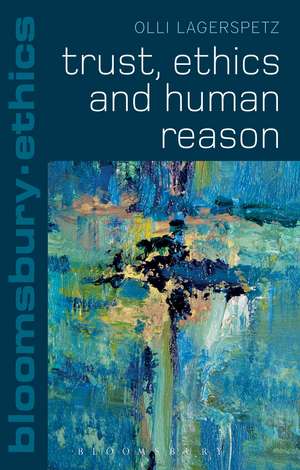
Trust, Ethics and Human Reason: Bloomsbury Ethics
Autor Dr Olli Lagerspetzen Limba Engleză Paperback – 19 noi 2015
Olli Lagerspetz breathes new life into the philosophical debate by showing how questions about trust are at the centre of any in-depth analyses of the nature of human agency and human rationality and that these issues, in turn, lie at the heart of philosophical ethics.
Ideal for those grappling with these issues for the first time, Trust, Ethics and Human Reason provides a thorough and impassioned assessment of the concept of trust in moral philosophy.
Preț: 223.30 lei
Preț vechi: 263.98 lei
-15%
Puncte Express: 335
Carte tipărită la comandă
Livrare economică 08-22 iunie
Specificații
ISBN-13: 9781441184870
ISBN-10: 1441184872
Pagini: 224
Dimensiuni: 138 x 216 x 18 mm
Greutate: 0.26 kg
Editura: Bloomsbury Publishing
Colecția Bloomsbury Academic
Seria Bloomsbury Ethics
Locul publicării:London, United Kingdom
ISBN-10: 1441184872
Pagini: 224
Dimensiuni: 138 x 216 x 18 mm
Greutate: 0.26 kg
Editura: Bloomsbury Publishing
Colecția Bloomsbury Academic
Seria Bloomsbury Ethics
Locul publicării:London, United Kingdom
V-ar putea interesa
-
 Mere ApologeticsAlister McgrathPreț: 82.51 lei
 -
 Why Does God Allow Suffering?Robin GillPreț: 60.27 lei
 -
 Being DisciplesRowan WilliamsPreț: 74.19 lei
 -
 Satan: A BiographyHenry Ansgar KellyPreț: 213.01 lei
 -
 An Introduction to ChristianityLinda WoodheadPreț: 305.96 lei
 -
 God, Freedom, and EvilAlvin PlantingaPreț: 84.30 lei
 -
 Losing Our VirtueDavid F WellsPreț: 142.18 lei
 -
 The Ethical Thought of Hans Urs von BalthasarChristopher SteckPreț: 214.65 lei
 -
 Bernard of ClairvauxDennis TamburelloPreț: 105.13 lei
 -
 -43%Preț: 94.38 lei165.92 lei
 -
 Christian Theology – An Introduction 6eAE McGrathPreț: 416.07 lei
 -
 Preț: 344.06 lei
 -
 Christology: Origins, Developments, DebatesGerald O'Collins, S.J.Preț: 344.83 lei
 -
 Preț: 299.22 lei
 -
 Preț: 262.85 lei
 -
 -30%Preț: 197.96 lei281.40 lei
 -
 Embraced By The LightBetty J. EadiePreț: 60.67 lei
Cuprins
Acknowledgements
1 Trust and our worries with it
Trust and reason: Friends or foes?
On how to write about what trust 'is'
The need for reflexivity
Current issues
Trust and reliance
Normative and non-normative conceptions of trust
What happens next?
2 Trust and Hobbesian reason
The Hobbesian dilemma
Trust as risk management
A game-theoretic solution
Critique of game theory: The need for a social
framework
Trustworthiness and encapsulated interests
Is this trust? - A caveat
Trust and strategic reason, and where to go from
here
The metaphysics of interests
3 Vulnerability and entrusting
Baier's ambiguous critique of rationalism
The theory of trust as entrusting
Entrusting and simple trust
Factual and ethical vulnerability
The notion of possibility
Vulnerability revisited
A Novel from the 21st Century
Trusting and being trusted
4 The time dimension
Methodological timelessness
Prisoners' Dilemma revisited
Timelessness in non-formal treatments of trust
Assessing probability
Trust as an interpretative activity
Normality in ongoing interaction
Methodological timelessness and methodological
individualism
5 'Trust' as an organizing tool
Is trust a psychological state?
The 'dys-appearance' of trust
First- and third-person perspectives
The need for challenge
Conclusion
6 Communication, truthfulness, trust
Communication as manipulation and mindreading
The testimony debate
The norm of truthfulness
Løgstrup: Trust in conversation
'Image' vs real presence
The place of 'trust' in different ideas of
language
7 Basic trust
Trust as a response to scepticism
A self-deception theory of basic trust
Paranoia and scepticism
'The substratum of all my enquiring and asserting'
Meeting the other in trust: Weil and Løgstrup
Ideas of basic trust in context
8 Conclusions
Notes
Bibliography
Index
1 Trust and our worries with it
Trust and reason: Friends or foes?
On how to write about what trust 'is'
The need for reflexivity
Current issues
Trust and reliance
Normative and non-normative conceptions of trust
What happens next?
2 Trust and Hobbesian reason
The Hobbesian dilemma
Trust as risk management
A game-theoretic solution
Critique of game theory: The need for a social
framework
Trustworthiness and encapsulated interests
Is this trust? - A caveat
Trust and strategic reason, and where to go from
here
The metaphysics of interests
3 Vulnerability and entrusting
Baier's ambiguous critique of rationalism
The theory of trust as entrusting
Entrusting and simple trust
Factual and ethical vulnerability
The notion of possibility
Vulnerability revisited
A Novel from the 21st Century
Trusting and being trusted
4 The time dimension
Methodological timelessness
Prisoners' Dilemma revisited
Timelessness in non-formal treatments of trust
Assessing probability
Trust as an interpretative activity
Normality in ongoing interaction
Methodological timelessness and methodological
individualism
5 'Trust' as an organizing tool
Is trust a psychological state?
The 'dys-appearance' of trust
First- and third-person perspectives
The need for challenge
Conclusion
6 Communication, truthfulness, trust
Communication as manipulation and mindreading
The testimony debate
The norm of truthfulness
Løgstrup: Trust in conversation
'Image' vs real presence
The place of 'trust' in different ideas of
language
7 Basic trust
Trust as a response to scepticism
A self-deception theory of basic trust
Paranoia and scepticism
'The substratum of all my enquiring and asserting'
Meeting the other in trust: Weil and Løgstrup
Ideas of basic trust in context
8 Conclusions
Notes
Bibliography
Index
Recenzii
A very welcome addition to the discussion of a topic that is increasingly recognized as crucial to an adequate understanding of agency, rationality and ethics. Lagerspetz offers a useful survey of philosophical views of the place and importance of trust in human life, while making his own distinctive and valuable contribution to the discussion. This is essential reading for all working in these and related areas.
There is much to like about this book. And I have not done it justice in this brief review. I've not touched on Lagerspetz's engagement with the epistemology of testimony, or mentioned his introduction of Wittgenstein, K. E. Løgstrup and Peter Winch into the trust debate.
There is much to like about this book. And I have not done it justice in this brief review. I've not touched on Lagerspetz's engagement with the epistemology of testimony, or mentioned his introduction of Wittgenstein, K. E. Løgstrup and Peter Winch into the trust debate.