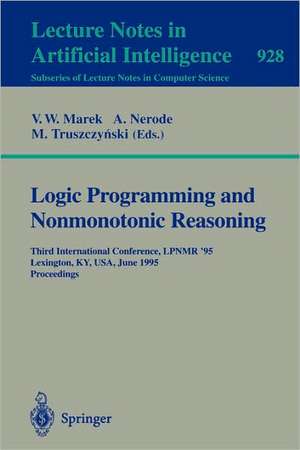
Logic Programming and Nonmonotonic Reasoning
Editat de V. Wiktor Marek, Anil Nerode, Miroslaw Truszcynskien Limba Engleză Paperback – 7 iun 1995
The LPNMR conferences bring together researchers from logic programming and the logical foundations of artificial intelligence in order to facilitate cooperation and cross-fertilization of ideas. The 28 full papers presented define the state of the art in this interdisciplinary area of research, which has recently attracted much interest.
Preț: 399.70 lei
Puncte Express: 600
Carte tipărită la comandă
Livrare economică 28 noiembrie-12 decembrie
Livrare prin curier în România Termenul estimat este afișat lângă disponibilitate.
Transport gratuit de la 400.00 lei Plată online sau ramburs, în funcție de opțiunile comenzii.
Retur gratuit în 14 zile Comandă securizată și suport în română.
Specificații
ISBN-13: 9783540594871
ISBN-10: 3540594876
Pagini: 436
Ilustrații: IX, 415 p.
Dimensiuni: 155 x 235 x 24 mm
Greutate: 0.66 kg
Ediția:1995
Editura: Springer
Locul publicării:Berlin, Heidelberg, Germany
ISBN-10: 3540594876
Pagini: 436
Ilustrații: IX, 415 p.
Dimensiuni: 155 x 235 x 24 mm
Greutate: 0.66 kg
Ediția:1995
Editura: Springer
Locul publicării:Berlin, Heidelberg, Germany
V-ar putea interesa
-
 Elements of Set TheoryHerbert B. Enderton-31%Preț: 382.75 lei558.35 lei
 -
 DefinitionRichard Robinson-33%Preț: 785.92 lei1170.31 lei
 -
 Twenty Five Years of Constructive Type TheoryGiovanni Sambin-37%Preț: 703.45 lei1123.30 lei
 -
 -28%Preț: 471.91 lei659.32 lei
 -
 A Course in Model TheoryBruno Poizat-15%Preț: 612.43 lei720.50 lei
 -
 Godel's ProofErnest NagelPreț: 138.96 lei
 -
 -36%Preț: 66.83 lei104.45 lei
 -
 Introduction to LogicAlfred TarskiPreț: 87.22 lei
 -
 TopoiRobert Goldblatt-23%Preț: 162.04 lei211.69 lei
 -
 Principia Mathematica to *56Alfred North Whitehead-14%Preț: 799.94 lei930.17 lei
 -
 Mathematical Logic for Computer ScienceMordechai Ben-Ari-20%Preț: 395.53 lei494.41 lei
 -
 The Joy of SetsKeith Devlin-15%Preț: 443.91 lei522.24 lei
 -
 Preț: 497.59 lei
 -
 Sets, Logic and CategoriesPeter J. CameronPreț: 280.57 lei
 -
 Incompleteness in the Land of SetsM. FittingPreț: 237.44 lei
 -
 -18%Preț: 1176.29 lei1434.50 lei
 -
 -15%Preț: 735.59 lei865.39 lei
Public țintă
ResearchCuprins
Complexity results for abductive logic programming.- A terminological interpretation of (abductive) logic programming.- Abduction over 3-valued extended logic programs.- On logical constraints in logic programming.- An operator for composing deductive data bases with theories of constraints.- Update rules in datalog programs.- Characterizations of the stable semantics by partial evaluation.- Game characterizations of logic program properties.- Computing the well-founded semantics faster.- Loop checking and the well-founded semantics.- Annotated revision specification programs.- Update by means of inference rules.- A sphere world semantics for default reasoning.- Revision by communication.- Hypothetical updates, priority and inconsistency in a logic programming language.- Situation calculus specifications for event calculus logic programs.- On the extension of logic programming with negation through uniform proofs.- Default consequence relations as a logical framework for logic programs.- Skeptical rational extensions.- Reasoning with stratified default theories.- Incremental methods for optimizing partial instantiation.- A transformation of propositional Prolog programs into classical logic.- Nonmonotonic inheritance, argumentation and logic programming.- An abductive framework for extended logic programming.- Embedding circumscriptive theories in general disjunctive programs.- Stable classes and operator pairs for disjunctive programs.- Nonmonotonicity and answer set inference.- Trans-epistemic semantics for logic programs.- Computing the acceptability semantics.