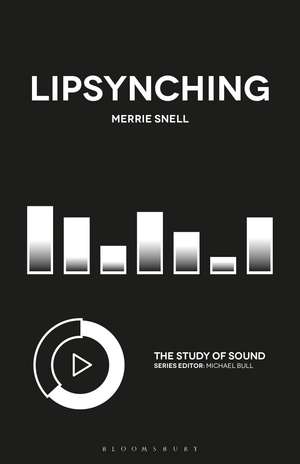
Lipsynching: The Study of Sound
Autor Dr. Merrie Snellen Limba Engleză Hardback – 9 ian 2020




Preț: 706.69 lei
Preț vechi: 993.83 lei
-29%
Puncte Express: 1060
Carte tipărită la comandă
Livrare economică 23 noiembrie-07 decembrie
Livrare prin curier în România Termenul estimat este afișat lângă disponibilitate.
Transport gratuit pentru acest produs Plată online sau ramburs, în funcție de opțiunile comenzii.
Retur gratuit în 14 zile Comandă securizată și suport în română.
Specificații
ISBN-13: 9781501352355
ISBN-10: 1501352350
Pagini: 200
Dimensiuni: 140 x 216 mm
Greutate: 0.38 kg
Editura: Bloomsbury Publishing
Colecția Bloomsbury Academic
Seria The Study of Sound
Locul publicării:New York, United States
ISBN-10: 1501352350
Pagini: 200
Dimensiuni: 140 x 216 mm
Greutate: 0.38 kg
Editura: Bloomsbury Publishing
Colecția Bloomsbury Academic
Seria The Study of Sound
Locul publicării:New York, United States
Cuprins
List of Figures
Acknowledgments
Introduction
1. Locating the Disembodied Voice
2. Lipsynching to Conceal
3. Lipsynching to Express
4. Lipsynching to Start Your Day: The Soundtracked Life
Final Reflections and Participant Observation: Or, I Was a Middle-aged Lipsynching Star
Notes
Bibliography
Index
Acknowledgments
Introduction
1. Locating the Disembodied Voice
2. Lipsynching to Conceal
3. Lipsynching to Express
4. Lipsynching to Start Your Day: The Soundtracked Life
Final Reflections and Participant Observation: Or, I Was a Middle-aged Lipsynching Star
Notes
Bibliography
Index
Recenzii
Engages with the phenomenon from a variety of different perspectives ... Snell covers interesting historical and technical material.
This book is a gripping and wide-ranging study of the issues that arise when a voice inhabits another body and, by doing so, creates a new audio-visual collage. Its insights will come as a revelation to anyone who thinks lipsynching is simply a matter of ensuring that your lips move at the same time as the recorded voice.
Spanning from the Kinetograph to viral videos, this is a rich study that situates lipsynching - as a creative, 'readerly' form of listening - in a long history of audio-visual media, culminating in what Snell calls a 'soundtracked life'. It will be a valuable book for sound and media scholars, and for anyone interested in how notions of the cinematic extend into today's vernacular musical practices.
This book is a gripping and wide-ranging study of the issues that arise when a voice inhabits another body and, by doing so, creates a new audio-visual collage. Its insights will come as a revelation to anyone who thinks lipsynching is simply a matter of ensuring that your lips move at the same time as the recorded voice.
Spanning from the Kinetograph to viral videos, this is a rich study that situates lipsynching - as a creative, 'readerly' form of listening - in a long history of audio-visual media, culminating in what Snell calls a 'soundtracked life'. It will be a valuable book for sound and media scholars, and for anyone interested in how notions of the cinematic extend into today's vernacular musical practices.