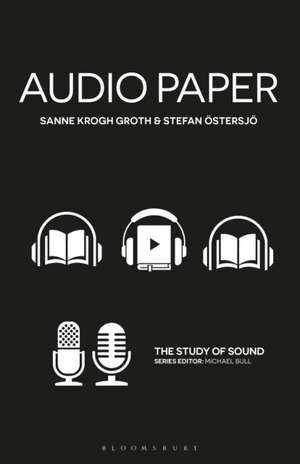
Audio Paper: The Study of Sound
Autor Sanne Krogh Groth, Stefan Östersjöen Limba Engleză Paperback – 12 noi 2026
What happens when research is communicated through sound rather than text? This book introduces the audio paper, an emerging academic publication format that presents scholarly research as an audio production. Drawing on the authors' pioneering work and insights from researchers who have developed audio papers over the past decade, it traces the format's evolution and growing impact. Linking the audio paper to traditions of radio production, electroacoustic music and contemporary podcasting, the book situates this novel format within a broader history of auditory culture. Through analyses of published works, it reveals how sound can generate knowledge, shape scholarly argument and engage audiences in new ways. Provocative and forward-looking, the book argues that the audio paper has the potential to transform academic publishing and enable new forms of research through sound.




Preț: 133.76 lei
Nou
Puncte Express: 201
Carte disponibilă
Livrare economică 07-21 decembrie
Livrare express 20-26 noiembrie pentru 24.74 lei
Livrare prin curier în România Termenul estimat este afișat lângă disponibilitate.
Transport gratuit de la 400.00 lei Plată online sau ramburs, în funcție de opțiunile comenzii.
Retur gratuit în 14 zile Comandă securizată și suport în română.
Specificații
ISBN-13: 9781501393341
ISBN-10: 1501393340
Pagini: 144
Dimensiuni: 138 x 214 x 10 mm
Greutate: 0.24 kg
Editura: Bloomsbury Publishing
Colecția Bloomsbury Academic
Seria The Study of Sound
Locul publicării:New York, United States
ISBN-10: 1501393340
Pagini: 144
Dimensiuni: 138 x 214 x 10 mm
Greutate: 0.24 kg
Editura: Bloomsbury Publishing
Colecția Bloomsbury Academic
Seria The Study of Sound
Locul publicării:New York, United States
V-ar putea interesa
-
 -24%Preț: 1041.65 lei1366.43 lei
-
 Preț: 139.42 lei
-
 Preț: 137.37 lei
-
 -14%Preț: 114.50 lei133.38 lei
-
 The Auditory Culture ReaderMichael BullPreț: 393.26 lei
-
 Audio Culture, Revised Edition: Readings in Modern MusicProfessor Christoph Cox-14%Preț: 294.54 lei344.13 lei
-
 -23%Preț: 148.87 lei193.05 lei
-
 Visual Methods for Digital Research - An IntroductionGabriele ColomboPreț: 141.04 lei
-
 Sound TracksGraeme LawsonPreț: 94.23 lei
-
 Soundwriting: A Guide to Making Audio ProjectsTanya K. Rodrigue-36%Preț: 181.58 lei282.88 lei
-
 Podcast StudiesLori BecksteadPreț: 311.22 lei
-
 -23%Preț: 1078.27 lei1400.34 lei
-
 Sonic FactionJustin Barton-14%Preț: 108.05 lei125.13 lei
-
 Listening to the Music the Machines MakeRichard Evans-16%Preț: 93.32 lei110.49 lei
-
 -18%Preț: 1119.50 lei1365.24 lei
-
 Opera Meets New MediaGabrielle DottoPreț: 188.57 lei
-
 Turntables in Live Performance: Bricolage, Craft and PlasticityDr. Karin Weissenbrunner-31%Preț: 603.50 lei878.45 lei
Cuprins
List of Audio papers discussed in the book
Acknowledgements
Foreword
1 Introduction: Welcome to the audio paper
2 Sonic argumentation: Predecessors and aesthetic
neighbours
3 Multimodal production of knowledge: Listening to
audio papers
4 Collaboration and production: Listening to authors
5 A theatre of embodied listening
References
Index
Acknowledgements
Foreword
1 Introduction: Welcome to the audio paper
2 Sonic argumentation: Predecessors and aesthetic
neighbours
3 Multimodal production of knowledge: Listening to
audio papers
4 Collaboration and production: Listening to authors
5 A theatre of embodied listening
References
Index
Recenzii
Audio Paper is a timely, compelling case for sound as a rigorous mode of scholarly argument, critically examining the opportunities of this emerging form. It is an insightful and engaging book, and an essential resource for sound researchers across multiple disciplines.
Through close analysis, the authors highlight the audio paper as an embodied and experiential approach to advancing understandings of sonic materiality and meaning. Posing the concept of "sonic argumentation", Audio Paper clarifies the format where sounding, writing and listening become a dynamic form of authorship
Wonderfully vibrant and deeply researched, Audio Paper offers the definitive account of the format as a distinct mode of "sonic argumentation". Combining historical breadth with analysis, it is an essential resource for sound scholars and a compelling invitation to rethink the future of academic knowledge
Audio Paper argues that this format can express new ideas in ways that augment any possible written account. It is the first thorough look at origins and approaches to the creation of such a document, being both a manifesto and an open, (non-directive) guidebook.