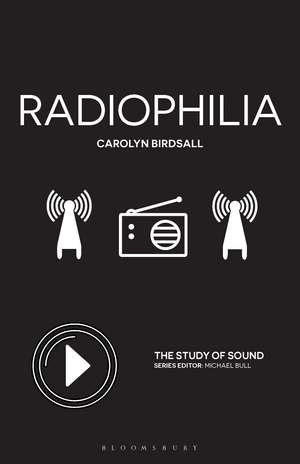
Radiophilia: The Study of Sound
Autor Dr. Carolyn Birdsallen Limba Engleză Paperback – 21 sep 2023
This book introduces a new concept of radiophilia, defined as the attachment to, or even a love of radio. Treating radiophilia as a dynamic cultural phenomenon, it unpacks the various pleasures associated with radio and its sounds, the desire to discover and learn new things via radio, and efforts to record, re-experience, and share radio.
Surveying 100 years of radio from early wireless through to digital audio formats like podcasting, the book engages in debates about fandom, audience participation, listening experience, material culture, and how media relate to affect and emotions.



Preț: 178.63 lei
Preț vechi: 246.14 lei
-27%
Puncte Express: 268
Carte disponibilă
Livrare economică 31 octombrie-14 noiembrie
Livrare express 17-23 octombrie pentru 95.85 lei
Livrare prin curier în România Termenul estimat este afișat lângă disponibilitate.
Transport gratuit de la 400.00 lei Plată online sau ramburs, în funcție de opțiunile comenzii.
Retur gratuit în 14 zile Comandă securizată și suport în română.
Specificații
ISBN-13: 9781501374968
ISBN-10: 1501374966
Pagini: 296
Dimensiuni: 140 x 216 x 18 mm
Greutate: 0.37 kg
Editura: Bloomsbury Publishing
Colecția Bloomsbury Academic
Seria The Study of Sound
Locul publicării:New York, United States
ISBN-10: 1501374966
Pagini: 296
Dimensiuni: 140 x 216 x 18 mm
Greutate: 0.37 kg
Editura: Bloomsbury Publishing
Colecția Bloomsbury Academic
Seria The Study of Sound
Locul publicării:New York, United States
V-ar putea interesa
-
 The Oxford Handbook of Radio and PodcastingMichele Hilmes-32%Preț: 917.47 lei1348.68 lei
 -
 Why Sound MattersDamon KrukowskiPreț: 132.05 lei
 -
 Radio Modernisms: Features, Cultures and the BBCAasiya LodhiPreț: 411.77 lei
 -
 Oasis: When are you getting back together?Harry MaddisonPreț: 72.28 lei
 -
 -26%Preț: 105.88 lei142.72 lei
 -
 In Love with Love: The Persistence and Joy of Romantic FictionElla Risbridger-27%Preț: 82.28 lei112.70 lei
 -
 Last Train to Hilversum: A journey in search of the magic of radioCharlie Connelly-41%Preț: 57.02 lei96.35 lei
 -
 Immaterial BodiesLisa Blackman-8%Preț: 481.51 lei523.38 lei
 -
 Happiness and LoveZoe DubnoPreț: 122.80 lei
 -
 Sound TracksGraeme LawsonPreț: 94.08 lei
 -
 Podcast StudiesLori BecksteadPreț: 307.50 lei
 -
 RadioAlasdair Pinkerton-11%Preț: 140.88 lei158.87 lei
 -
 Preț: 93.17 lei
 -
 Preț: 120.50 lei
 -
 The Wireless OperatorDavid TuchPreț: 141.97 lei
 -
 Radio BenjaminWalter BenjaminPreț: 114.22 lei
 -
 Listen In: How Radio Changed the HomeBeaty RubensPreț: 247.02 lei
 -
 Radio as Art: Concepts, Spaces, PracticesAnne Thurmann-Jajes-18%Preț: 322.77 lei392.02 lei
 -
 Empathy Machines: This American Life, Podcasting, and the Public Radio Structure of FeelingProfessor Jason Loviglio-17%Preț: 159.06 lei191.24 lei
Cuprins
List of Figures
Acknowledgments
Introduction
1. Loving
2. Knowing
3. Saving
4. Sharing
Conclusion
Notes
Index
Acknowledgments
Introduction
1. Loving
2. Knowing
3. Saving
4. Sharing
Conclusion
Notes
Index
Recenzii
An inspiring example of how to resist entrenched narratives. Birdsall's study issues a rallying cry for work that is intermedial and interdisciplinary, crossing boundaries of geography and history in order to love radio better.
Carolyn Birdsall has provided a brilliant and extremely original way of understanding the affective and emotional engagement with radio at the intersection of media cultural history, cultural studies, fan and sound studies. The book offers a refined analysis of the different forms of affection towards radio and provides a new key to understanding the social uses of radio. No scholar has ever written such an accurate analysis or comprehensive description of how we love, know, save and share radio.
Ranging from the collection of merchandise to the conservation of infrastructure, Radiophilia is a brilliant analysis of how radio matters to people. Detailing how affective practices have moved between professional broadcasters, archivists and listeners, and how crossover fandom has connected radio and music fans, this book is itself a superb bridging of radio/fan studies. Carolyn Birdsall skilfully explores the material, multisensorial and intermedial dimensions of radiophilia: any reader interested in radio's history, preservation and present-day energy will find a lot to love here.
Radiophilia provides an original and compelling investigation of how radio - as a medium, a practice, an idea, an object of desire, an institution - has entered into our lives along a shifting variety of axes across the last hundred years, changing the way we both experience and respond to the world around us. A wonderful addition to the field.
This approach to fan culture perspectives and research delineated above speaks of how comprehensive and wide-reaching this book is; it discusses radio in its many forms, as medium and practice, as idea and infrastructure, as desire and archive. And despite it being a love letter to radio, the intermedial framing means Birdsall never loses sight of how this medium draws from and builds on existing sound media, or how the love of it is boosted or complemented by content derived from a variety of dialogues and inter-dependencies.
The author successfully balances an ambitious new and overarching concept with more concrete examples, and by doing so brings in a wide range of geographical and historical contexts, which makes the result particularly convincing.
It allows the reader to engage with non-Western aspects of radio history and brings attention to narratives that challenge the traditionally male-centred focus, making Radiophilia an incredibly valuable touchstone for diversifying our understanding of radio and its history.
Carolyn Birdsall has provided a brilliant and extremely original way of understanding the affective and emotional engagement with radio at the intersection of media cultural history, cultural studies, fan and sound studies. The book offers a refined analysis of the different forms of affection towards radio and provides a new key to understanding the social uses of radio. No scholar has ever written such an accurate analysis or comprehensive description of how we love, know, save and share radio.
Ranging from the collection of merchandise to the conservation of infrastructure, Radiophilia is a brilliant analysis of how radio matters to people. Detailing how affective practices have moved between professional broadcasters, archivists and listeners, and how crossover fandom has connected radio and music fans, this book is itself a superb bridging of radio/fan studies. Carolyn Birdsall skilfully explores the material, multisensorial and intermedial dimensions of radiophilia: any reader interested in radio's history, preservation and present-day energy will find a lot to love here.
Radiophilia provides an original and compelling investigation of how radio - as a medium, a practice, an idea, an object of desire, an institution - has entered into our lives along a shifting variety of axes across the last hundred years, changing the way we both experience and respond to the world around us. A wonderful addition to the field.
This approach to fan culture perspectives and research delineated above speaks of how comprehensive and wide-reaching this book is; it discusses radio in its many forms, as medium and practice, as idea and infrastructure, as desire and archive. And despite it being a love letter to radio, the intermedial framing means Birdsall never loses sight of how this medium draws from and builds on existing sound media, or how the love of it is boosted or complemented by content derived from a variety of dialogues and inter-dependencies.
The author successfully balances an ambitious new and overarching concept with more concrete examples, and by doing so brings in a wide range of geographical and historical contexts, which makes the result particularly convincing.
It allows the reader to engage with non-Western aspects of radio history and brings attention to narratives that challenge the traditionally male-centred focus, making Radiophilia an incredibly valuable touchstone for diversifying our understanding of radio and its history.