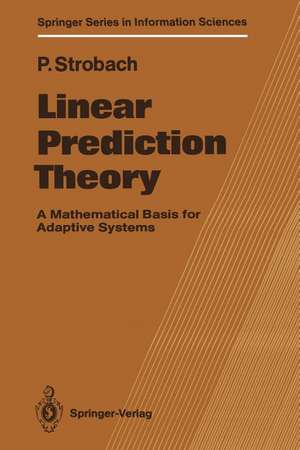
Linear Prediction Theory: Springer Series in Information Sciences, cartea 21
Autor Peter Strobachen Limba Engleză Paperback – 27 dec 2011
Din seria Springer Series in Information Sciences
- 20%
 Preț: 340.57 lei
 - 18%
 Preț: 960.18 lei
 - 15%
 Preț: 650.40 lei
 - 20%
 Preț: 327.54 lei
 -
 Preț: 373.66 lei
 -
 Preț: 384.30 lei
 -
 Preț: 379.88 lei
 - 20%
 Preț: 314.03 lei
 -
 Preț: 383.03 lei
 - 18%
 Preț: 750.88 lei
 -
 Preț: 376.01 lei
 - 20%
 Preț: 320.37 lei
 -
 Preț: 385.01 lei
 - 15%
 Preț: 663.47 lei
 - 15%
 Preț: 642.81 lei
 - 20%
 Preț: 335.91 lei
 -
 Preț: 389.74 lei
 - 20%
 Preț: 657.71 lei
 - 15%
 Preț: 666.07 lei
 - 18%
 Preț: 1397.25 lei
 - 15%
 Preț: 641.55 lei
 - 15%
 Preț: 646.18 lei
 -
 Preț: 388.77 lei
 - 20%
 Preț: 624.51 lei
 - 18%
 Preț: 924.27 lei
 -
 Preț: 378.41 lei
 - 20%
 Preț: 656.89 lei
 - 20%
 Preț: 649.02 lei
 -
 Preț: 393.24 lei
 -
 Preț: 376.01 lei
 - 15%
 Preț: 558.59 lei
Preț: 385.10 lei
Puncte Express: 578
Carte tipărită la comandă
Livrare economică 07-21 decembrie
Livrare prin curier în România Termenul estimat este afișat lângă disponibilitate.
Transport gratuit de la 400.00 lei Plată online sau ramburs, în funcție de opțiunile comenzii.
Retur gratuit în 14 zile Comandă securizată și suport în română.
Specificații
ISBN-13: 9783642752087
ISBN-10: 364275208X
Pagini: 444
Ilustrații: XVI, 422 p.
Dimensiuni: 155 x 235 x 24 mm
Greutate: 0.67 kg
Ediția:Softcover reprint of the original 1st ed. 1990
Editura: Springer
Colecția Springer Series in Information Sciences
Seria Springer Series in Information Sciences
Locul publicării:Berlin, Heidelberg, Germany
ISBN-10: 364275208X
Pagini: 444
Ilustrații: XVI, 422 p.
Dimensiuni: 155 x 235 x 24 mm
Greutate: 0.67 kg
Ediția:Softcover reprint of the original 1st ed. 1990
Editura: Springer
Colecția Springer Series in Information Sciences
Seria Springer Series in Information Sciences
Locul publicării:Berlin, Heidelberg, Germany
V-ar putea interesa
-
 The Designer's Guide to VHDLPeter J. Ashenden-34%Preț: 375.93 lei572.56 lei
 -
 Deep SimplicityJohn GribbinPreț: 92.84 lei
 -
 Evolution of Networks: From Biological Nets to the Internet and WWWS. N. Dorogovtsev-23%Preț: 432.72 lei558.75 lei
 -
 The Computer and the BrainJohn Von NeumannPreț: 113.01 lei
 -
 Introduction to Systems TheoryNiklas LuhmannPreț: 169.40 lei
 -
 -15%Preț: 572.75 lei673.83 lei
 -
 Perturbation Analysis of Optimization ProblemsJ.Frederic Bonnans-18%Preț: 1341.26 lei1635.67 lei
 -
 Stochastic Networked Control SystemsSerdar Yüksel-18%Preț: 995.63 lei1214.17 lei
 -
 Stochastic Networked Control SystemsSerdar Yüksel-18%Preț: 909.87 lei1109.60 lei
 -
 -18%Preț: 918.59 lei1120.23 lei
 -
 Modeling and Control of Discrete-Event Dynamic SystemsBranislav Hrúz-15%Preț: 471.15 lei554.30 lei
 -
 Introducing ChaosIwona AbramsPreț: 64.56 lei
 -
 Model-Based Control of Networked SystemsEloy Garcia-15%Preț: 675.30 lei794.47 lei
 -
 Introduction to Time-Delay Systems: Analysis and ControlEmilia Fridman-46%Preț: 513.77 lei945.44 lei
Public țintă
ResearchCuprins
1. Introduction.- 2. The Linear Prediction Model.- 2.1 The Normal Equations of Linear Prediction.- 2.2 Geometrical Interpretation of the Normal Equations.- 2.3 Statistical Interpretation of the Normal Equations.- 2.4 The Problem of Signal Observation.- 2.5 Recursion Laws of the Normal Equations.- 2.6 Stationarity — A Special Case of Linear Prediction.- 2.7 Covariance Method and Autocorrelation Method.- 2.8 Recursive Windowing Algorithms.- 2.9 Backward Linear Prediction.- 2.10 Chapter Summary.- 3. Classical Algorithms for Symmetric Linear Systems.- 3.1 The Cholesky Decomposition.- 3.2 The QR Decomposition.- 3.3 Some More Principles for Matrix Computations.- 3.4 Chapter Summary.- 4. Recursive Least-Squares Using the QR Decomposition.- 4.1 Formulation of the Growing-Window Recursive Least-Squares Problem.- 4.2 Recursive Least Squares Based on the Givens Reduction.- 4.3 Systolic Array Implementation.- 4.4 Iterative Vector Rotations — The CORDIC Algorithm.- 4.5 Recursive QR Decomposition Using a Second-Order Window.- 4.6 Alternative Formulations of the QRLS Problem.- 4.7 Implicit Error Computation.- 4.8 Chapter Summary.- 5. Recursive Least-Squares Transversal Algorithms.- 5.1 The Recursive Least-Squares Algorithm.- 5.2 Potter’s Square-Root Normalized RLS Algorithm.- 5.3 Update Properties of the RLS Algorithm.- 5.4 Kubin’s Selective Memory RLS Algorithms.- 5.5 Fast RLS Transversal Algorithms.- 5.6 Descent Transversal Algorithms.- 5.7 Chapter Summary.- 6. The Ladder Form.- 6.1 The Recursion Formula for Orthogonal Projections.- 6.2 Computing Time-Varying Transversal Predictor Parameters from the Ladder Reflection Coefficients.- 6.3 Stationary Case — The PARCOR Ladder Form.- 6.4 Relationships Between PARCOR Ladder Form and Transversal Predictor.- 6.5 The Feed-BackPARCOR Ladder Form.- 6.6 Frequency Domain Description of PARCOR Ladder Forms.- 6.7 Stability of the Feed-Back PARCOR Ladder Form.- 6.8 Burg’s Harmonic Mean PARCOR Ladder Algorithm.- 6.9 Determination of Model Order.- 6.10 Chapter Summary.- 7. Levinson-Type Ladder Algorithms.- 7.1 The Levinson-Durbin Algorithm.- 7.2 Computing the Autocorrelation Coefficients from the PARCOR Ladder Reflection Coefficients — The “Inverse” Levinson-Durbin Algorithm.- 7.3 Some More Properties of Toeplitz Systems and the Levinson-Durbin Algorithm.- 7.4 Split Levinson Algorithms.- 7.5 A Levinson-Type Least-Squares Ladder Estimation Algorithm.- 7.6 The Makhoul Covariance Ladder Algorithm.- 7.7 Chapter Summary.- 8 Covariance Ladder Algorithms.- 8.1 The LeRoux-Gueguen Algorithm.- 8.2 The Cumani Covariance Ladder Algorithm.- 8.3 Recursive Covariance Ladder Algorithms.- 8.4 Split Schur Algorithms.- 8.5 Chapter Summary.- 9. Fast Recursive Least-Squares Ladder Algorithms.- 9.1 The Exact Time-Update Theorem of Projection Operators.- 9.2 The Algorithm of Lee and Morf.- 9.3 Other Forms of Lee’s Algorithm.- 9.4 Gradient Adaptive Ladder Algorithms.- 9.5 Lee’s Normalized RLS Ladder Algorithm.- 9.6 Chapter Summary.- 10. Special Signal Models and Extensions.- 10.1 Joint Process Estimation.- 10.2 ARMA System Identification.- 10.3 Identification of Vector Autoregressive Processes.- 10.4 Parametric Spectral Estimation.- 10.5 Relationships Between Parameter Estimation and Kalman Filter Theory.- 10.6 Chapter Summary.- 11. Concluding Remarks and Applications.- A.1 Summary of the Most Important Forward/Backward Linear Prediction Relationships.- A.2 New PORLA Algorithms and Their Systolic Array Implementation.- A.3 Vector Case of New PORLA Algorithms.